
In the world of private equity and institutional investing, fund finance plays a pivotal role in providing liquidity, enhancing capital efficiency, and enabling greater flexibility for fund managers and investors alike. Whether you’re a general partner (GP) working to streamline capital calls or a limited partner (LP) seeking stable returns, understanding fund finance can unlock significant opportunities for investment.
This article will walk you through what fund finance is, the types of financing available, how it operates, and why it matters to investors. With a comprehensive understanding, you’ll be equipped to make informed decisions about how to incorporate fund finance into your investment strategy.
What Is Fund Finance?
Fund finance refers to the credit extended to private investment funds to help manage their operations, investments, and liquidity. Unlike traditional corporate lending, fund finance is tailored specifically for funds, providing them with flexible solutions to manage their capital efficiently.
The main objective of fund finance is to bridge the gap between capital calls, enabling fund managers to access liquidity before calling on the capital committed by LPs. Fund finance products can include subscription-line facilities, net asset value (NAV) loans, and hybrid facilities, each offering unique benefits and risk profiles.
Types of Fund Finance Facilities

Subscription-Line Facilities
Subscription lines are short-term revolving credit lines secured against the capital commitments of limited partners (LPs). They allow GPs to access liquidity before calling capital from LPs, which can reduce the frequency of capital calls and provide funds with immediate capital for acquisitions or investments. These lines are typically low-risk because they’re backed by committed LP capital, offering stability and liquidity.
NAV Loans
NAV loans are a type of credit secured by the assets of a fund, typically used when the fund’s portfolio has matured, and most capital has already been called from the LPs. These loans are higher risk compared to subscription lines because they’re based on the value of a fund’s portfolio, which may fluctuate. However, NAV loans provide funds with the flexibility to continue operations or make additional investments without waiting for portfolio assets to realize their value.
Hybrid Facilities
A hybrid facility blends the characteristics of both subscription lines and NAV loans. This type of fund finance provides the flexibility to borrow against both LP commitments and the value of the fund’s portfolio. Hybrid facilities are gaining popularity because they offer greater adaptability to changing market conditions and fund needs.
Why Fund Finance Matters for Investors
Fund finance plays a crucial role in enhancing portfolio returns and capital efficiency, benefiting both GPs and LPs.
Liquidity for Fund Managers
GPs use fund finance to manage liquidity needs without having to make frequent capital calls from LPs. This allows funds to act quickly on investment opportunities, helping to generate higher returns.
Flexibility for Limited Partners
Subscription lines, in particular, provide LPs with greater predictability and certainty around capital calls, making it easier to manage their own investment strategies and cash flows. By reducing the frequency of capital calls, fund finance can improve the investment experience for LPs.
Diversification of Lenders
The growing use of non-bank lenders has diversified the pool of available capital for fund finance. This trend gives fund managers and investors more options, potentially lowering borrowing costs and improving terms. Increased competition among lenders also provides better negotiating power for borrowers.
Fund Finance vs. Corporate Lending
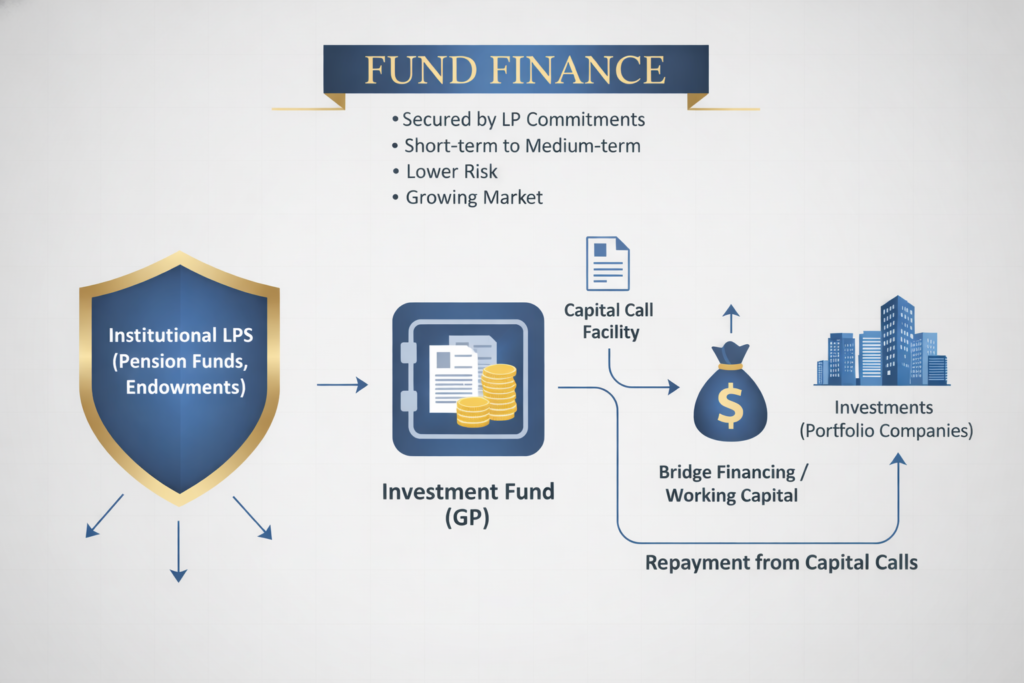
Fund finance differs significantly from traditional corporate lending in several ways. Corporate loans are typically secured by a company’s operational assets or cash flow, whereas fund finance is secured by capital commitments from LPs or the assets in the fund’s portfolio.
Fund finance is specifically designed to cater to the needs of investment funds, whether in the early or late stages of their lifecycle. Corporate lending, on the other hand, is typically more focused on supporting business operations or providing working capital. Fund finance also tends to have a lower risk profile when compared to other forms of lending due to its secured nature, whether by LP commitments or fund assets.
The Growing Role of Fund Finance in Private Markets
Fund finance has seen substantial growth, particularly in private equity and venture capital markets, as institutional investors look for ways to maximize returns and mitigate risks. This growth is driven by several factors:
Expansion of Private Capital Markets
As private markets grow, the need for flexible, low-cost liquidity solutions like fund finance has increased. Funds are using these facilities to manage capital calls and fund investments efficiently.
Institutional Demand for Better Liquidity
Institutions are increasingly seeking ways to improve capital efficiency and enhance returns, and fund finance offers a solution by allowing funds to access liquidity without liquidating assets prematurely.
Rising Use of Non-Bank Lenders

The rise of non-bank lenders has helped meet the growing demand for fund finance, providing funds with more options for credit, often with better terms and lower rates than traditional banks.
Challenges and Risks in Fund Finance
While fund finance offers numerous advantages, it isn’t without risks. For example, NAV loans are more susceptible to market volatility since they’re based on the value of a fund’s portfolio. If the portfolio’s value drops, the lender’s exposure increases, which could complicate risk management strategies.
Moreover, managing multiple fund finance facilities can be complex for fund managers, particularly as the size and diversity of their portfolios grow. Effective data management and compliance monitoring are crucial to ensure that the terms of each facility are met and that risk is managed appropriately.
Fund Finance in Investment Portfolios
Investors have increasingly turned to fund finance as part of their investment strategy due to its ability to provide liquidity and enhance returns. By incorporating fund finance into their portfolios, institutional investors gain access to a variety of private market assets that are typically less correlated with traditional asset classes like stocks or bonds. This can offer valuable portfolio diversification and improve overall risk-adjusted returns.
Fund finance also allows investors to leverage the capital already committed to a fund, without needing to sell assets prematurely. This provides flexibility for fund managers to continue their investment strategies without interrupting the fund’s long-term growth trajectory.
Final Thoughts: Why Fund Finance Matters

Fund finance is an indispensable tool in modern fund management, offering private equity and venture capital funds the liquidity they need to manage capital calls, investments, and operations efficiently. For investors, it presents an opportunity to diversify portfolios, access stable returns, and enhance capital efficiency.
As the private equity market continues to expand and the demand for flexible financing solutions increases, the role of fund finance will only grow in importance. By understanding how fund finance works and when to use it, investors can better position themselves for long-term success in the ever-evolving financial landscape.
Related Articles
Mutual Funds Explained: What They Are, How They Work, and Why Investors Use Them