



The Child Tax Credit (CTC) is one of the most valuable financial tools available to parents in the United States. Designed to help reduce the financial burden of raising children, the CTC can provide significant relief in the form of a direct tax reduction or even a refund. As we look ahead to 2026, it’s important to fully understand how the Child Tax Credit works, who qualifies, how to claim it, and how you can maximize the benefits for your family. This guide will take you step-by-step through everything you need to know.
What Is the Child Tax Credit?
The Child Tax Credit is a federal tax benefit aimed at helping families offset the cost of raising children. For the 2026 tax year, eligible families can receive up to $2,200 per qualifying child. This credit reduces the amount of tax you owe on a dollar-for-dollar basis, meaning that for each qualifying child, your total tax liability can be reduced by $2,200.
But here’s where it gets even better: the Additional Child Tax Credit (ACTC) is the refundable portion of the CTC. This means that if your tax liability is lower than the amount of the CTC, you could still receive a refund for the difference, making it an especially helpful benefit for low- to moderate-income families.
The CTC is one of the most widely claimed tax credits in the U.S., helping millions of families every year reduce their financial burden and get some much-needed extra cash.
Eligibility Requirements for the Child Tax Credit

Qualifying Child
To claim the CTC, the child must meet specific requirements. The child must be under 17 years old at the end of the tax year, and must be a U.S. citizen, national, or resident alien. The child must also have lived with you for more than half of the year and cannot provide more than half of their own financial support. The child must have a valid Social Security Number (SSN) or Individual Taxpayer Identification Number (ITIN).
Income Limits
The CTC is subject to income limits, based on your Modified Adjusted Gross Income (MAGI). For 2026, if you’re a single filer, the credit begins to phase out once your MAGI exceeds $200,000. For married couples filing jointly, the phase-out begins at $400,000. For every $1,000 over these thresholds, the credit is reduced by $50, so high earners may see a reduction in the credit amount.
Filing Status
You must file your taxes as a single filer, head of household, or married filing jointly to qualify. Married individuals filing separately can’t claim the CTC.
Refundable Amounts and How the Credit Works
The Child Tax Credit is partially refundable, thanks to the Additional Child Tax Credit (ACTC). Here’s what you need to know about how this works:
The CTC reduces your tax liability on a dollar-for-dollar basis. If your tax liability is higher than the total credit, the entire credit will reduce your tax bill. However, if your tax liability is less than the total credit, the ACTC provides a way to receive the remaining amount as a refund. The ACTC can provide up to $1,700 per child for those who meet the income and other criteria. For example, if your tax bill is $1,000, you would pay that amount, and the remaining $1,200 of the credit would be refunded to you.
The ACTC is especially beneficial for families who owe little or no taxes but still qualify for the credit.
How to Claim the Child Tax Credit
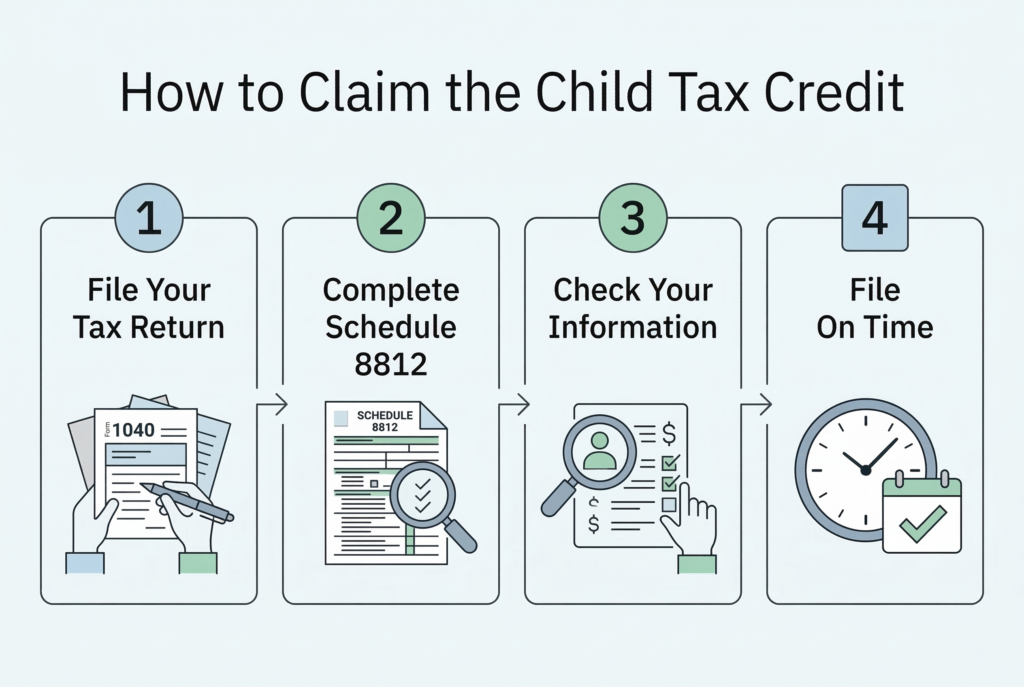
Step 1: File Your Tax Return
The first step in claiming the CTC is to file a federal income tax return, regardless of whether you owe taxes. You’ll need to use Form 1040 (the standard tax return form).
Step 2: Complete Schedule 8812
If you’re claiming the Additional Child Tax Credit (ACTC), you will also need to fill out Schedule 8812, which calculates the refundable portion of the credit. This form ensures you get the refund you’re entitled to if your tax liability is less than the total credit.
Step 3: Check Your Information
Make sure that all the eligibility details are accurate. Verify the Social Security Number (SSN) or ITIN for each child you claim. Any errors can delay your refund or result in the credit being denied.
Step 4: File On Time
The IRS processes most returns within 21 days if you file electronically. Make sure to submit your return by the filing deadline, typically April 15. Late filing could delay your refund and cause you to miss out on the full credit.
How to Maximize Your Benefits in 2026

- File early: Filing early not only speeds up the process but ensures you’ll receive your refund quicker. The IRS aims to issue refunds in 21 days for e-filed returns.
- Keep track of your income: If your income is close to the MAGI phase-out threshold, consider contributing to retirement accounts like a 401(k) or IRA, which reduces your taxable income.
- Use the refund wisely: If you receive a refund through the ACTC, consider using it to support your family’s long-term financial goals. For example, contribute to a 529 College Savings Plan for your child’s education, start or contribute to a Roth IRA for retirement, or build an emergency savings fund for unexpected expenses.
- Claim other tax credits: You may also qualify for other credits that can reduce your overall tax liability, such as the Earned Income Tax Credit (EITC) or the Child and Dependent Care Credit. Make sure to explore all available options to reduce your tax bill.
Key Updates and Trends for 2026
Increased Credit Amount
The Child Tax Credit for 2026 will increase to $2,200 per child. This increase will be indexed for inflation in future years, ensuring that the value of the credit keeps pace with the cost of living.
Higher Phase-Out Thresholds
The income thresholds for the CTC have been raised, which means more families will qualify for the full credit, particularly those with higher incomes.
Focus on Refundable Benefits
There is an increasing focus on refundable tax credits like the ACTC, which ensures that families who may not owe taxes can still access vital financial support. This shift helps ensure families receive the help they need, even if their tax liability is low.
Conclusion
The Child Tax Credit is a powerful tool for helping families reduce their tax burden and support their children’s future. Understanding the eligibility requirements, how to claim the credit, and how to maximize your benefits is crucial to getting the most out of this financial support. By filing early, ensuring accurate information, and using your refund strategically, you can make the most of this valuable tax benefit and secure a brighter financial future for your family.
As we move into 2026, take advantage of the increased credit amount, higher income limits, and refundable portion to help your family thrive financially. Don’t leave money on the table, instead claim your Child Tax Credit and ACTC today, and plan for a brighter, financially secure future.

