


Buying a car can be exciting, but it also comes with important financial decisions. Most Americans rely on car loans to finance their vehicles, and understanding how these loans work can save you thousands, protect your credit, and give you confidence. In this guide, we break down the mechanics of car loans, offer practical examples, and show strategies to save money and make smart financing choices.
What Is a Car Loan and How It Works
A car loan is an installment loan that allows you to purchase a vehicle while paying the total cost over time, including interest. The principal is the amount you borrow, and interest is the lender’s fee for providing the loan. Typically, your vehicle acts as collateral, meaning it can be repossessed if payments aren’t made. For example, if you borrow $25,000 for a car at a 6% APR over 60 months, your monthly payment would be roughly $483, and you’d pay about $3,000 in interest over the life of the loan. Understanding these numbers upfront helps you plan and avoid surprises.
Applying for a Car Loan: Pre-Approval vs Pre-Qualification
Car loans are available through banks, credit unions, online lenders, and dealership financing. While dealers may offer convenience and promotional rates, their loans can come with higher fees or add-ons. Banks and credit unions often provide lower rates, while online lenders give fast pre-approvals.
Pre-qualification gives an estimate of your interest rate and loan amount without affecting your credit score. Pre-approval is more formal: it involves a hard credit inquiry, verifying income, and producing a guaranteed loan offer. For instance, a pre-approved borrower may negotiate better rates at the dealership because the lender has already committed to financing.
To prepare, gather: proof of income, tax returns, ID, current debt details, and a list of assets. Organized documentation often speeds up approval and can improve your offered terms.
Key Terms You Should Know
Understanding loan terminology helps you make informed choices:
- APR (Annual Percentage Rate): Combines interest and fees to show the real cost of borrowing.
- Loan term: Number of months to repay the loan, typically 36–72 months. Shorter terms mean higher monthly payments but lower total interest.
- Down payment: A portion of the car price you pay upfront; higher down payments reduce the loan principal and may secure lower APRs.
- Amortization: Payment schedule showing how interest and principal are applied over time. Early payments mostly cover interest, while later payments reduce the principal faster.
- Loan-to-value ratio (LTV): Loan amount divided by car value; lower ratios often yield better rates.
- Total cost: Sum of principal, interest, fees, taxes, and insurance. Comparing total cost rather than just monthly payments is critical to avoid overpaying.
For example, a $30,000 loan at 5% for 48 months costs around $690/month, totaling $33,120, while the same loan over 60 months is about $566/month but totals $33,960 in interest, showing how term length impacts cost.
Comparing Lenders and Offers
Interest rates and fees vary widely based on credit score, vehicle type, and lender. Excellent credit borrowers may get rates under 5%, while subprime borrowers may face double-digit APRs. Fees can include title, registration, dealer add-ons, GAP insurance, and prepayment penalties. Always compare APR, term, monthly payment, and total cost. Some lenders advertise low monthly payments but hide fees in the APR or add-ons. Practical tip is getting at least three pre-approvals from different lenders to see who offers the best total cost.
Steps to Save Money on Your Car Loan
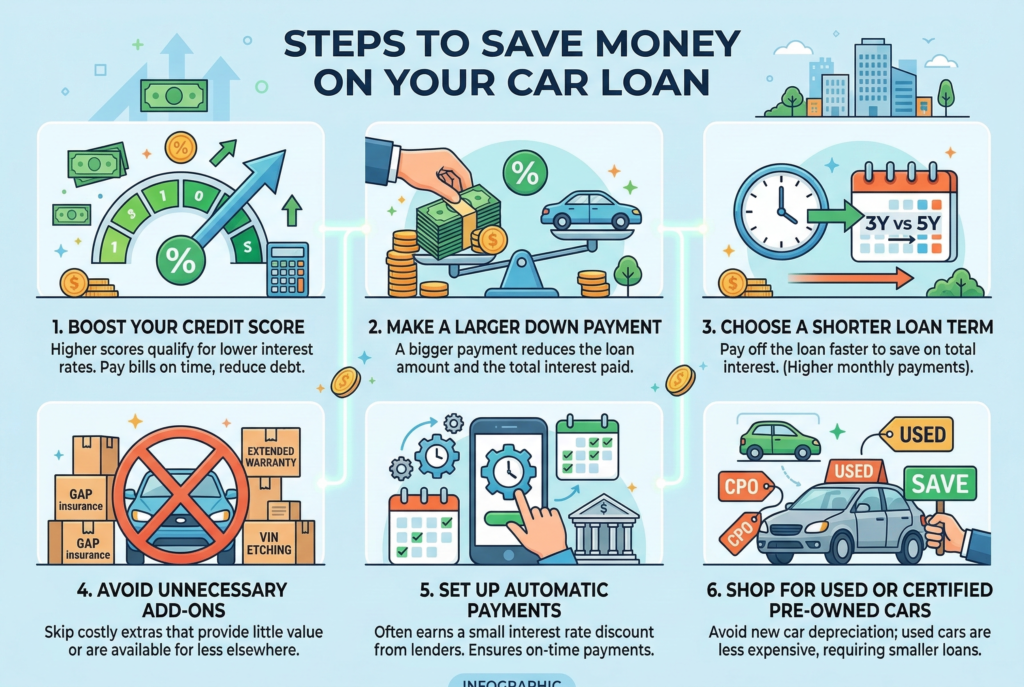
- Boost your credit score: Even a 20–30 point increase can reduce APR by 0.5–1%.
- Make a larger down payment: Reduces principal and monthly payment, while improving LTV.
- Choose a shorter loan term: Saves thousands in interest but requires a higher monthly budget.
- Avoid unnecessary add-ons: Dealer warranties, gap insurance, or protection plans often add hidden costs.
- Set up automatic payments: Some lenders offer interest discounts for autopay.
- Shop for used or certified pre-owned cars: They may cost less upfront and sometimes have lower interest rates.
Tools and Calculators
Auto loan calculators are invaluable for visualizing monthly payments, total interest, and the effect of down payments. They allow you to adjust APR, loan term, and principal to find a balance that suits your budget and long-term goals. Some advanced calculators even simulate extra principal payments, showing how a $50–$100 extra monthly can shorten your loan by months and save hundreds in interest.
Managing Your Car Loan
After securing a loan, make on-time payments a priority. Keep insurance active, monitor your loan balance, and review statements for errors. If your budget allows, apply extra payments to the principal to reduce interest over time. For example, paying an extra $100/month on a $20,000, 5-year loan at 6% APR can shorten your term by almost a year and save over $500 in interest.
Final Thoughts

Car loans don’t have to be intimidating. By understanding terms, comparing lenders, pre-qualifying, and following practical strategies, you can finance a vehicle efficiently without overpaying. Being informed ensures you make confident decisions, reduce costs, and maintain financial stability while enjoying your new car.
