

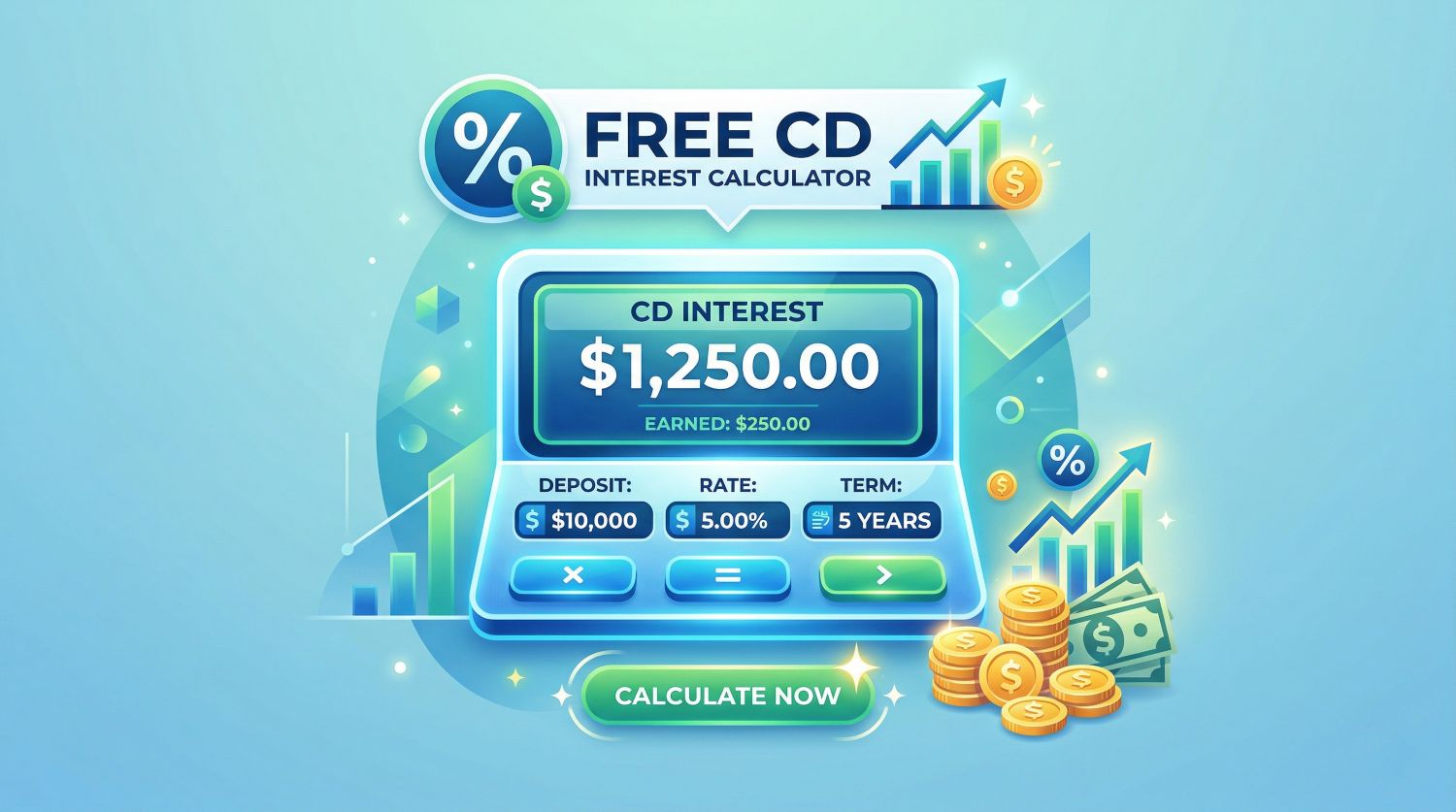
A CD interest calculator is a quick and effective way to see how your savings can grow with minimal risk. Instead of estimating returns, you can easily calculate your final balance, total interest earned, and how your money compounds over time.
This calculator is built for simplicity. Enter your initial deposit, term length, and APY to get instant results. Beyond the numbers, it also helps you understand how CDs work, how interest is calculated, and how to make more informed decisions with your money.
How to Use This Certificate Calculator

Using a certificate of deposit calculator is simple, but understanding each input helps you make better decisions.
Start with your initial deposit. This is the one time amount you put into the CD. Next, choose the term length, which determines how long your money stays locked in. Finally, enter the APY, which represents the real annual return including compounding. The calculator assumes your interest compounds over time and stays fixed throughout the term. This means the result shows the maturity value if you hold the CD until the end.
Instead of focusing only on the final number, it’s more useful to understand how that number changes when you adjust inputs like APY or term length. A longer term can increase your returns, but it also reduces flexibility. Understanding these trade offs is what turns a basic CD interest calculator into a practical decision making tool.
Back to Basics: How Does a CD Account Work Right Now?

So, how does a CD account work in practice? A Certificate of Deposit is a fixed-term savings product where you agree to leave your money untouched for a specific period in exchange for a guaranteed return. Unlike stocks, your balance doesn’t fluctuate. That’s why CDs are considered one of the safest savings options available.
Most CDs are FDIC-insured, which means your principal is protected up to legal limits. This makes them attractive when interest rates are high but expected to decline. However, there’s a trade-off. Your money isn’t fully liquid. If you withdraw early, you’ll likely face a penalty, which can reduce or even eliminate your earned interest.
That’s why timing matters. In today’s rate environment, many savers are locking in yields before rates drop further. A CD interest calculator helps you see whether that strategy makes sense for your situation.
The Math: How to Calculate Percent Yield & APY

To truly understand your returns, you need to know how to calculate percent yield and how compounding works. The basic APR formula looks like this:
But CDs use compounding, which means your interest earns interest over time. That’s where APY comes in. APY reflects the true annual return after compounding. This is why understanding dividend rate vs APY matters. The dividend rate shows the base interest, while APY shows what you actually earn.
For example, a 5% APY CD will grow faster than a simple 5% rate without compounding. When you use a CD interest calculator, you’re seeing the result of this compounding effect. The longer the term and the higher the APY, the more powerful this growth becomes.
The Cost of Cashing Out: Early Withdrawal Penalties Explained

The main downside of CDs is early withdrawal penalties. If you take your money out before maturity, you may lose several months of interest. Typical penalties range from three to six months of interest, depending on the term. In some cases, this can reduce your total return significantly. This is why liquidity matters. A CD isn’t designed for short-term access. It works best when you can commit your funds for the full term.
Using a CD interest calculator alongside penalty awareness helps you avoid common mistakes. It isn’t just about how much you earn. It’s about whether you can actually keep those earnings.
Smart Cash Allocation: CD vs Money Market Accounts

Choosing between options is where most users get stuck. That’s why comparing CD vs money market accounts is essential. A CD offers fixed returns and stability. A money market account offers flexibility and easier access to funds.
One effective strategy is splitting your savings. Allocate about 60% into a CD to lock in higher rates, and keep 40% in a flexible account. If you want to explore alternatives, tools like a money market calculator or money market account calculator can help you compare scenarios. This approach gives you both growth and liquidity. Instead of choosing one option, you balance both.
Do You Pay Taxes on CD Interest?
A common question is simple: do you pay taxes on CD interest? Yes, you do. In the United States, CD interest is taxed as ordinary income, even if you don’t withdraw it.
This means you may owe taxes annually on interest earned, not just at maturity. That’s an important detail many calculators ignore. Your actual return depends on your tax bracket. A CD with a high APY may still deliver lower net gains after taxes. Understanding this helps you make more accurate comparisons and avoid overestimating your earnings.
Advanced Strategy: Try Our CD Ladder Calculator

If you want to go beyond basic savings, consider using a CD ladder calculator. CD laddering involves splitting your money across multiple CDs with different terms. This allows you to access funds periodically while still benefiting from higher long-term rates.
For example, you might divide your investment into one year, two year, and three year CDs. As each one matures, you can reinvest or withdraw as needed. This strategy works especially well in uncertain rate environments. It balances flexibility with return, making it a smarter long-term approach.
Where to Find the Best Rates Today
After using a CD interest calculator, the next step is finding competitive rates. Many savers compare offers from institutions like Schwab CD rates, Keybank CD rates, Becu CD rates, and Associated Bank CD rates. These providers often offer different terms and promotional rates. Instead of choosing the first option you see, compare APY, term flexibility, and early withdrawal penalties. Rates change frequently, so staying informed helps you lock in the best opportunity.
Conclusion
A CD interest calculator gives you the answer, but understanding the context gives you the advantage. From learning how a CD works to comparing CD vs money market options, every decision affects your final return. When you factor in compounding, taxes, and penalties, the picture becomes much clearer.
The goal isn’t just to calculate your earnings. It’s to maximize them. By combining smart planning with the right tools, you can confidently estimate your returns and make better financial decisions.
