

Buying a home is one of the most significant financial decisions you’ll make, and for many, securing the right mortgage is a key part of that process. Conventional mortgages are among the most common types of home loans available today. These loans are offered by private lenders such as banks and credit unions, and unlike government-backed loans (like FHA, VA, or USDA loans), they aren’t insured by the government. While conventional mortgages can provide a streamlined path to homeownership, they come with specific requirements and considerations.
In this article, we’ll break down everything you need to know about conventional mortgages: the requirements, credit score guidelines, down payment options, and the pros and cons. Whether you’re a first-time homebuyer or looking to refinance, this guide will help you understand if a conventional mortgage is the right choice for you.
What is a Conventional Mortgage?
A conventional mortgage is a home loan offered by a private lender (such as a bank, credit union, or online lender) that isn’t backed or insured by a government agency. Unlike loans from the Federal Housing Administration (FHA) or the Department of Veterans Affairs (VA), which are government-sponsored, conventional loans are typically subject to stricter requirements and higher down payments.
There are two main types of conventional mortgages:
- Conforming loans: These loans meet the guidelines set by Fannie Mae and Freddie Mac, the government-sponsored entities (GSEs) that buy and sell mortgages. The loan amounts are subject to loan limits set by the Federal Housing Finance Agency (FHFA) each year.
- Non-conforming loans: These loans don’t meet the guidelines of Fannie Mae or Freddie Mac and are often referred to as jumbo loans. They’re typically for higher loan amounts, and the interest rates may be higher.
Conventional mortgages can be fixed-rate or adjustable-rate (ARMs), depending on whether you prefer predictable payments or a more flexible interest rate that could change over time.

Key Requirements for Conventional Mortgages
When applying for a conventional mortgage, there are several key requirements that you need to meet. These include your credit score, down payment, debt-to-income ratio (DTI), income verification, and property eligibility.
Credit Score
The minimum credit score required for a conventional mortgage is typically 620. However, to get the best interest rates and loan terms, a score of 740 or higher is ideal.
Good credit scores (typically 700 or higher) can help you secure better loan terms, such as lower interest rates and fewer fees, which can save you thousands of dollars over the life of the loan. If your credit score is below 620, you may still qualify for a conventional loan, but your options will likely come with higher interest rates or require a larger down payment.
Down Payment
Down payment requirements for conventional loans generally start at 3% for first-time homebuyers. However, most buyers will need a 5% or higher down payment, especially if they aren’t first-time buyers.
If you want to avoid paying private mortgage insurance (PMI), you’ll need to make a 20% down payment. PMI is typically required if your down payment is less than 20%, which will increase your monthly payment until you build 20% equity in your home.
A larger down payment (20% or more) can help you qualify for a lower interest rate and, importantly, eliminate PMI, further reducing your monthly mortgage costs.
Debt-to-Income Ratio (DTI)
Your debt-to-income (DTI) ratio is a critical factor in securing a conventional mortgage. This ratio compares your monthly debt payments (including the new mortgage) to your gross monthly income.
The standard DTI limit for conventional loans generally falls between 36% to 43%. This means that no more than 43% of your gross monthly income can be used to cover all of your debt obligations, including the mortgage.
If your DTI ratio is higher than 43%, some lenders may still be willing to approve your loan, especially if you have strong financial reserves or a larger down payment.
Income Verification

Lenders require proof of income to ensure that you can afford the mortgage payments. This usually includes pay stubs, tax returns, and other documentation showing your ability to make monthly payments.
For self-employed borrowers, lenders may require additional documentation, such as profit-and-loss statements, bank statements, and tax filings, to verify income.
Property Eligibility
The property you wish to purchase must meet specific criteria. It should be a primary residence. You can’t use a conventional loan to buy a vacation home or an investment property, unless the loan is a jumbo loan.
Additionally, the property must meet safety standards and pass an appraisal. The home should be in good condition, as it serves as collateral for the loan. If the property doesn’t meet these standards, the lender may deny the loan or require repairs before approval.
Pros and Cons of Conventional Mortgages
Pros:
- Lower interest rates: If you have a good credit score, you can often secure a lower interest rate with a conventional mortgage than with government-backed loans.
- More loan flexibility: Conventional loans offer both fixed-rate and adjustable-rate mortgages (ARMs), giving you more flexibility in terms of payment structure.
- No mortgage insurance with 20% down: If you make a 20% down payment, you won’t have to pay for private mortgage insurance (PMI), which can save you hundreds of dollars per month.
- Higher loan amounts: Conventional loans allow for higher loan amounts compared to FHA loans (especially jumbo loans), which can be a significant benefit if you’re looking to buy in an expensive area.
Cons:
- Higher down payment: While first-time homebuyers can get away with a smaller down payment (as low as 3%), most conventional loans require at least 5%. Without the 20% down payment, you’ll also have to pay PMI, which adds to your monthly cost.
- Tougher eligibility requirements: Compared to FHA loans, conventional loans typically require higher credit scores and stricter eligibility criteria.
- PMI costs: If your down payment is less than 20%, you’ll have to pay PMI, which can increase your monthly mortgage payment until you reach 20% equity.
How to Apply for a Conventional Mortgage
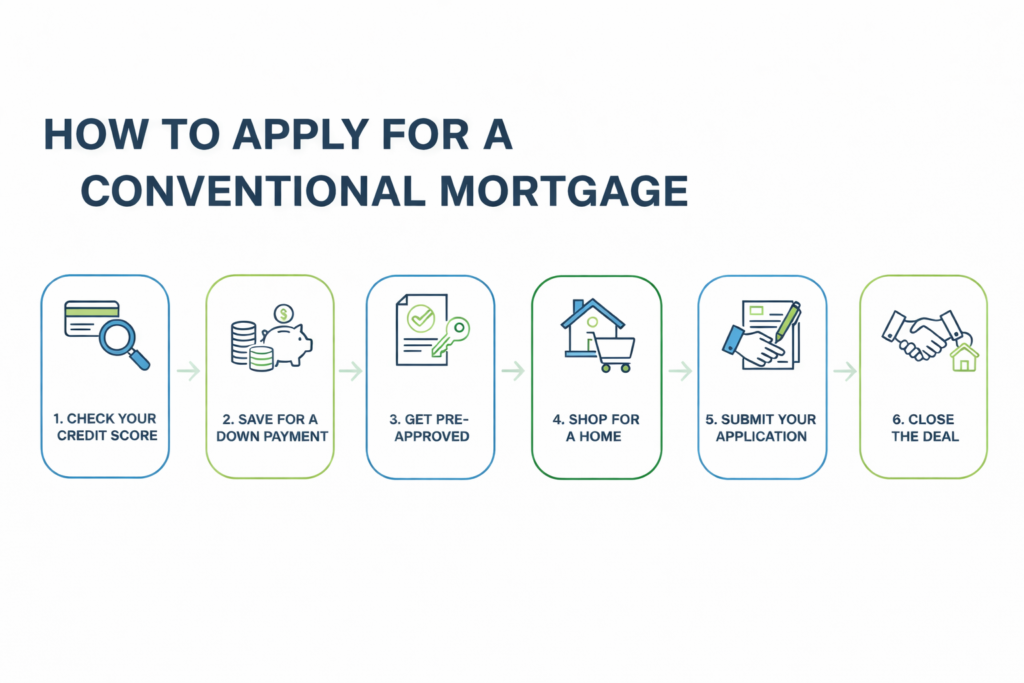
- Check your credit score: Ensure that your credit score meets the 620 minimum. If your score is below 620, consider improving it before applying to secure better loan terms.
- Save for a down payment: Aim for a 5% down payment at a minimum. If you can, save up 20% to avoid PMI.
- Get pre-approved: Speak with a lender to get pre-approved for a mortgage. Pre-approval helps you understand how much you can borrow and shows sellers you are a serious buyer.
- Shop for a home: Once pre-approved, start shopping for homes that meet your needs and budget. Ensure the home meets the lender’s requirements.
- Submit your application: Once you’ve selected a home, submit your mortgage application, providing all necessary documentation.
- Close the deal: After your application is processed, you’ll go through the closing process, where you’ll sign documents and pay closing costs.
Final Thoughts: Is a Conventional Mortgage Right for You?
Conventional mortgages offer flexibility, competitive interest rates, and a streamlined process for homebuyers with good credit and the ability to make a larger down payment. While they come with higher eligibility standards compared to government-backed loans, they’re often the best option for those who meet the criteria and want to avoid mortgage insurance.
Before you apply for a conventional mortgage, make sure you understand the requirements and assess your financial situation. With a solid credit score, a reasonable down payment, and a manageable debt-to-income ratio, a conventional mortgage can help you secure the home of your dreams while providing financial stability for years to come.
Related Articles
FHA vs. Conventional Mortgages: Key Differences, Requirements, Costs, and Which Option Fits You Best
