


Starting to plan retirement can seem like a huge task. It might feel even tougher if you’re balancing your job, family duties, rising expenses, and that constant thought of “I should have started this earlier.” On average, people in the U.S. don’t begin retirement planning until they’re about 33 years old, and many find themselves playing catch-up by their 40s or 50s.
However, you don’t need to get everything perfect. What you do need is a solid plan, smart strategies, and enough time for small choices to grow into meaningful progress.
This guide is designed for beginners. It explains what you need to do step by step using simple language. It will help boost your confidence, ease your worries, and get you closer to financial stability.
Why Planning for Retirement Is Crucial Today
Retirement today looks very different than it did in the past. People are living longer, medical costs continue to rise, and far fewer workers receive pensions than previous generations. At the same time, Social Security typically replaces only about 37% of pre-retirement income, while most Americans have saved less than $100,000 for retirement.
This is why it’s so important to make a plan or to start now even if you feel like you’re behind. A clear plan helps you take control of your financial future, build stronger financial stability to handle unexpected events, and create the flexibility to retire on your own terms.
A Quick Look at What You’ll Learn
This guide takes you through the following:
- Ways to predict when you could stop working
- How timing your Social Security impacts your earnings
- Strategies to pay off debt
- How much money to put aside and the best accounts for saving
- Tips for picking good investments
- Steps to prepare for increasing healthcare expenses
- Ways to create a retirement strategy that grows with your life
1. Begin Early: Time and Compound Interest Make a Big Difference
If there’s one thing to remember, it’s this: Time is your greatest financial tool.
Compound interest, which means your earnings make even more earnings over time, can grow small contributions into huge savings.
Real-Life Example
Emily saves $440 every month starting at 25 years old earning 6%. By the time she’s 67, she has $1 million saved up.
Her friend Elliot waits until he’s 30 to begin. To catch up, he has to save $613 each month for the same result spending over $50,000 more.
If you start late, don’t worry. Compound interest still helps. You just need to work smarter with your savings, use catch-up contributions, and plan on a shorter path to your goal.
2. Evaluate Your Financial Position
Understand your financial picture before deciding on investments or figuring out when to retire.
Write Down Your Assets
Start by listing everything you own that has financial value. This includes retirement accounts such as a 401(k), traditional IRA, or Roth IRA; taxable brokerage accounts; and savings accounts. Be sure to include home equity, any pension benefits you’re entitled to (if applicable), and life insurance policies that have a cash value. Creating a complete asset list gives you a clear snapshot of where you stand today and helps you plan your next steps with confidence.
List Every Liability
Next, write down all of your outstanding debts so you have a clear picture of what you owe. Pay special attention to high-interest obligations such as personal loans, private student loans, credit cards, and car loans. Identifying and prioritizing these liabilities helps you reduce interest costs faster and strengthens your overall financial plan.
Work Out Your Net Worth
Your net worth is calculated by subtracting your total debts from your total assets. This number serves as a starting point and a solid foundation for planning your financial future.
Learn Your Spending Patterns
Many retirees spend between $2,000 and $4,000 per month, but actual expenses vary widely depending on lifestyle, healthcare needs, housing costs, and where you live. Understanding these factors is essential for building a realistic retirement budget that supports the life you want to maintain.
To make estimating easier, break your expected retirement expenses into clear categories. Start with essentials like housing, food, transportation, and healthcare. Then account for personal choices such as hobbies, travel, and dining out. Finally, include big-picture goals like helping your children, starting a business, or purchasing a vacation home. This approach helps you estimate how much income you’ll need in retirement and identify areas where adjustments may be necessary.
3. Create Practical Retirement Plans
Retirement looks different for everyone: some people dream of traveling and staying active, while others value quiet time with family or meaningful part-time projects. As a general guideline, many experts suggest planning to replace about 70%–85% of your pre-retirement income, though a more active lifestyle may require closer to 100%. When shaping your plan, think about when you want to retire, how you want to spend your days, the expenses you’ll need to cover, whether you plan to downsize or relocate, and whether your priority is leaving an inheritance or fully enjoying your savings.
4. Figure Out How Much Money You’ll Need
Step 1: Calculate how much you’ll spend each year in retirement.
Example: $50,000 each year over 25 to 30 years of retirement.
Step 2: Next, subtract any additional income you expect to receive in retirement. This may include Social Security benefits, pension payments, rental income from property you own, and earnings from a part-time job. It helps you determine how much income your savings and investments will need to provide.
Step 3: After accounting for all other income sources, your savings and investments need to make up whatever income remains. This is where retirement calculators become especially useful. They allow you to test different scenarios, such as retiring at 62, 67, or 70, earning higher or lower investment returns, adjusting how much you contribute, and factoring in inflation and future cost-of-living changes.
5. Pick the Best Retirement Accounts
401(k) or 403(b)
It’s one of the most powerful tools for building retirement savings. In 2025, the contribution limit is $23,500, and many employers offer matching contributions, which can significantly boost your savings.
Traditional and Roth IRAs
In 2025, the contribution limit for an IRA is $7,000. With a Roth IRA, qualified withdrawals in retirement are tax-free, allowing you to take money out without paying taxes. With a Traditional IRA, your contributions may reduce your taxable income today, while withdrawals are taxed in retirement.
Extra Contributions for Those 50 and Up
If you’re 50 or older, you can take advantage of catch-up contributions to boost your retirement savings. For 401(k) plans, you can add an extra $7,500, and for IRA contributions, you can contribute an additional $1,000 each year. Starting in 2025, a new “Super Catch-Up” option is available for individuals aged 60 to 63, allowing an extra $11,250 in contributions.
Do You Work for Yourself?
If you work for yourself, you can consider a SEP IRA or a Solo 401(k). Both options let you contribute more.
6. Create a Simple Plan for Long-Term Investments

The Basics of Asset Allocation
Here’s a practical way to think about asset allocation as you move through different life stages. Between ages 20 and 40, many investors lean toward growth by holding roughly 70–85% in stocks and 15–30% in bonds. By age 50 and beyond, it often makes sense to gradually reduce risk by shifting to about 60–70% stocks and 30–40% bonds. At age 60 and older, a more balanced approach, around 40–60% in stocks and 40–60% in bonds, can help protect savings while still allowing for growth.
Why Diversification Is Key
A well-diversified portfolio typically includes a mix of U.S.-based stocks, international stocks from markets outside the U.S., and bonds to provide stability. Many investors also use target-date funds for simplicity and affordable index funds or ETFs to keep costs low while maintaining broad market exposure.
Stay Calm When Investing
To become successful in the long run, you need to follow your plan, adjust things yearly, and tune out short-term market chatter.
7. Learn About Social Security And Plan
Social Security typically replaces about 40% of the average American’s pre-retirement income. If you claim Social Security at age 62, your monthly benefit is permanently reduced. Waiting until your full retirement age, typically 66 or 67, depending on your birth year, allows you to receive your full benefit. If you delay benefits until age 70, your payment increases by about 8% per year after full retirement age, resulting in a substantially higher monthly check for life.
8. Plan Ahead to Cover Healthcare and Medicare Costs
Healthcare is often one of the most expensive parts of retirement. In fact, a 65-year-old couple may spend around $330,000 on healthcare costs over the course of retirement. And while Medicare helps cover many medical expenses, it doesn’t pay for everything. Retirees still need to budget for monthly premiums, deductibles, copays, prescription drugs, as well as dental and vision care.
As you plan for retirement, it’s important to prepare for healthcare costs by understanding Medicare Parts A, B, and D, as well as Medigap (also known as Medicare Supplement Insurance). You may also want to consider long-term care insurance and create a separate budget specifically for healthcare expenses.
9. Add Tax Planning to Your Financial Plan
Three Tax Categories
When planning for retirement, it helps to think in terms of three tax categories: taxable accounts like brokerage accounts, tax-deferred accounts such as a Traditional IRA or 401(k), and tax-free accounts like a Roth IRA or Roth 401(k).
Think About Roth Conversions
Roth conversions can lower taxes in retirement before you turn 73, which is when Required Minimum Distributions (RMDs) start.
10. Plan Your Debt Approach Before Retiring
As you approach retirement, it’s smart to focus on paying off high-interest debt first, such as credit cards, car loans, and personal loans. You’ll also need to decide what to do about your mortgage. Some retirees choose to pay it off before retiring, while others keep a low-interest mortgage and invest their extra cash instead. If you plan to carry a mortgage into retirement, make sure the payment fits comfortably within your retirement budget, and consider downsizing if needed. Carrying debt into retirement can reduce your financial freedom and add unnecessary stress.
11. Create a Retirement Timeline
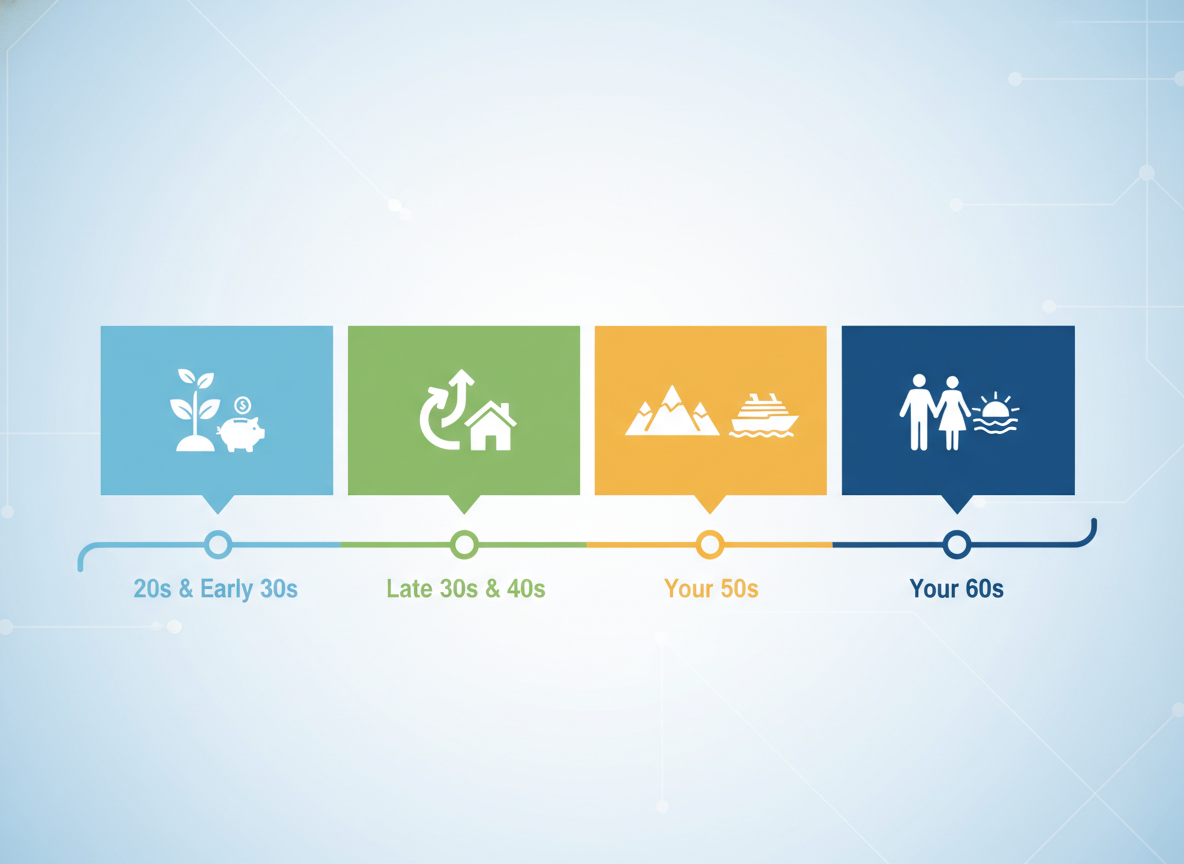
In Your 20s and Early 30s
In your 20s and early 30s, the goal is simply to start. Even saving just 1% to 5% of your income can make a meaningful difference over time. Take full advantage of any employer matching programs, set up automatic contributions so saving happens consistently, and focus on building strong financial habits that will support your long-term retirement success.
In Your Late 30s and 40s
It’s time to become more intentional with your retirement strategy. As your income increases, gradually raise your contributions, prioritize paying down high-interest debt, and review how your investments are allocated to ensure they still align with your goals. This is also a good stage to start thinking about when you might want to retire.
When You’re in Your 50s
You should focus on maximizing your savings by contributing as much as allowed through catch-up contributions. Consider gradually shifting investments toward more conservative options if needed, estimate your potential Social Security income, and prepare for healthcare expenses so you’re financially ready for the transition into retirement.
When You’re in Your 60s
As retirement gets closer, it’s important to finalize the details. Lock in a sustainable withdrawal plan, choose the right time to start your Social Security benefits, and make sure all estate planning documents are current. This is also the time to reassess how much investment risk you’re comfortable taking and confirm that your expected income will support your retirement lifestyle.
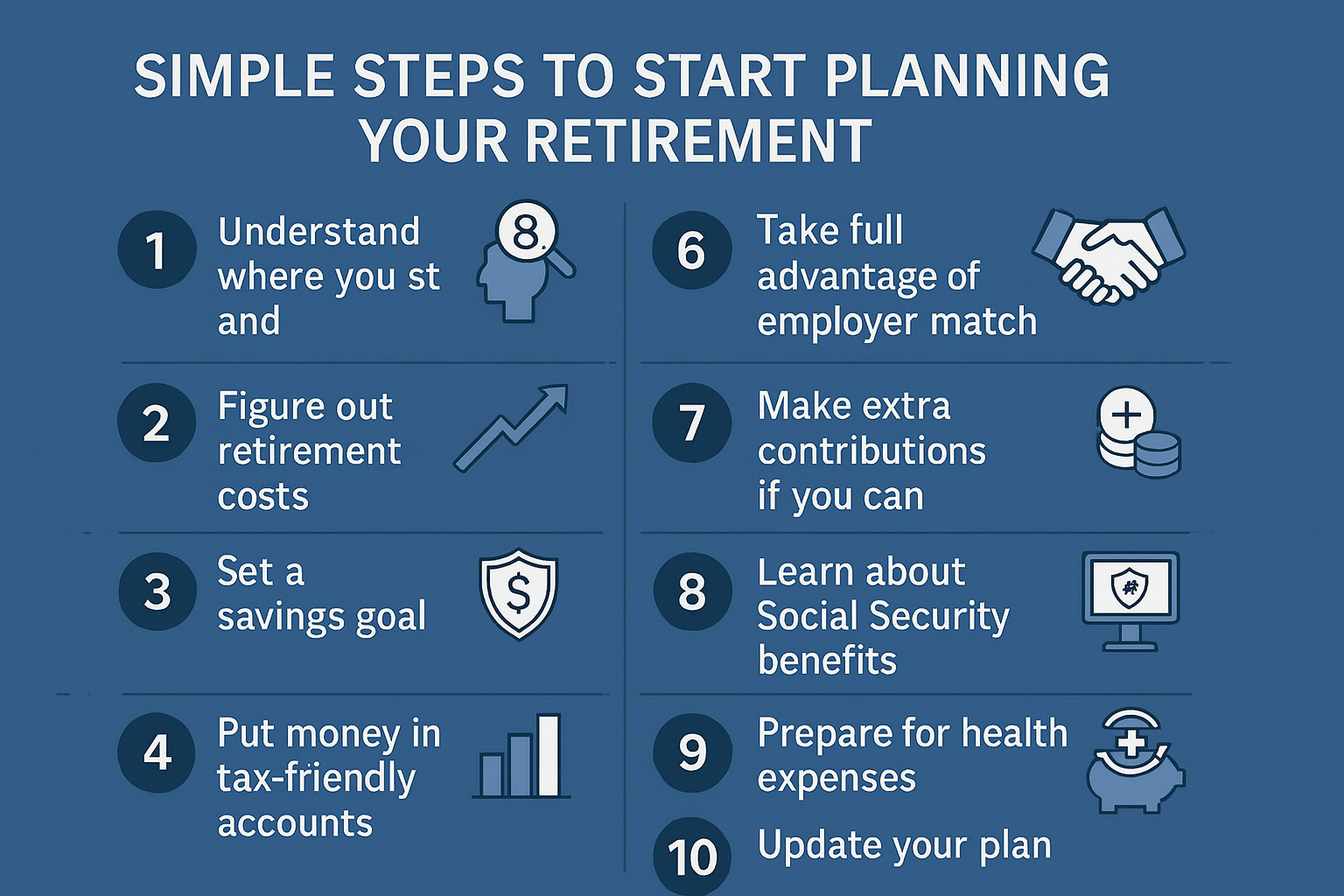
12. Simple Steps to Start Planning Your Retirement
Here’s an easy guide to get going:
- Understand where you stand: look at what you own, what you owe, how you spend, and your total net worth.
- Figure out retirement costs: think about housing, healthcare daily needs, and travel.
- Set a savings goal: try using tools like retirement calculators.
- Put money in tax-friendly accounts: options include 401(k), IRA, Roth IRA, and HSA.
- Invest with variety: look into index funds, ETFs, and adjust based on your age.
- Take full advantage of employer match: it’s free money that helps grow your savings.
- Make extra contributions if you can: this is helpful if you started saving later.
- Learn about Social Security benefits: choose the right age to start claiming.
- Prepare for health expenses: plan for Medicare and possible long-term care costs.
- Update your plan: life changes so don’t forget to tweak your strategy each year.
Closing Thoughts: Building a Secure Future Begins with Little Steps
Retirement planning is about taking steps forward, no matter your age or how much money you have. Each time you save pay off a debt, or make an investment, you are shaping a secure and independent future.
Always keep this in mind: You don’t have to tackle it all at once. Starting is what matters most. Little actions add up over time. The choices you make today will create a future you’ll be glad to have planned for.
