


Making charitable donations can support causes you care about while also creating potential tax deductions on your federal return. But the rules are more detailed than many people expect. In the United States, not every donation qualifies, not every organization is eligible, and not every taxpayer will benefit unless they claim the deduction the right way. Understanding the basics can help you give more confidently, keep better records, and avoid mistakes that could reduce or disallow your tax break.
What Counts as a Charitable Donation for Tax Purposes?
A charitable donation is generally a contribution of money or property made to a qualified charitable organization. The IRS says deductible contributions usually must be made to qualified organizations such as certain religious organizations, charitable nonprofits, governments for public purposes, and other eligible entities. Contributions to individuals, political organizations, and many foreign organizations generally aren’t deductible.
This distinction matters because many people assume that any generous gift creates a tax benefit. It doesn’t. A gift may be meaningful and still not qualify for a federal charitable contribution deduction. Before claiming anything, it’s important to verify that the organization is eligible under IRS rules.
How Charitable Tax Deductions Work
For now, the basic rule is that taxpayers generally can deduct charitable contributions only if they itemize deductions on Schedule A (Form 1040). The IRS also notes an upcoming change: beginning with tax year 2026, taxpayers who don’t itemize may deduct up to $1,000 of qualifying cash contributions, or $2,000 if filing jointly. That means the rules depend partly on which tax year you’re filing for.
When you do itemize, the deduction reduces your taxable income, not your tax bill dollar for dollar. So the value of the deduction depends on your tax bracket and whether your total itemized deductions exceed your standard deduction. For some households, charitable giving creates a clear tax benefit. For others, the donation is still worthwhile, but the federal tax savings may be limited or nonexistent in that year. This is an inference based on how itemized deductions work on Schedule A.
Which Donations May Be Deductible?
Cash gifts are the most straightforward. Donations made by cash, check, electronic funds transfer, credit card, or payroll deduction may qualify if they go to an eligible organization and are properly documented. The IRS also allows deductions for many noncash donations, including clothing, household goods, vehicles, securities, and other property, subject to valuation and reporting rules.
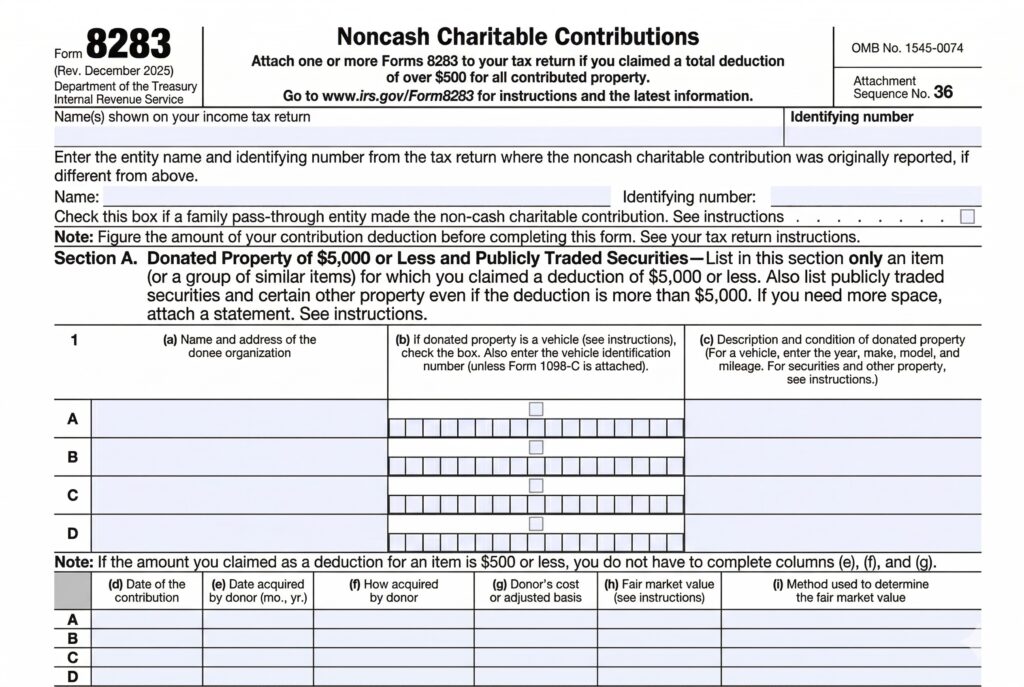
Noncash gifts are where people often run into trouble. The IRS requires additional substantiation for donated property, and larger noncash gifts may require Form 8283. For noncash contributions over $5,000, the donor generally must attach Form 8283, and the charitable organization usually must sign Part V of Section B unless the gift is publicly traded securities.
The value of donated items also matters. The IRS points donors to Publication 561 for rules on determining fair market value, which means you can’t simply guess a number that feels reasonable. Overstating donated property is one of the easiest ways to create tax problems later.
How to Qualify for a Charitable Contribution Deduction
To claim a deduction correctly, you generally need to meet several conditions. First, the organization must qualify. Second, the gift itself must be deductible under IRS rules. Third, you need proper records. Fourth, you usually must itemize deductions unless you’re filing under the newer non-itemizer rule that begins in 2026.
Documentation is especially important. The IRS says cash donations require written records such as a bank record, payroll deduction record, or written communication from the charity showing the organization’s name, the date, and the amount. For any contribution of $250 or more, you must obtain a contemporaneous written acknowledgment from the charity.
If you receive something in return for your donation, such as event tickets, merchandise, or a dinner, you generally can deduct only the amount that exceeds the value of the benefit you received. That’s another area where taxpayers sometimes overclaim without realizing it.

AGI Limits and Why They Matter
The IRS explains that charitable deductions are also subject to adjusted gross income (AGI) limits. In many cases, cash contributions to qualifying organizations are deductible up to 60% of AGI, though 20%, 30%, or 50% limits can apply in certain situations depending on the type of contribution and the organization. If your donation exceeds the applicable limit, you may be able to carry over the unused amount to future tax years.
This is an important planning point for larger gifts. A major donation may still be deductible, but not always all at once. People making substantial gifts of appreciated assets, business interests, or other high-value property should be especially careful because the percentage limit can change based on what was donated and to whom.
Smart Ways to Maximize Tax Savings
One practical way to maximize charitable tax deductions is to keep excellent records all year instead of scrambling at filing time. Small donations are easy to forget, and missing documentation can make an otherwise valid deduction unusable.
Another smart strategy is paying attention to noncash gifts. Donating appreciated property can sometimes be more tax-efficient than donating cash, though the rules can be more complex and valuation requirements are stricter. This is an inference supported by IRS rules distinguishing types of contributions and deduction limits for different property categories.
Timing also matters. Since deductions are generally claimed for the year the donation is made, year-end giving can affect the current return if completed on time and properly documented. For taxpayers who are close to the threshold where itemizing becomes worthwhile, combining donations into one tax year may sometimes increase the chance of receiving a federal tax benefit. This is an inference based on Schedule A itemizing mechanics.
Common Mistakes to Avoid
One of the biggest mistakes is assuming every donation counts. Gifts to individuals, crowdfunding for a private person, or contributions to nonqualified groups may be generous but not deductible.
Another common mistake is failing to get the right acknowledgment for gifts of $250 or more. Without that written acknowledgment, the deduction can be denied even if the donation clearly happened. People also run into trouble with noncash donations by guessing inflated values, forgetting Form 8283, or failing to keep required records. For higher-value property gifts, substantiation becomes much more important.
Finally, many taxpayers overestimate the tax benefit itself. A charitable deduction reduces taxable income, but it doesn’t automatically return the full donated amount through taxes. The main purpose of giving should still be supporting a cause you value. The tax break is helpful, but it’s only one part of the decision. This is an inference based on how itemized deductions function.
How to Claim Charitable Donations Correctly
To claim charitable donations correctly, start by confirming the organization qualifies. Then save every receipt, bank record, acknowledgment letter, and property valuation document that applies. If you’re itemizing, report the contribution on Schedule A. If you donated noncash property above the reporting threshold, include Form 8283 when required.
The IRS also highlights that written substantiation rules aren’t optional details. They are a core part of claiming the deduction properly. In other words, qualifying to deduct a donation doesn’t depend only on generosity. It also depends on documentation.
Conclusion
Charitable donations and tax deductions can work well together when you understand the rules before you file. The most important steps are making sure the organization is qualified, knowing whether you need to itemize deductions, keeping strong records, and following the special rules for larger cash and noncash donations. For bigger gifts, it’s also important to watch AGI limits, carryover rules, and additional forms such as Form 8283.
Handled carefully, charitable giving can support meaningful causes while also helping you reduce taxable income. The best approach is to treat the deduction as a valuable tax benefit, not an afterthought. When you plan ahead and document everything properly, you’re much more likely to maximize savings and claim your donation correctly.
