


As a business owner, one of the biggest challenges you may face is minimizing your tax liability while investing in the growth of your business.
Fortunately, there’s a powerful tax incentive available: the Investment Tax Credit (ITC). This federal tax credit provides businesses with a significant reduction in their tax bill for investing in renewable energy systems such as solar, wind, and geothermal. Understanding how the ITC works, what it covers, and how to claim it can save your business a substantial amount of money, all while contributing to sustainability goals.
In this article, we’ll explain exactly how the Investment Tax Credit (ITC) works, its benefits for businesses, and provide a clear, step-by-step guide on how to claim it. Whether you’re installing solar panels or investing in wind power, the ITC offers a chance to reduce your upfront costs and boost your bottom line.
What is the Investment Tax Credit (ITC)?

The Investment Tax Credit (ITC) is a federal program that allows businesses to reduce their tax liability by a percentage of the total cost of purchasing and installing renewable energy systems. This credit is designed to make renewable energy investments more affordable by offsetting the high initial costs. The ITC covers a broad range of renewable energy systems, including solar energy systems, wind turbines, geothermal systems, and fuel cells.
For solar installations, the ITC offers a 30% tax credit on the total cost of the system, including installation, equipment, and labor. Other renewable energy systems like wind and geothermal can also benefit from this incentive, though the percentage may vary depending on the system and installation type. This credit is applied to the year in which the system is installed, so businesses can immediately benefit from it during tax season.
How Does the ITC Work?
The ITC works by allowing businesses to deduct a percentage of the installation costs from their federal tax liability.
Step 1: Determine the Total Cost of Installation
First, calculate the total cost of your renewable energy system. This includes the cost of equipment, labor, permits, inspections, and any other associated costs related to installation. For example, if your solar installation costs $100,000, this is the amount on which you will base your ITC.
Step 2: Claim the Credit
The 30% ITC is applied to the total installation cost. For a $100,000 solar installation, the ITC allows you to claim a $30,000 tax credit.
Step 3: File IRS Form 3468
To claim the ITC, you must file IRS Form 3468 as part of your business tax return. This form helps you calculate the amount of the credit and ensures it is applied to your tax liability. If your business’s tax liability is smaller than the credit, you can carry the unused portion over to the following year’s tax return.
Step 4: Impact on Your Tax Bill
The credit directly reduces the amount of taxes you owe to the IRS. If your tax liability is $50,000 and you claim a $30,000 ITC, your new tax liability would be $20,000. This is a substantial savings and can help improve cash flow for your business.
Step 5: Carrying Over Unused Credits
If your tax liability is less than the credit you are eligible for, the IRS allows you to carry the remaining portion of the credit forward to future years. This means that if you owe less tax than your ITC, you won’t lose the credit; instead, you can apply it to your taxes in the next year(s).
Eligibility for the ITC: Who Can Claim It?

Business Ownership
The business must own the property where the renewable energy system is installed. This includes sole proprietorships, corporations, and partnerships. If you’re leasing the equipment, the credit typically isn’t available to you. However, if you own the system, you’re eligible to claim the ITC.
Type of Renewable Energy System
The ITC applies to solar energy systems, wind turbines, geothermal heat pumps, and fuel cells. These systems must meet specific installation and performance standards as outlined by the IRS.
Domestic Installation
The system must be installed in the United States. This ensures the ITC benefits the U.S. economy by promoting renewable energy growth domestically.
Installation Timing
To qualify for the current 30% ITC, your system must be installed by December 31, 2024. After 2024, the ITC will begin to phase down, reducing the credit to 26% in 2025 and 22% in 2026. After 2026, the ITC will expire for residential projects, though it may continue to apply to commercial systems.
What Costs Are Covered by the ITC?
The ITC covers a wide range of costs associated with installing a renewable energy system. These include:
- Solar panels: The cost of the solar panels themselves is fully covered by the ITC.
- Inverters: These devices, which convert solar energy into usable electricity, are included in the credit.
- Battery storage: Many businesses opt to pair their solar panels with battery storage systems to store excess energy. The ITC covers the cost of the solar battery.
- Installation labor: Labor costs associated with setting up the renewable energy system are eligible for the credit.
- Permits and fees: Fees for permits, inspections, and other regulatory costs can be included in the credit calculation.
This comprehensive coverage ensures that businesses can recover a significant portion of their investment in renewable energy systems through the ITC.
How to Claim the ITC
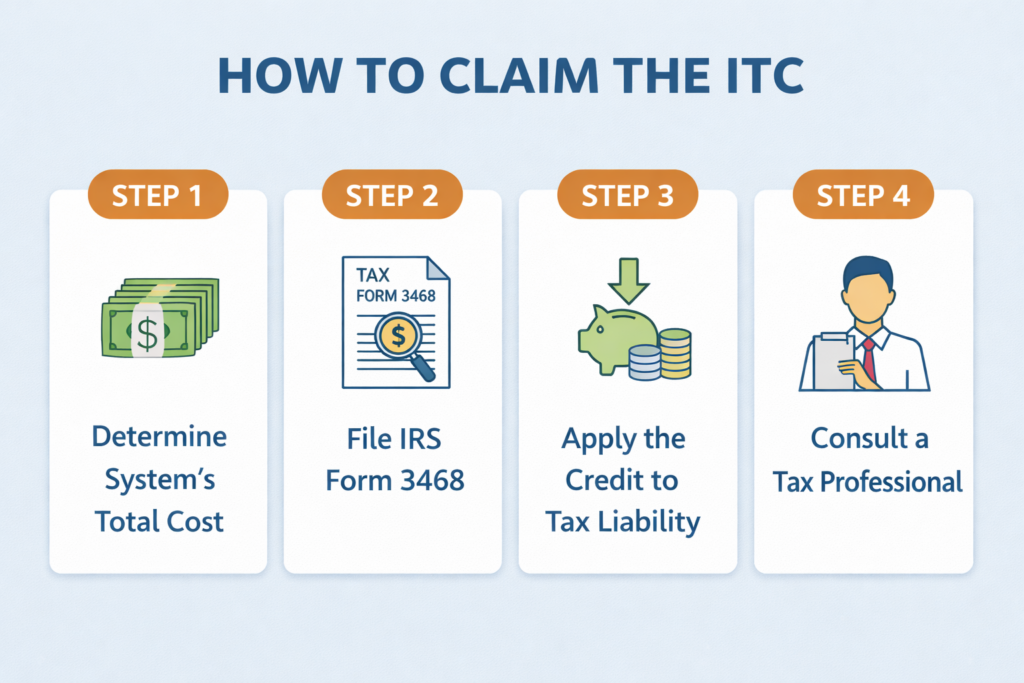
Step 1: Determine Your System’s Total Cost
Keep track of all costs related to your renewable energy system, including labor, permits, equipment, and installation. Ensure you have all the necessary invoices and receipts.
Step 2: File IRS Form 3468
This form is used to claim the ITC. It’s part of your business tax return, and it helps calculate the amount of the credit.
Step 3: Apply the Credit to Your Tax Liability
Once the credit is calculated, you can apply it to your federal tax bill. If your business’s tax liability is lower than the credit, carry it forward to the next tax year.
Step 4: Consult a Tax Professional
While filing for the ITC is straightforward, it’s advisable to consult a tax professional to ensure you’re eligible for the full credit and that the process is completed correctly.
Benefits Beyond Tax Savings: Sustainability and Public Image
In addition to the tax savings, investing in renewable energy systems can provide significant long-term benefits for your business:
- Energy savings: By switching to renewable energy, businesses can reduce their energy costs over time, especially in areas with high electricity rates.
- Sustainability goals: Incorporating renewable energy aligns your business with sustainability practices, which is becoming increasingly important to consumers, investors, and stakeholders.
- Positive public image: Businesses that invest in renewable energy often see improved public perception, especially among environmentally conscious customers.
Final Thoughts: Maximize Your Savings with the ITC

The Investment Tax Credit (ITC) is a powerful tool for businesses looking to reduce their tax liability while investing in renewable energy. By claiming the credit, businesses can lower their upfront costs for solar, wind, and other renewable systems and take advantage of long-term savings from energy efficiency.
With the ITC’s 30% credit available until the end of 2024, now is the time to act if you want to maximize your savings. As the tax credit phases down in subsequent years, businesses should take full advantage of this incentive before it decreases.
Understanding how the ITC works and claiming it correctly can provide substantial financial relief and set your business on a path to a more sustainable future. Don’t miss out on this opportunity to reduce your energy costs and take advantage of federal incentives.
