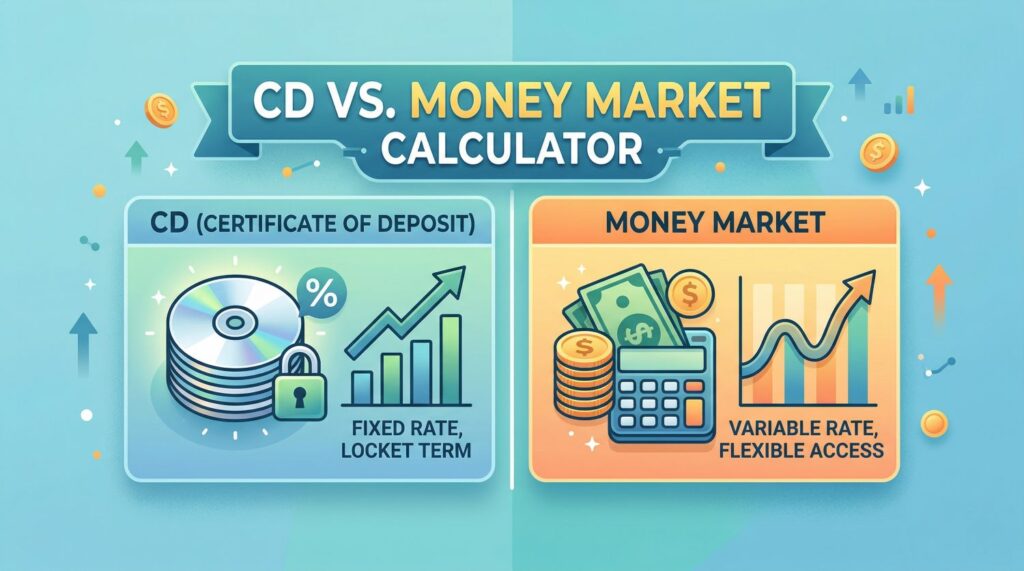
A smart CD interest calculator and money market calculator should help you do more than compare two projected balances. It should help you understand why one account may fit your timeline better, how liquidity affects the decision, and what kind of return you can realistically expect after taxes and account rules are considered.
If you are deciding between a CD and a money market account, the real question is simple. Do you want a fixed return for a set period, or do you want easier access to your cash while still earning interest? That is why a side by side comparison matters. A CD can offer predictability and structure. A money market account can offer flexibility and quicker access. Both can play a valuable role in a savings plan, but they solve different problems.
Understanding CD vs Money Market
The best way to think about the CD vs money market is to start with your goal, not the product label. If you focus only on which account has the higher advertised rate, you may end up choosing the wrong tool for your actual needs.
So, how does a cd account work? A certificate of deposit is a deposit account that locks your money in for a fixed term. In exchange, the bank or credit union pays a fixed rate for that period. Your return is easier to estimate because the APY usually stays the same until maturity. The tradeoff is access. If you need the money before the term ends, you may face an early withdrawal penalty.

A money market account works differently. It usually gives you more flexibility, limited check or transfer access in some cases, and a variable rate that can move with market conditions. That makes it useful for cash you may need sooner or money you want to keep available for emergencies. If your top priority is certainty, a CD usually makes more sense. If your top priority is liquidity, a money market account is often the better fit. If you care about both, a blended approach may give you a stronger overall result.
APR Formula & Percent Yield Explained

To compare these accounts properly, it helps to understand the math behind the return. The basic APR formula is:
That formula works as a starting point, but most deposit products are discussed using APY because APY reflects compounding. If you want to know how to calculate percent yield, you need to look beyond the headline rate and consider how often interest is credited, whether the rate is fixed or variable, and how long the money stays in the account.
This is also where dividend rate vs APY becomes important. The dividend rate or nominal rate is the raw annual rate. APY is the effective annual yield after compounding is included. Two accounts can look similar at first glance, but once compounding is taken into account, the actual return may differ.
A CD is easier to model because the rate is usually fixed for the term. A money market account is harder to predict over time because the rate can change. That is why a money market account calculator is often best used as an estimate, while a certificate calculator or CD estimate can feel more exact.
Which Account Fits Your Savings Goal?
The right account depends on what the money is for. A broad definition is helpful, but a real decision becomes much easier when you match the account to a real life purpose.
The Emergency Fund
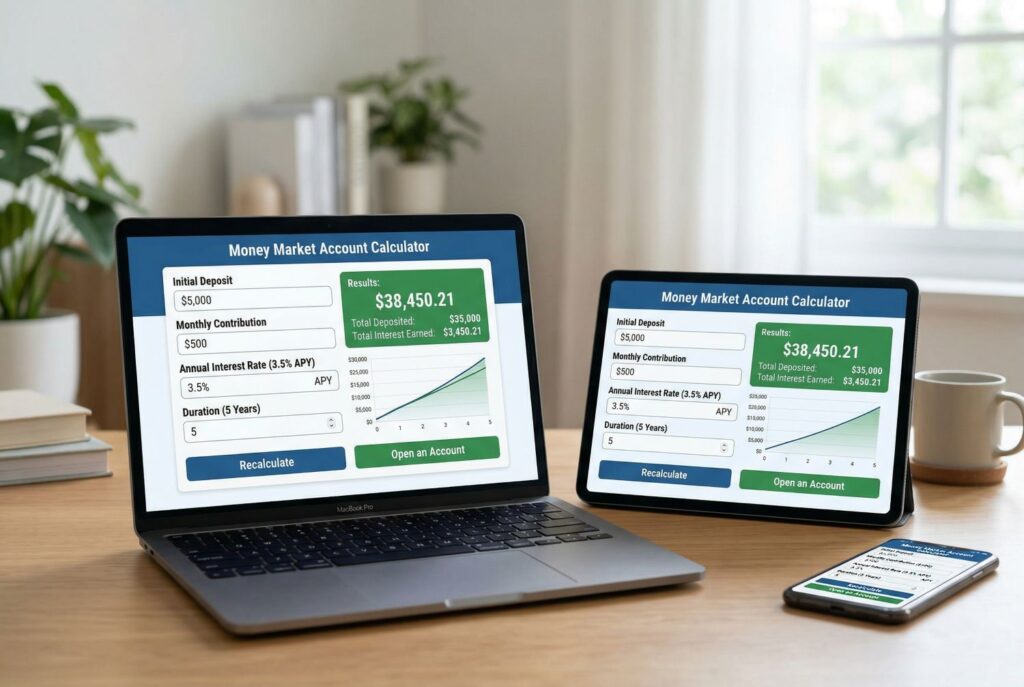
If this money is your emergency fund, access matters more than squeezing out the last bit of yield. A money market account is usually the stronger option because it keeps your cash available while still helping it earn interest. A money market account calculator can help you estimate what that flexibility may earn over time. For job transitions, medical bills, surprise repairs, or general peace of mind, liquidity should come first. In those cases, locking all your cash into a CD may create unnecessary stress.
The Down Payment

If you are saving for a house down payment, tuition payment, or another expense with a known timeline, a CD may be the better choice. This is where a certificate calculator becomes especially useful. You can align your deposit, APY, and term length with the date you expect to need the money.
A CD works well for this kind of goal because it removes rate uncertainty and reduces the temptation to dip into the funds. If the purchase date is reasonably predictable, the guaranteed structure can be a real advantage.
Advanced Tactics: The Blended Strategy

You don’t always have to choose one account and ignore the other. In many cases, the most practical answer is to use both. A simple framework is to split your safe cash so that part stays liquid and part earns a fixed return. One useful approach is a 60-40 structure. Place 60% into a CD to lock in stronger yield, and keep 40% in a money market account so you still have access to cash when you need it.
If you want even more flexibility on the CD side, a ladder can help. A CD ladder calculator can show you how to divide your money across multiple maturities so a portion becomes available at regular intervals. This approach reduces the discomfort of locking up everything at once and can make it easier to respond if rates change over time.
A blended strategy works especially well for savers who want discipline without giving up access. It can also help you stay organized by giving each portion of your cash a clear job.
Hidden Costs: Penalties and Taxes
Projected earnings are useful, but they don’t tell the full story. The real return on a CD or money market account can be affected by penalties, taxes, and account conditions. With a CD, the biggest hidden cost is usually the early withdrawal penalty. If you break the CD before maturity, the bank may charge a penalty equal to several months of interest. That can reduce your return significantly and, in some cases, wipe out much of the benefit of choosing the CD in the first place.
Do You Pay Taxes on CD Interest?
Yes. In the United States, CD interest is generally taxed as ordinary income in the year it is earned, even if you leave it in the account to compound. That means your after tax return may be lower than the APY suggests. Money market account interest is also generally taxable, so taxes don’t automatically make one product better than the other. But if you are comparing returns carefully, it makes sense to think in after tax terms, not just pre tax yield.
Where to Find the Best Rates Today
Once you understand the structure, the next step is shopping carefully. When comparing offers, look beyond the top advertised APY. Check whether the rate is fixed or variable, whether there are early withdrawal penalties, whether the account requires a high minimum balance, and whether the product fits your timeline. A good rate is only useful if the account itself matches your goal.
Many savers also search specific providers to compare market options, including Keybank CD rates, Becu CD rates, Associated Bank CD rates, and Schwab CD rates. Looking at multiple institutions can help you understand how rates vary by term, brand, and account type. If you are also considering liquid alternatives, it can help to compare your CD estimate with a money market calculator result. That gives you a more realistic picture of the tradeoff between guaranteed yield and access to cash.
Conclusion
A side by side CD interest calculator and money market calculator can show you which account may earn more on paper. But the smarter decision comes from matching the account to your actual goal. If you want a fixed return and can commit to leaving the money alone, a CD often makes the most sense. If you want flexibility and easier access, a money market account is usually the better fit. If you want both, using the two accounts together can create a stronger and more balanced savings plan.
That is why the best CD vs money market decision starts with purpose, not just yield. Use the calculator for the numbers. Use your timeline, liquidity needs, and tax awareness to choose the account that actually works for your life.
Related Articles
Free CD Interest Calculator: Estimate Earnings & Maximize Your Returns