

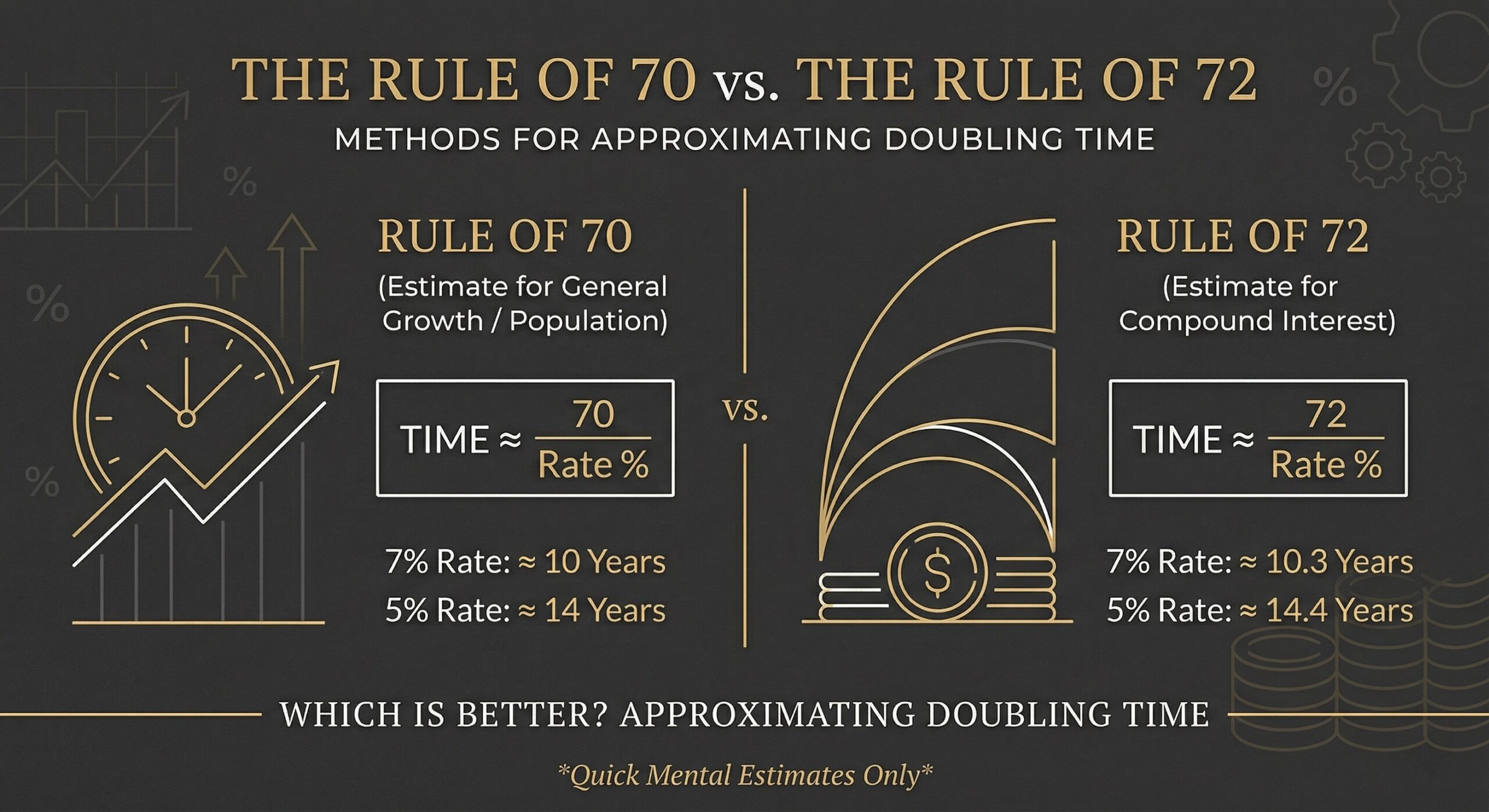
When it comes to investing, understanding the power of compound interest and estimating how long it will take for your investment to double can be crucial for long-term financial planning. The Rule of 70 and Rule of 72 are two widely used formulas that help investors make quick estimates of the time required for their money to double based on a fixed rate of return. But which formula is better, and when should you use each?
In this article, we’ll dive deep into both formulas, compare their advantages, explore their limitations, and provide practical tips on using them for effective investment growth. Whether you’re a beginner investor or a financial professional, understanding how and when to apply these rules will help guide your investment strategies.
What is the Doubling Time Formula?
At the core of both the Rule of 70 and Rule of 72 is the concept of doubling time. This is the time it takes for an investment to double, based on a given interest rate or rate of return. The formula works by dividing a constant number (70 or 72) by the interest rate (expressed as a percentage).
This formula is often used for slower growth rates, particularly when interest rates are below 10%. It’s ideal for scenarios like economic growth or inflation, where interest rates tend to be lower.
Rule of 72 Formula
The Rule of 72 is more flexible and provides slightly more accuracy, especially for interest rates between 6% and 10%, making it a popular choice among investors looking at stock market returns or growth projections for mutual funds and bonds.
The Rule of 70 Explained
The Rule of 70 is a simple way to estimate how long it will take for your investment to double if you’re dealing with slower growth rates. It’s commonly applied to economic growth or low-risk investments with returns below 10%. Here’s how you can use it:
How to Calculate Doubling Time with Rule of 70
Let’s say you have an interest rate of 5%. To estimate the time it’ll take for your investment to double, you would use the Rule of 70 formula:
This tells you that with a 5% rate of return, your investment will double in about 14 years. The Rule of 70 is particularly useful for estimating economic growth or inflation effects over the long term, where growth rates tend to be modest.

The Rule of 72 Explained
The Rule of 72 is a more versatile formula, providing more accuracy for rates of return in the 6% to 10% range. It’s widely used by investors who are looking to estimate how quickly their investments in stocks, ETFs, or other higher-growth assets will double.
When to Use the Rule of 72
The Rule of 72 is a great tool for estimating investment growth in sectors with moderate to high returns, like the stock market, where the rate of return usually falls between 6% and 10%. It’s particularly useful when looking at investment strategies that are driven by compound interest.
Let’s say your investment growth rate is 8%:
This means that with an 8% rate of return, it would take approximately 9 years for your investment to double. The Rule of 72 is a bit more accurate than the Rule of 70 for growth rates in this range, making it ideal for most stock market investors.
Comparison Chart: Rule of 70 vs. Rule of 72
To give you a clearer picture of how these two formulas compare, we’ve created a simple chart that shows the doubling time for various interest rates using both the Rule of 70 and the Rule of 72.
| Interest Rate | Rule of 70 | Rule of 72 |
|---|---|---|
| 2% | 35 years | 36 years |
| 4% | 17.5 years | 18 years |
| 6% | 11.67 years | 12 years |
| 8% | 8.75 years | 9 years |
| 10% | 7 years | 7.2 years |
As you can see, the Rule of 72 provides a more accurate estimate for most growth rates, especially when dealing with rates above 6%. The Rule of 70, on the other hand, is slightly less accurate, particularly for higher interest rates.
The Hidden Trap: Taxes, Fees, and Inflation
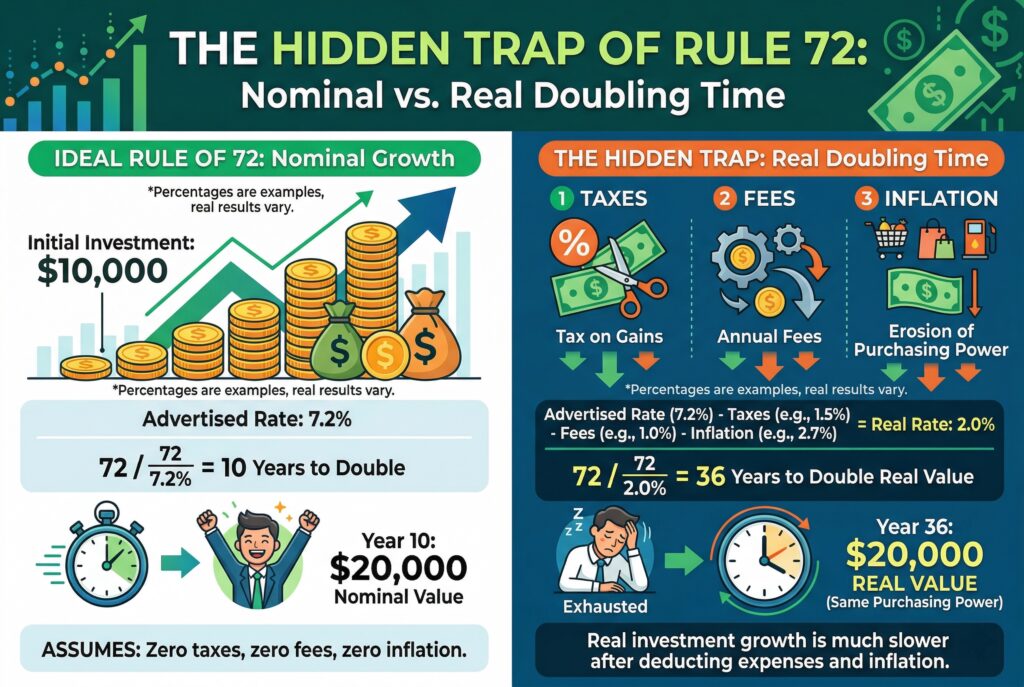
While both the Rule of 70 and Rule of 72 are helpful tools for estimating investment growth, they do have limitations. These formulas do not take into account important real-world factors like taxes, fees, or inflation that can significantly affect your actual returns.
Taxes
Investments in taxable accounts are subject to capital gains taxes, which can reduce your effective return. These taxes can extend the time it takes for your investment to double, especially in high-tax environments.
Fees
Management fees and fund expenses can eat into the growth of your investment. Over time, these costs may cause the doubling time to be longer than estimated by the formulas, as the returns are diminished by ongoing fees.
Inflation
Inflation erodes the purchasing power of money over time. Even if your investment doubles, its real value may not be as high as you expect. In periods of high inflation, the return on investment might not keep pace with the increased cost of living, meaning that the wealth you accumulate could be worth less in the future.
To account for these factors, you should always adjust your financial planning assumptions based on your specific tax situation, investment costs, and the anticipated impact of inflation. Doing so will provide a more accurate picture of your actual investment growth and help you make smarter, more informed financial decisions.
Which Formula Should You Choose?

Now that we’ve examined both the Rule of 70 and Rule of 72, it’s time to choose the best formula for your investment strategy:
- Use the Rule of 70: If you’re estimating returns in the range of 2% to 6%, such as for bonds, savings accounts, or low-risk investments, the Rule of 70 is a solid choice.
- Use the Rule of 72: If your focus is on higher growth rates, such as with stocks, ETFs, or any investments where the rate of return is likely between 6% and 10%, the Rule of 72 will offer a more accurate estimate.
Remember, both rules offer a simplified approach to understanding how long your investments will take to double. However, for more precise predictions, it’s important to consider other financial estimation tools, and integrate inflation, tax implications, and market volatility into your decision-making.
Conclusion: Rule of 70 vs. Rule of 72
In summary, both the Rule of 70 and Rule of 72 are essential tools for investors looking to estimate the doubling time of their investments. The Rule of 72 is more accurate for most investment growth scenarios, especially when the rate of return is between 6% and 10%. The Rule of 70 is more useful for lower growth rates, making it a good choice for economic growth calculations or low-risk investments.
To ensure your investment strategy is optimized, consider the specific growth rates, financial goals, and the economic conditions you’re working with. And don’t forget to account for inflation, taxes, and other real-world factors that can impact your actual returns.
By understanding when to use each formula, you’ll be better equipped to plan for long-term financial success and maximize the power of compound interest in your investment journey.
Related Articles
How to Double Your Money: The Ultimate Rule of 72 Guide & Calculator
