
If you earn $15 an hour, every dollar has a job before it even reaches your account. Rent, groceries, gas, phone bills, insurance, and savings all compete for a paycheck that may look decent on paper but feels much smaller after taxes.
So, $15 an hour is how much a year? If you work full-time at 40 hours a week for 52 paid weeks, $15 an hour equals $31,200 a year before taxes. If you take two unpaid weeks off, your gross yearly income drops to $30,000. That difference matters because many hourly workers don’t receive paid vacation, sick leave, or holiday pay.
The Pay Breakdown: Gross vs. Net Pay on $15 an Hour
Gross pay is the amount you earn before anything is deducted. Net pay, or take-home pay, is what actually reaches your bank account after taxes and deductions.
| Pay Period | Gross Pay Before Taxes | Estimated Net Pay After 22% Taxes |
| Weekly | $1,200 | ~$936 |
| Biweekly | $2,400 | ~$1,872 |
| Monthly | $5,200 | ~$3,900 |
| Annually | $62,400 | ~$48,672 |
These net numbers use a rough 21% to 22% deduction estimate for FICA, federal tax, and possible state tax. Your actual $15 an hour after taxes may be higher or lower depending on your filing status, state, benefits, dependents, and deductions.
Why Paid Time Off Changes the Math
Many calculators assume 52 paid weeks. That works if your employer pays you for holidays, vacation, and sick days. But many hourly workers only get paid when they clock in.
At 52 paid weeks, 15 an hour annual salary equals $31,200.
At 50 paid weeks, it equals $30,000.
That $1,200 gap isn’t just a spreadsheet detail. It can represent one month of groceries, a car repair, emergency savings, or part of a security deposit. If your job doesn’t offer paid time off, you need to budget as if unpaid days will happen.
Can You Actually Survive on $15 an Hour in 2026?
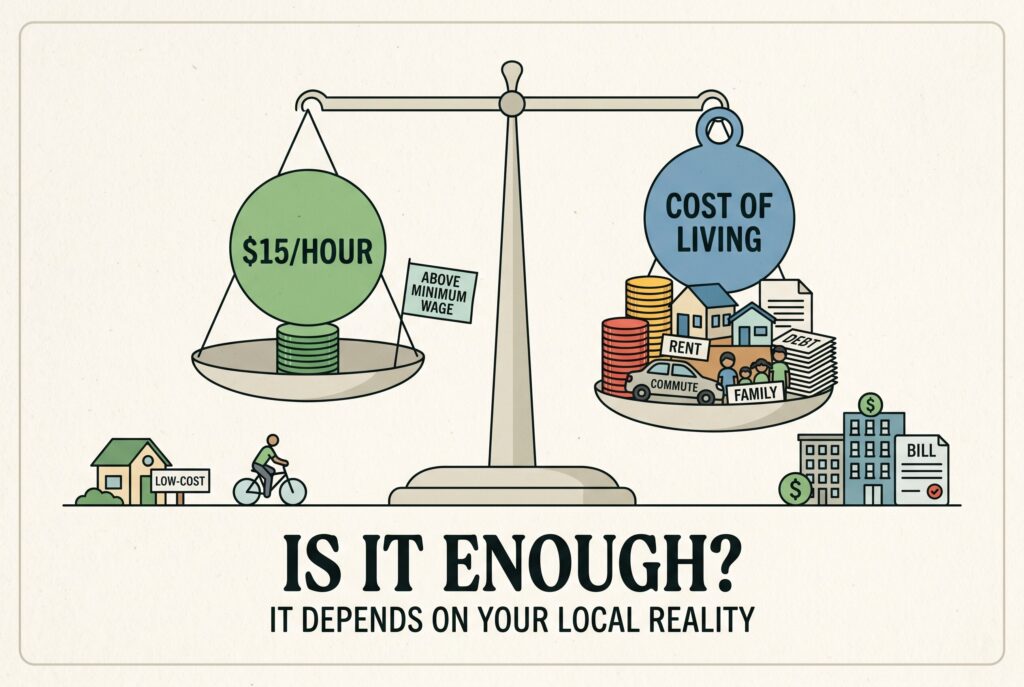
Surviving on $15 an hour is possible in some areas, but it is difficult without careful spending. The biggest problem is housing. If your monthly take-home pay is around $2,041, the traditional 30% rent rule gives you only about $612 per month for housing. In many U.S. cities, $612 won’t cover a studio or one-bedroom apartment. That means you may need a roommate, family support, subsidized housing, or a lower-cost town. This is why $15 an hour can feel workable in some rural or low-cost areas but extremely tight in expensive cities.
A Realistic Monthly Budget on $15 an Hour
A survival-style budget might look like this:
- Rent with roommate: $700
- Utilities and phone: $200
- Groceries: $350
- Transportation: $300
- Insurance and medical: $200
- Debt payments: $150
- Savings: $100
- Personal spending: $41
This budget leaves very little room for mistakes. A flat tire, medical bill, unpaid sick day, or rent increase can break it. That doesn’t mean $15 an hour is hopeless, but it does mean the budget needs structure. Expenses have to be carefully planned and prioritized, with housing costs kept low, unnecessary spending minimized, emergency savings protected, and debt managed carefully so unexpected costs don’t immediately create a financial crisis.
Is $15 an Hour Better Than Minimum Wage?
Yes, $15 an hour is above the federal minimum wage, but that doesn’t automatically make it comfortable. The real question is whether it covers your local cost of living. If your rent is low and you have benefits, $15 can be a starting point. If you pay full rent alone, commute far, have children, or carry debt, it may not be enough. In many cases, living on $15 an hour also requires strict budgeting because even small unexpected expenses can create financial stress.
3 Ways to Boost Your $31,200 Annual Salary
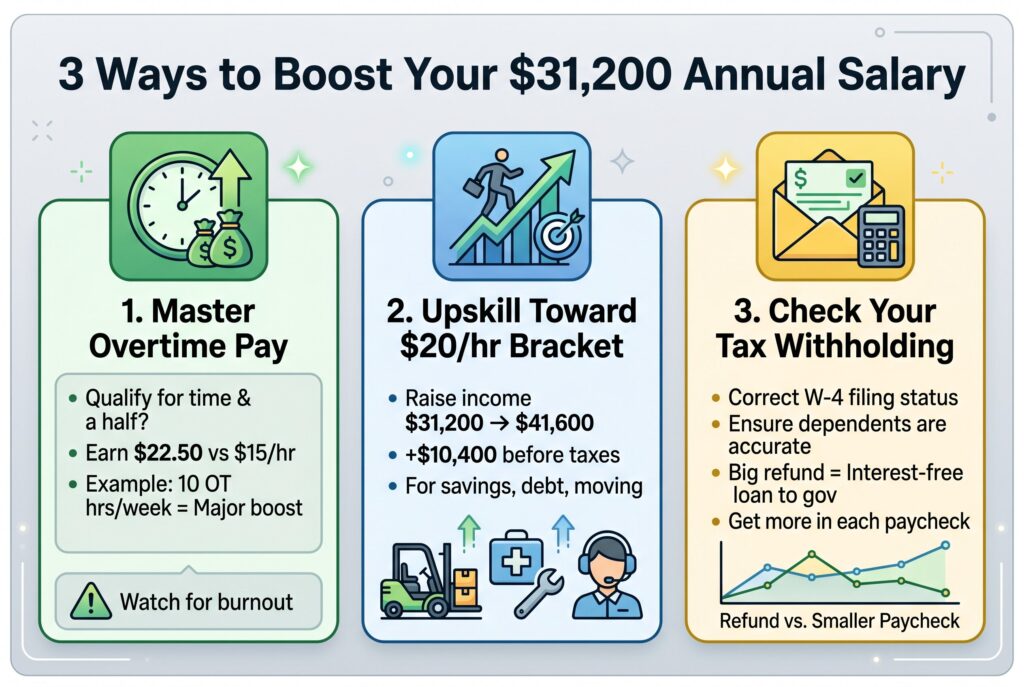
1. Master Overtime Pay
If you qualify for time and a half, your $15 hourly wage becomes $22.50 for overtime hours. Ten overtime hours per week can dramatically change your annual income. The risk is burnout. Overtime helps, but it shouldn’t be your only financial survival plan.
2. Upskill Toward the $20 Bracket
Moving from $15 to $20 an hour raises your full-time gross income from $31,200 to $41,600. That extra $10,400 before taxes can change your ability to save, move, pay debt, or handle emergencies. Look for roles with training paths: warehouse lead, medical assistant, bank teller, customer service specialist, delivery driver, or certified technician.
3. Check Your Tax Withholding
If too much tax is withheld, your paycheck may feel smaller than necessary. Review your W-4 and make sure your filing status and dependents are accurate. A big refund may feel nice, but it also means you gave the government an interest-free loan while struggling month to month.
Final Thoughts
15 dollars an hour is how much a year?” The answer is about $31,200 a year before taxes if you work a full paid year. After taxes, your take-home pay may be closer to $24,500. That is survivable in some places, but it usually requires roommates, low debt, strict budgeting, and steady hours. The number isn’t just math. It is a reality check. At $15 an hour, stability depends on paid time off, housing costs, benefits, overtime, and how quickly you can move toward a higher wage.
Related Articles
- Salary to Hourly Calculator: Get Your 2026 Pay Breakdown
- A Practical Guide to Build a Budget That Matches Your Lifestyle
- Top 9 Smart Budgeting Strategies to Reduce Financial Stress and Anxiety
- 10 Proven Ways to Save Money on Grocery Shopping and Shop Smarter on Any Budget
- Food Shopping on a Budget: 10 Smart Ways to Cut Costs and Save More Every Week