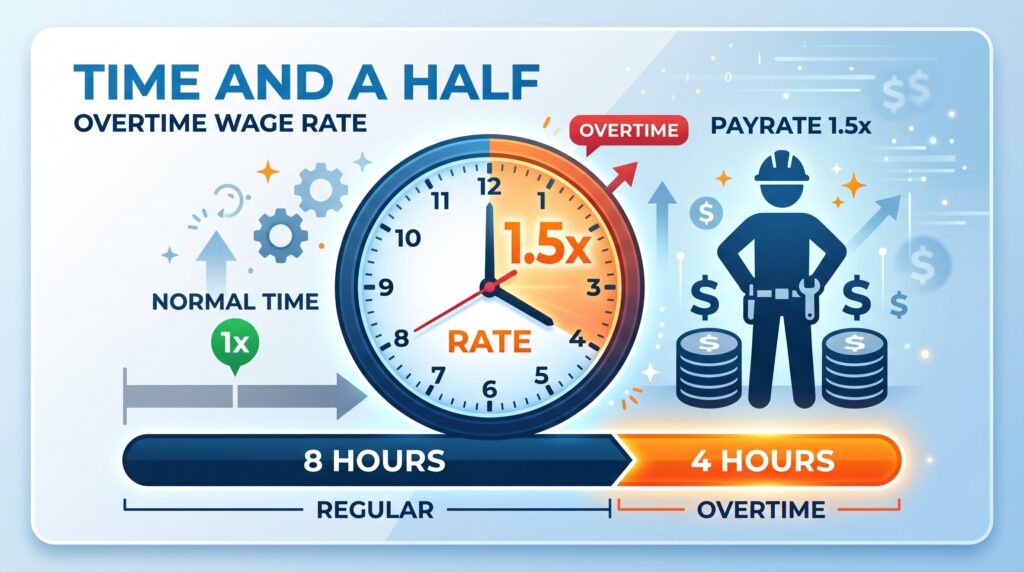
If you worked more than 40 hours this week, those extra hours may be worth more than your normal hourly rate. That extra pay is called overtime, and knowing what does time and a half mean help you understand why overtime paychecks are larger than normal.
Under the Fair Labor Standards Act, covered non-exempt employees must receive overtime pay at not less than 1.5 times their regular hourly rate for hours worked over 40 in a workweek. The FLSA generally doesn’t require extra pay simply because work happens on weekends or holidays unless those hours also create overtime.
How to Calculate Time and a Half
Time and a Half Calculator
The basic formula is simple:
Hourly Rate × 1.5 = Overtime Rate
Then:
Overtime Rate × Overtime Hours = Overtime Pay
Many employees use a time and half calculator to quickly estimate overtime earnings before payday. For example, if you make $20 per hour and work 45 hours in one week, your first 40 hours are paid at $20. The 5 overtime hours are paid at $30. That means your regular pay is $800, your overtime pay is $150, and your gross weekly pay is $950. This example also helps explain how does time and a half work in real payroll situations.
Quick Overtime Cheat Sheet
| Regular Hourly Rate | Time and a Half Rate |
| $15/hour | $22.50/hour |
| $18/hour | $27/hour |
| $20/hour | $30/hour |
| $25/hour | $37.50/hour |
| $30/hour | $45/hour |
| $35/hour | $52.50/hour |
| $40/hour | $60/hour |
| $50/hour | $75/hour |
This table is useful for quick estimates, but your actual overtime pay may change if bonuses, commissions, shift differentials, or state overtime rules apply.
FLSA Overtime Rules: Who Qualifies in 2026?
The main dividing line is exempt vs. non-exempt. Non-exempt employees are generally entitled to overtime pay when they work more than 40 hours in a workweek. Exempt employees aren’t usually entitled to overtime if they meet the required salary and duties tests. As of current U.S. Department of Labor enforcement guidance, the Department is applying the 2019 rule’s minimum salary level of $684 per week for certain white-collar exemptions while litigation around the 2024 rule continues. That threshold alone doesn’t decide everything, because job duties also matter.
Do You Get Time and a Half on Holidays or Weekends?

This is one of the most common overtime mistakes. Federal law doesn’t automatically require time and a half just because you work on Saturday, Sunday, a holiday, or a night shift. Extra pay is required under the FLSA when covered non-exempt employees work more than 40 hours in a workweek. And holiday overtime is usually based on company policy rather than automatic federal law.
How to Calculate Overtime for Salaried Employees
Some salaried employees can still qualify for overtime if they are non-exempt. In that case, the first step is finding the regular hourly rate.
A simple estimate is:
Annual Salary / 2,080 = Approximate Hourly Rate
For example, a $52,000 salary divided by 2,080 equals $25 per hour. Time and a half would be $37.50 per overtime hour. This is only a simplified estimate. Payroll rules for salaried non-exempt employees can become more complex if the employee has fluctuating hours, bonuses, commissions, or state-specific rules.
3 Common Overtime Calculation Mistakes

1. Ignoring Bonuses and Commissions
Overtime is based on the regular rate of pay, not always just the base hourly wage. Non-discretionary bonuses, commissions, and certain incentive payments may need to be included before calculating overtime. This mistake can quietly underpay employees. It’s especially common in sales, retail, hospitality, and production-based jobs.
2. Allowing Off-the-Clock Work
If an employee checks messages, prepares tools, closes a store, cleans equipment, or finishes required tasks after clocking out, those hours may still count as work time. Off-the-clock work can create unpaid overtime problems. Employers should track all hours worked accurately, and employees should keep their own records if something looks wrong.
3. Forgetting State Overtime Rules
Federal law is only the baseline. Some states apply stricter overtime protections. California, for example, often uses daily overtime rules in addition to weekly overtime thresholds. That is why a time and half calculator should be treated as an estimate rather than a guaranteed payroll figure.
Final Thoughts
Overtime hours are usually paid at 1.5 times your normal hourly rate. But real payroll calculations can become more complicated once taxes, bonuses, state laws, holiday pay, and employee classification rules enter the picture.