

A single step income statement is one of the simplest income statement format options for small businesses, freelancers, and service companies. Instead of separating gross profit, operating income, and non-operating income into multiple layers, it uses one clean calculation to reach net income. This format remains useful for owners who need fast reporting, simple financial health analysis, and a clear income statement example without unnecessary accounting complexity.
What is a Single-Step Income Statement? The Meaning
What is an income statement? It is a financial report that shows a company’s revenues, expenses, gains, and losses over a specific period. A single step income statement is the simplest version of that report. This format groups all revenue and gains together, then groups all expenses and losses together. After that, it subtracts total expenses from total income to calculate net income.
Small service businesses often like this format because it is easy to prepare and easy to read. If your business doesn’t have inventory, complex departments, or many cost categories, a single-step report may be enough for internal decision-making.
Interactive Tool: Single-Step Income Statement Builder
A single-step income statement builder should ask for total revenue, other income, operating expenses, non-operating losses, and taxes. Then it should calculate net income instantly.
For example:
Total Revenue: $80,000
Other Income: $5,000
Total Expenses: $52,000
Losses: $3,000
Net Income = ($80,000 + $5,000) − ($52,000 + $3,000)
Net Income = $30,000
This kind of tool helps business owners see the final result quickly without building a spreadsheet from scratch.
Single-Step Income Statement Builder
Single-Step vs. Multi-Step Income Statement: Key Differences
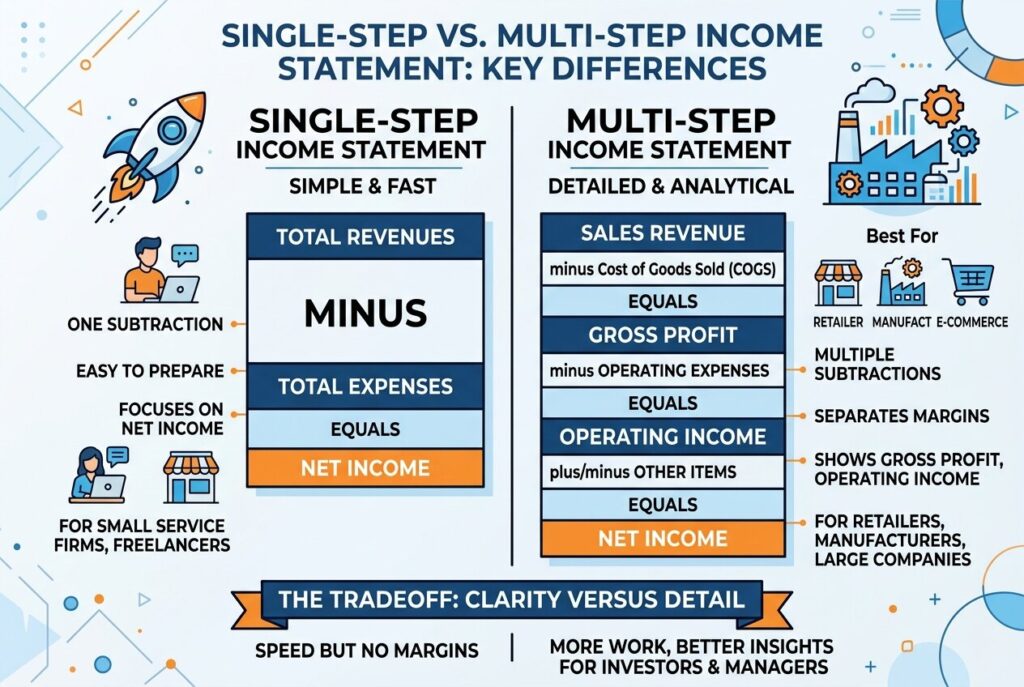
A single-step income statement is simple. It uses one subtraction, is easy to prepare, and focuses on net income. It works best for freelancers, consultants, small service companies, and businesses with basic cost structures.
A multi-step income statement is more detailed. It separates gross profit, operating income, and net income. This format is better for retailers, manufacturers, e-commerce stores, and larger companies that need to analyze margins. The tradeoff is clarity versus detail. Single-step reporting is fast, but it doesn't show gross margin or operating efficiency. Multi-step reporting takes more work, but it gives investors, lenders, and managers more insight.
The Formula: How to Calculate Net Income
The formula is:
Net Income = (Revenues + Gains) − (Expenses + Losses)
Revenues include money earned from normal business activity, such as service fees, product sales, subscriptions, or advertising income. Gains are extra income from non-core activity, such as selling old equipment. Expenses include costs required to run the business, such as payroll, software, rent, hosting, contractors, marketing, utilities, and insurance. Losses include one-time or non-operating losses, such as selling an asset below book value. The strength of this format is speed. The weakness is that it doesn't separate operating performance from one-time events.
Real-World Example: A Digital Content Publisher
Imagine a finance website. It earns $40,000 from display ads and $10,000 from affiliate commissions. Total revenue is $50,000. The website pays $6,000 for hosting and software, $12,000 for writers, $4,000 for editing, $2,000 for design, and $1,000 in taxes and fees. Total expenses are $25,000.
Single-Step Income Statement:
Revenue
Advertising Revenue: $40,000
Affiliate Revenue: $10,000
Total Revenue: $50,000
Expenses
Hosting and Software: $6,000
Content Writing: $12,000
Editing: $4,000
Design: $2,000
Taxes and Fees: $1,000
Total Expenses: $25,000
Net Income: $50,000 − $25,000 = $25,000
This P&L example is clean and useful for internal review. The owner can immediately see whether the site was profitable.
Common Mistakes to Avoid in Single-Step Reporting

The first mistake is confusing profit with cash. A P&L may show profit even if customers haven't paid invoices yet. The second mistake is forgetting non-operating losses. If you sell equipment at a loss, that still affects net income. The third mistake is oversimplifying too much. If investors or lenders need to evaluate gross margin or operating efficiency, a single-step format may not provide enough detail. The fourth mistake is mixing reporting periods. Don’t combine January revenue with February expenses unless the report clearly covers both months.
Conclusion
A single-step income statement is right for businesses that value speed, simplicity, and clear net income reporting. It works well for service businesses, freelancers, and small companies with simple operations. But if your business has inventory, COGS, investors, lenders, or complex departments, a multi-step format may be better. Use the single-step format when you need a fast, clean view of profit. Use a deeper format when you need to understand exactly where that profit came from.
