
Before you call an insurance agent or compare online quotes, a home insurance calculator can give you a realistic starting point. In 2026, the national average homeowners insurance premium is about 2,490 USD per year for a policy with 400,000 USD in dwelling coverage, assuming good credit, no recent claims, a 1,000 USD deductible, and 300,000 USD in liability coverage.
That number is useful, but it isn’t a guarantee. Your actual premium can change sharply based on your ZIP code, roof age, square footage, construction type, claims history, credit tier, deductible, and local climate risk. A home in a wildfire zone, hurricane corridor, or hail prone area can cost far more to insure than a similar home in a lower risk market.
The purpose of a homeowners insurance calculator isn’t just to estimate home insurance costs. It helps you understand what drives the price, what coverage you actually need, and where you may be overpaying. The smartest homeowners don’t guess. They calculate first, then compare quotes with confidence.
Behind the Math: Our Calculator’s Methodology
Home Insurance Cost Calculator
Estimate your annual home insurance premium based on dwelling coverage, location risk, home age, square footage, deductible, liability coverage, credit profile, claims history, and optional coverage add-ons.
Estimated Annual Premium:
$0This is an educational estimate only. Actual insurance premiums vary by insurer, state regulations, underwriting rules, coverage limits, and property details.
A good home insurance cost calculator shouldn't feel like a random number generator. It should be built around standard insurance assumptions and adjusted by the details that actually affect risk. The base estimate usually begins with dwelling coverage, which is the amount needed to rebuild the structure of your home after a covered disaster. From there, the calculator adjusts for location, home age, square footage, deductible level, liability coverage, credit profile, and claims history.
For a standard estimate, many tools assume good credit, no recent claims, a 1,000 USD deductible, and 300,000 USD in liability coverage. If you raise your deductible to 2,500 USD, your premium may fall because you’re agreeing to pay more out of pocket after a claim. If you lower your deductible to 500 USD, your premium may rise because the insurer carries more short term risk.
Coverage add-ons also change the final result. Flood insurance, earthquake insurance, extended replacement cost, water backup coverage, and scheduled valuables can all increase the premium. That doesn't mean they’re bad. It means the cheapest estimate isn't always the safest estimate.
The Big Three Factors Wrecking Your Estimate Home Insurance Costs
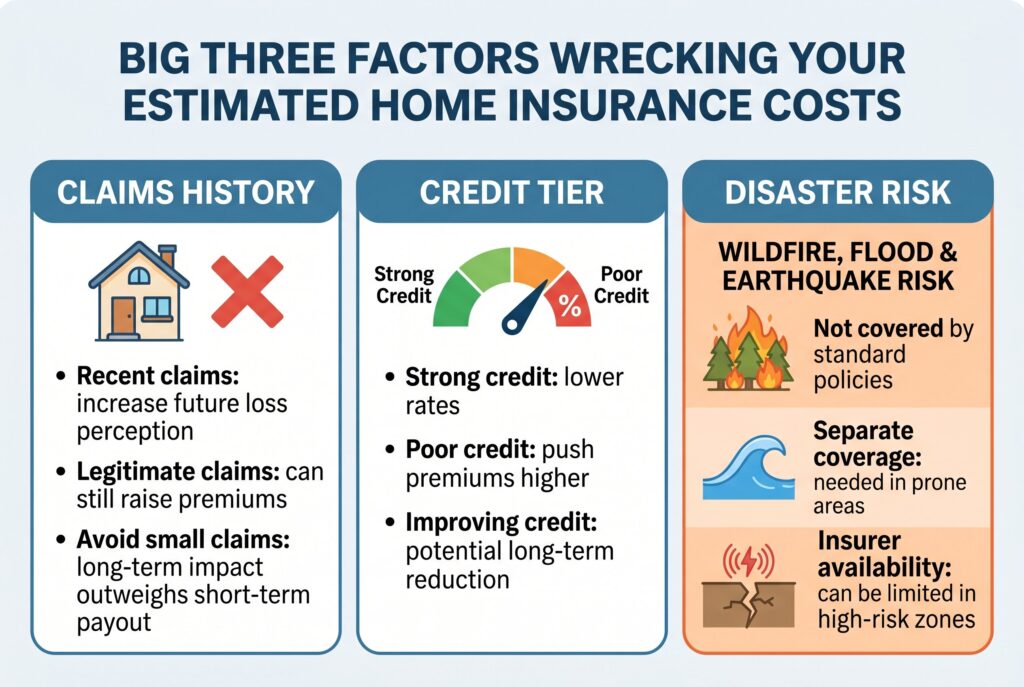
1. Claims History
Claims history can follow you longer than many homeowners expect. A recent water damage claim, roof claim, theft claim, or liability claim may increase your premium because insurers see a higher chance of future losses. Even if the claim was legitimate, the pricing model may still respond. This doesn't mean you should never file a claim. Insurance exists for serious financial losses. But filing small claims that barely exceed your deductible can backfire. If a repair costs 1,300 USD and your deductible is 1,000 USD, the 300 USD payout may not be worth the potential premium increase. Before filing, compare the short term payout with the long term impact.
2. Credit Tier
In most states, insurers can use credit based insurance scores to help calculate home insurance premiums. A strong credit tier may lower your rate, while poor credit can push your premium much higher. California, Hawaii, and Massachusetts restrict or prohibit the use of credit in insurance pricing, but in many other states, credit still matters.
This can feel frustrating because your credit score doesn't change the age of your roof or the distance to the nearest fire station. Still, insurers often view credit behavior as a predictor of claim frequency. Improving your credit, paying bills on time, lowering card balances, and correcting report errors can sometimes reduce insurance costs over time.
3. Wildfire, Flood, and Earthquake Risk
Climate risk is now one of the harshest forces in home insurance. Standard homeowners policies usually don't cover flood damage or earthquake damage. If you live near a coast, river, wildfire zone, or seismic area, you may need separate flood insurance, earthquake insurance, or specialty coverage. This is where a basic average can mislead you. A national number may say 2,490 USD per year, but your real cost could be much higher once disaster riders, separate policies, or high risk surcharges are included. In some markets, insurer availability itself becomes the problem. The question isn't only what the premium costs. It’s whether enough companies are willing to insure the property at all.
How to Use a Home Insurance Calculator the Smart Way
Start with accurate details. Enter the real square footage, year built, roof age, construction type, deductible preference, and coverage amount. Don't guess low just to make the estimate look cheaper. A low estimate can leave you underinsured after a disaster.
Next, run several scenarios. Try a 1,000 USD deductible, then 2,500 USD. Compare 300,000 USD versus 500,000 USD in liability coverage. Add water backup coverage if your basement or plumbing risk is meaningful. Test flood or earthquake insurance if your location needs it.
Finally, compare quotes using the same inputs. If one quote is much cheaper, check what’s missing. It may have lower dwelling coverage, weaker personal property protection, actual cash value instead of replacement cost, or exclusions that matter.
Conclusion
A home insurance calculator gives you power before the sales process begins. It helps you estimate home insurance costs, understand dwelling coverage, avoid the market value trap, and see how claims history, credit score, deductible, and climate risk shape the final premium.
In 2026, relying on averages alone isn't enough. Construction costs are higher, weather risk is sharper, and insurers are more selective. Use the calculator first, review your replacement cost carefully, then compare multiple quotes before you commit.