
A UTMA account can be a useful way to save and invest for a child while keeping the setup relatively simple. For parents, grandparents, and other family members in the United States, it offers a practical way to transfer assets to a minor without creating a formal trust. At the same time, it comes with important rules around ownership, taxes, and control that shouldn’t be overlooked. Understanding how a UTMA account works can help you decide whether it fits your goals for a child’s future, especially if you want flexibility beyond education-only savings.
What a UTMA Account Is
UTMA stands for the Uniform Transfers to Minors Act. A UTMA account is a custodial account that allows an adult custodian to hold and manage assets for a minor child until the child reaches the age set by state law. UTMA and the older UGMA structure were created so assets could be transferred to minors without the complexity of a formal trust. FINRA notes that these accounts generally involve a donor, a custodian, a minor beneficiary, and transferred assets held for that child.
A key point is that the assets belong to the child, not the custodian. The adult manages the account, but the money or property is considered an irrevocable gift to the minor. Investor.gov defines UTMA as a law that allows a minor to receive gifts such as money, patents, royalties, real estate, and fine art under the management of a custodian. That broad asset flexibility is one reason UTMA accounts appeal to families who want more than a basic savings account.

How a UTMA Account Works in Practice
When a UTMA account is opened, an adult acts as custodian for the child. The custodian can contribute assets or receive contributions from others on the child’s behalf. The custodian then manages the account according to the rules of the account and the applicable state law. The account may hold cash, securities, and in many states other property types allowed under UTMA statutes. FINRA explains that UTMA accounts share common features across states, but the exact requirements can vary depending on state law.
The child doesn’t control the account while still a minor. Once the child reaches the applicable age of majority or termination age under state law, control generally shifts from the custodian to the beneficiary. FINRA specifically notes that a firm’s understanding of who has authority over a UTMA or UGMA account changes when the beneficiary reaches that age. That transition matters because the child can then use the funds for any lawful purpose, not only for college or a parent-approved goal.
Why Families Use UTMA Accounts
A UTMA account is often used because it’s simpler than creating a trust and more flexible than some education-focused accounts. Families may use one to build savings for a child’s future, invest gifts from relatives, or transfer appreciated assets over time.
It can work well for goals such as helping with a future first car, housing costs, business startup expenses, or general financial support in early adulthood. Unlike a 529 plan, which is designed for education savings, a UTMA account isn’t restricted to qualified education expenses. Investor.gov’s recent 529 bulletin makes clear that 529 plans are specifically education savings vehicles, which highlights the broader flexibility of UTMA assets by comparison. That flexibility is valuable, but it also means families need to be comfortable giving the child eventual full ownership.
The Main Benefits of a UTMA Account
One of the biggest advantages of a UTMA account is ease of setup. Opening a custodial brokerage or savings account is usually far more straightforward than establishing a trust. For many families, that makes it an accessible starting point for long-term saving.
Another benefit is flexibility in how the funds may eventually be used. Because the money belongs to the child, it isn’t limited to tuition or other narrow categories. That can be helpful if the child takes a nontraditional path after high school or needs support in a different area of life. UTMA accounts may also allow investment growth over many years. If the account is invested rather than left in cash, the child may benefit from compounding over time, though investment risk still applies.
There can also be tax considerations. A child’s unearned income, including interest and dividends, may be taxed under special rules often called the kiddie tax. The IRS states that if a child’s interest, dividends, and other unearned income exceeds certain thresholds, special tax rules may apply, and Form 8615 may be required in some cases. For 2025, the IRS says unearned income over $2,700 may be subject to this tax framework.

The Tradeoffs You Need to Understand
The biggest downside is loss of control over the long term. Because contributions are irrevocable gifts, the money can’t later be taken back and repurposed by the donor. Once the beneficiary reaches the controlling age under state law, the account becomes theirs to use.
That means a UTMA account may not be ideal if your top priority is keeping strict control over how the money is spent. If you want funds used only for education, a 529 plan may align more closely with that goal. Investor.gov’s 529 guidance emphasizes that 529 plans are designed specifically for education savings, which is a meaningful distinction from UTMA flexibility.
Another consideration is financial aid impact. Because a UTMA account is the child’s asset, it can affect need-based college aid calculations differently than some parent-owned accounts. The exact impact depends on aid formulas and school policies, so families planning heavily around aid should review current rules carefully. Taxes also require attention. While UTMA accounts can offer some tax efficiency, earnings aren’t tax-free, and the child’s investment income may trigger filing requirements or kiddie tax treatment.
How UTMA Accounts Compare With 529 Plans
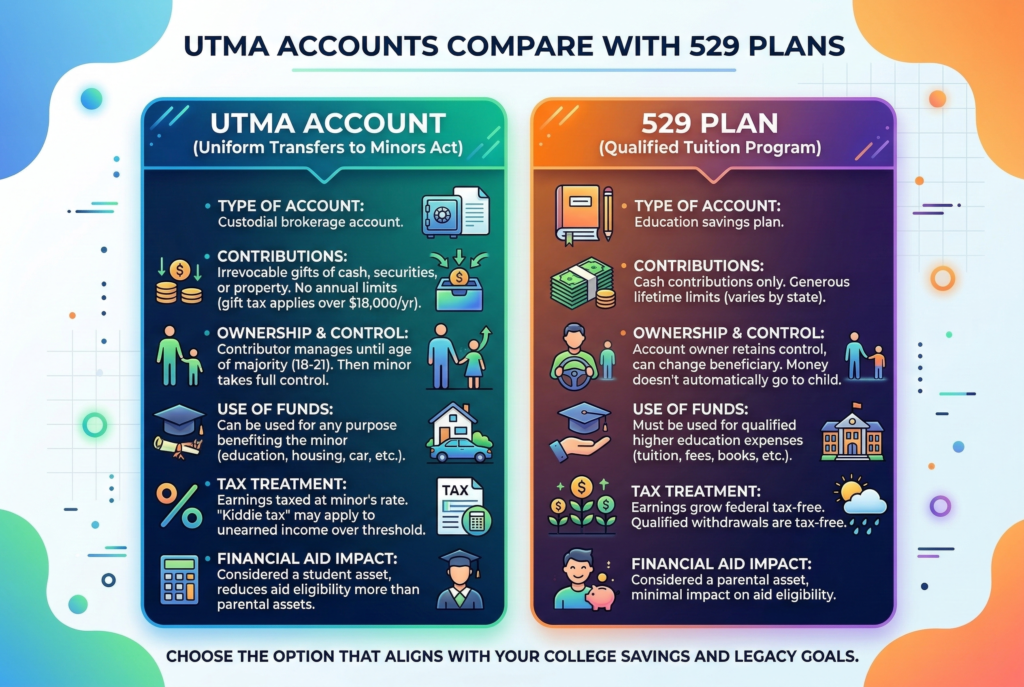
UTMA accounts and 529 plans are both popular tools for helping a child financially, but they serve different purposes.
A UTMA account is broader. The money belongs to the child and can eventually be used for nearly any lawful purpose that benefits them. That makes it more flexible. A 529 plan is narrower but offers education-focused tax advantages. Investor.gov explains that 529 plans are intended to encourage saving for future education costs.
In simple terms, a UTMA may fit families who want versatility, while a 529 may fit families who are primarily focused on future education expenses. Some households use both, keeping college savings in a 529 and broader child savings in a UTMA.
Gift Tax and Contribution Basics
Contributions to a UTMA account are gifts to the child. The IRS says gift tax rules apply to transfers of property, though the person making the gift, not the recipient, is generally the one who may have reporting responsibility if thresholds are exceeded.
For 2025, IRS Form 709 instructions state that the annual exclusion is $19,000 per donee. That means many contributors can give up to that amount to one child in 2025 without needing to file a gift tax return, assuming the gift otherwise qualifies. That doesn’t mean every family should aim for the maximum. The better approach is contributing an amount that fits your own financial plan while staying aware that the money is no longer yours once gifted.
When a UTMA Account Makes Sense

A UTMA account can be a strong choice when you want to give a child a financial head start and you value flexibility over restrictions. It may make sense if you’re comfortable with the child eventually taking full control, want a relatively simple setup, and may use the funds for more than education alone. It may be less appealing if you want tighter long-term control, significant tax planning, or a structure designed around one very specific goal.
Before opening one, it’s wise to review your state’s UTMA age rules, understand the tax implications, and think through how the account fits alongside other savings tools like 529 plans, regular brokerage accounts, or trusts. Because UTMA rules vary by state, the exact age when the child takes control can differ.
Conclusion
A UTMA account is a practical custodial account that allows adults to transfer money and other assets to a child while keeping management in adult hands until the child reaches the applicable age under state law. It can help build savings for a child’s future with more flexibility than education-only accounts, and it may be a good fit for families who want a simple, versatile way to invest on a child’s behalf.
Still, flexibility comes with tradeoffs. The assets become the child’s property, taxes may apply to earnings, and control eventually shifts to the beneficiary. For many families, that makes a UTMA account a useful part of a broader savings strategy rather than a one-size-fits-all solution. When used thoughtfully, it can be a meaningful way to support a child’s future and give them a stronger financial starting point.
Related Articles
Saving for Kids with UGMA or UTMA: Which Account Should You Choose?