
Making $20 an hour sounds simple until you turn it into rent, groceries, gas, insurance, taxes, and savings. The clean math says one thing. Real life says another because hourly income can feel very different once real monthly expenses enter the picture.
So, 20 dollars an hour is how much a year? If you work full time for 40 hours a week and get paid for all 52 weeks, your gross annual income is $41,600 before taxes. But if you take unpaid time off, your realistic yearly income may be closer to $40,000. That difference matters when every paycheck already has a job before it arrives.
The Paid vs. Unpaid Reality
There are two honest ways to calculate yearly income from hourly pay. The standard work year uses 2,080 hours, which equals 40 hours per week multiplied by 52 weeks. Under this method, $20 × 2,080 = $41,600 per year. However, unpaid vacation, sick days, or reduced schedules can lower real annual earnings.
The realistic unpaid-time year uses 2,000 hours. That assumes you work 50 paid weeks and take two unpaid weeks for illness, holidays, family needs, or vacation. Under this method, $20 × 2,000 = $40,000 per year. This is why hourly workers without paid time off should never rely only on the highest annual number.
$20 an Hour Pay Breakdown
| Pay Period | Gross Pay |
| Daily 8 hours | $160 |
| Weekly 40 hours | $800 |
| Biweekly 80 hours | $1,600 |
| Monthly average | $3,466 |
| Annual 52 paid weeks | $41,600 |
| Annual 50 paid weeks | $40,000 |
These are gross numbers before taxes, insurance deductions, retirement contributions, or other paycheck reductions. The most common calculation for annual income for 20 an hour assumes full time hours without extended unpaid leave.
$20 an Hour After Taxes
You don’t live on gross income. You live on take home pay. A rough estimate after federal taxes, FICA, and possible state taxes is around 20% in deductions for many workers, though the exact number depends on your location, filing status, dependents, and benefits. Using that estimate, $41,600 becomes roughly $33,280 after taxes. That equals about $2,773 per month, $1,280 biweekly, or $640 weekly. While how much a year is 20 dollars an hour sounds simple mathematically, your actual paycheck can vary significantly depending on insurance costs, retirement contributions, and local tax rates.
Can You Live on $20 an Hour in 2026?
You can live on $20 an hour in some places, but it depends heavily on location and housing. In lower-cost towns, rural areas, and some Midwest or Southern markets, $20 an hour can support a modest lifestyle if debt is low and rent is reasonable.
In expensive metro areas, it gets tight quickly. If rent alone takes more than 30% of your gross income, you may become rent-burdened. At $20 an hour, that means solo rent above roughly $1,040 per month can already strain the budget before utilities, transportation, food, insurance, and savings. For many workers, $20 an hour is livable with roommates, a paid-off car, low debt, or a second household income. It’s much harder with children, high rent, student loans, medical expenses, or no benefits.
The 50/30/20 Budget on $20 an Hour
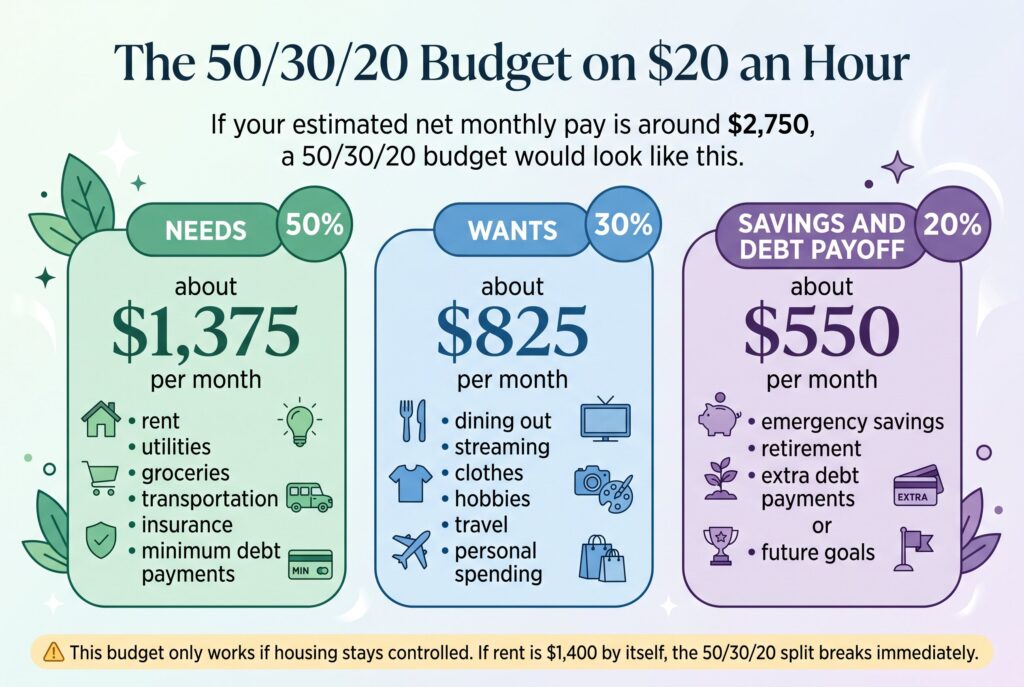
If your estimated net monthly pay is around $2,750, a 50/30/20 budget would look like this.
- Needs: about $1,375 per month for rent, utilities, groceries, transportation, insurance, and minimum debt payments.
- Wants: about $825 per month for dining out, streaming, clothes, hobbies, travel, and personal spending.
- Savings and debt payoff: about $550 per month for emergency savings, retirement, extra debt payments, or future goals.
This budget only works if housing stays controlled. If rent is $1,400 by itself, the 50/30/20 split breaks immediately.
Jobs That Pay $20 an Hour in 2026
Many jobs now pay close to $20 per hour without requiring a four year degree. Common examples include warehouse associates, delivery drivers, customer service representatives, medical assistants, hotel supervisors, skilled retail workers, and bank tellers. People researching how much is 20 dollars an hour annually are often comparing these positions while deciding whether the income is enough for their local cost of living. The strongest jobs are not always the ones with the highest hourly pay alone. Stable schedules, overtime opportunities, benefits, paid time off, and career growth often matter just as much.
How to Increase Your $41,600 Annual Income
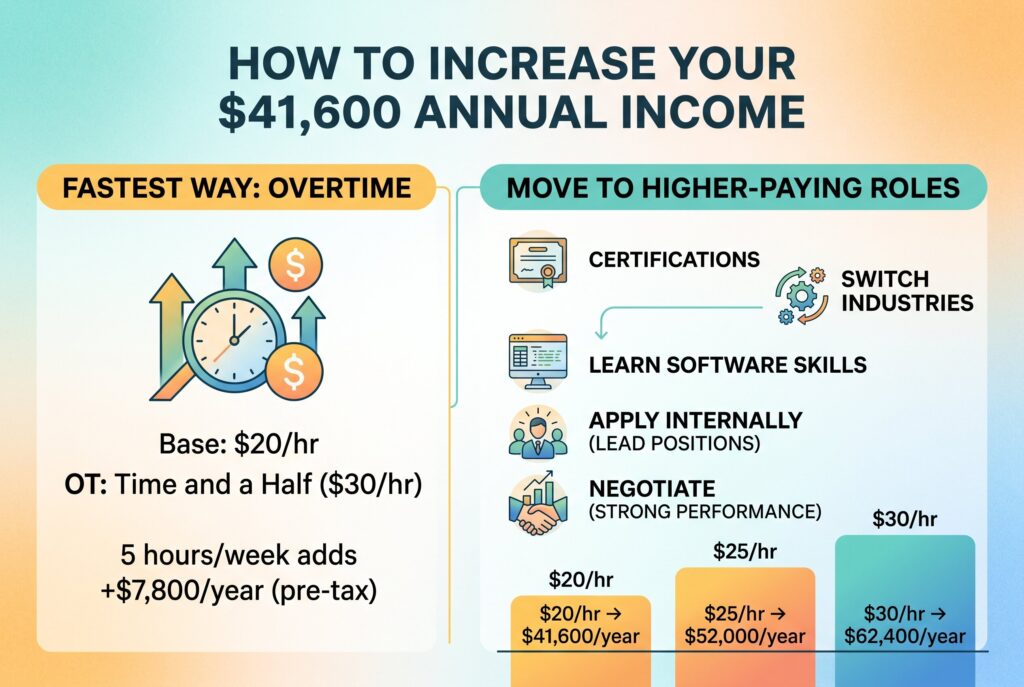
The fastest way to raise income is overtime. If you are eligible for time and a half, your $20 base rate becomes $30 an hour for overtime. Just five overtime hours per week at $30 adds about $7,800 per year before taxes.
You can also move toward higher-paying roles by getting certifications, switching industries, learning basic software skills, applying internally for lead positions, or negotiating after strong performance. Moving from $20 to $25 an hour raises full-time gross income from $41,600 to $52,000. Moving to $30 an hour raises it to $62,400.
Final Thoughts
So, if you earn $20 an hour, the base calculation is roughly $41,600 annually before taxes for a full time schedule. But income alone never tells the full story. Your actual financial comfort depends on rent, debt, taxes, healthcare costs, overtime availability, and overall cost of living.