
The decision to install solar panels on your home can be a major financial commitment, but it can also provide significant long-term savings. One of the best ways to reduce the upfront cost of solar energy systems is by taking advantage of the Federal Solar Tax Credit, also known as the Investment Tax Credit (ITC). This credit can save homeowners thousands of dollars, making solar energy more accessible and affordable. But how does the credit work, and how can you benefit from it?
In this article, we’ll break down everything you need to know about the Solar Tax Credit, explain how it works, and guide you through the process of claiming it. By the end of this article, you’ll have a complete understanding of how the Federal ITC can help lower your solar installation costs and why you should act now before the credit decreases in future years.
What Is the Solar Tax Credit (ITC)?
The Solar Tax Credit is a federal program that allows homeowners to reduce their tax liability by a percentage of the cost of installing a solar energy system. The program was designed to encourage the adoption of clean energy sources by making it more affordable for homeowners to switch to solar power. Essentially, the tax credit reduces the overall cost of installation by allowing you to claim a deduction on your federal income tax return.
As of 2024, the credit is 30% of the total installation cost of your solar system. This means that if your solar installation costs $20,000, you could receive a $6,000 tax credit, significantly lowering the amount you owe in federal taxes for that year.
In addition to solar panels, the ITC also covers other essential parts of a solar energy system, such as inverters, solar batteries, and other necessary components that make up the entire system. This helps to bring down the overall cost of installation, making solar power more accessible for homeowners.
How Does the Solar Tax Credit (ITC) Work?
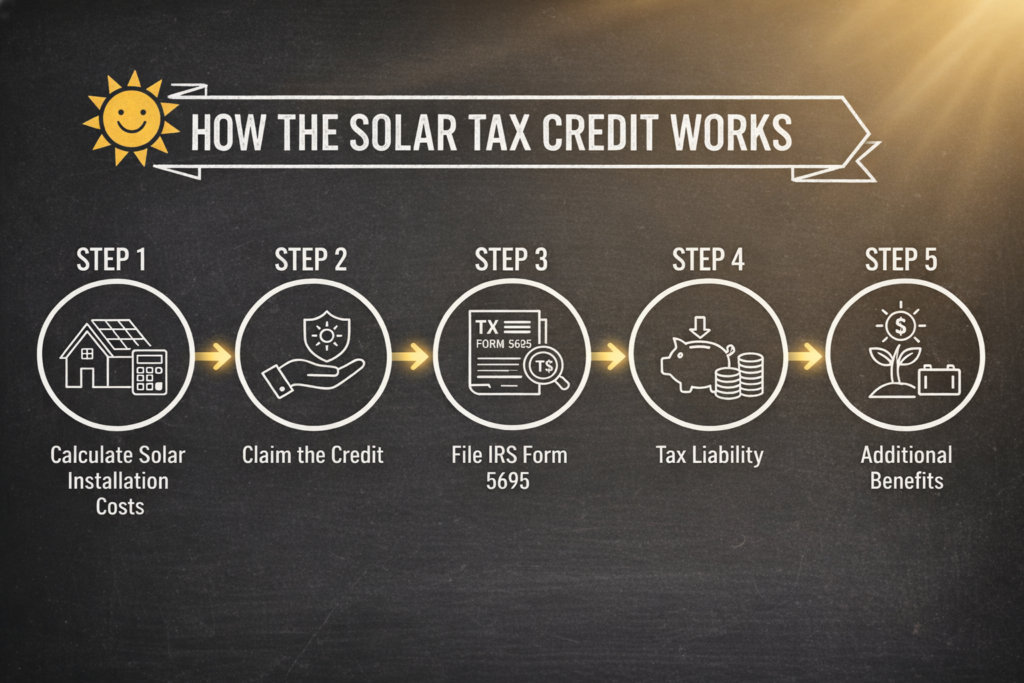
Step 1: Calculate Your Solar Installation Costs
The first step is to determine how much your solar system will cost, including all associated expenses like materials, labor, permits, and any additional features such as battery storage. This total cost is the basis for the tax credit.
Step 2: Claim the Credit
Once you know the total cost of your solar system, you can apply 30% of that cost as a tax credit. This amount is subtracted from the amount of taxes you owe. For instance, if your system costs $15,000, you can deduct $4,500 from your federal tax bill.
Step 3: File IRS Form 5695
To claim the Solar Tax Credit, you’ll need to fill out IRS Form 5695, which is part of your federal tax return. This form helps you calculate the amount of the credit and apply it to your tax liability.
Step 4: Tax Liability
If your tax bill is smaller than the credit you’re entitled to, you may not be able to use the entire amount in that year. The good news is that you can carry over the remaining credit to future tax years. This ensures you don’t lose out on any portion of the credit.
Step 5: Additional Benefits
If you’re installing solar energy storage (such as a solar battery), the costs of the battery system can also be covered by the credit. This is an important benefit, especially for homeowners who want to store excess energy for later use.
Eligibility for the Solar Tax Credit (ITC)

To qualify for the Solar Tax Credit, you must meet the following criteria:
Ownership of the Property
The solar system must be installed on a home you own. The credit isn’t available if you lease your solar equipment or rent your property.
Installation
The system must be installed before December 31, 2024, to qualify for the 30% credit. After 2024, the credit will begin to phase down, so it’s a good idea to act quickly if you want to take advantage of the full 30% rate.
Qualified Equipment
The solar system must meet certain technical specifications. The equipment must be certified and meet local code requirements. Solar panels, inverters, and battery storage are eligible for the credit, but roof repairs or improvements not directly related to the system aren’t covered.
Principal or Secondary Residence
The home must be your primary residence or a secondary residence where the solar system is being installed. This includes homes that are owned by the taxpayer, and it doesn’t require the homeowner to live in the home full-time.
What Costs Does the Solar Tax Credit Cover?

The Solar Tax Credit covers a broad range of costs related to your solar installation. These include:
- Solar panels: The solar panels themselves are covered by the ITC, which accounts for the largest part of the installation cost.
- Inverters: Inverters that convert the solar energy into usable electricity are also eligible.
- Battery storage: Costs for solar batteries that store excess energy for use during the night or during power outages are eligible for the credit. This is a growing trend, as more homeowners are opting for storage to maximize the benefits of their solar systems.
- Installation labor: The cost of labor involved in installing the solar system, including electricians and contractors, can be deducted as part of the total installation cost.
- Permits and inspection fees: Any fees associated with obtaining permits or inspections required for your solar installation are eligible for the credit.
The total eligible cost can add up, especially for larger homes or systems that include battery storage. By covering these costs, the ITC significantly reduces the amount of money you need to spend on solar installation.
How to Claim the Solar Tax Credit
- Track your solar installation costs: Keep all receipts, invoices, and contracts for the installation, as these will be necessary for claiming the credit.
- File IRS form 5695: This form is part of your tax return and calculates the exact amount of the credit you can claim. It’s essential for ensuring the credit is applied to your taxes.
- Claim your credit: The amount of the credit is deducted directly from your tax bill. If your tax liability is less than the credit, you can carry over the remaining credit to the following tax year.
- Consult a tax professional: While claiming the ITC is straightforward, working with a tax professional can help ensure that you’re maximizing your benefits and following all applicable tax laws, especially if you have other complex tax situations or business deductions.
What Happens After 2024?
The Solar Tax Credit is set to phase down starting in 2025. After the 30% credit expires in 2024, the credit will decrease to 26% for installations in 2025, and then 22% in 2026. After 2026, the credit will be eliminated for residential installations, although it may still apply for commercial projects.
This makes it essential for homeowners to act sooner rather than later if they want to take advantage of the full 30% credit. As the tax credit decreases, so does the financial benefit of installing solar systems, making now the best time to invest in solar energy.
Final Thoughts: Take Advantage of the Solar Tax Credit Now

The Federal Solar Tax Credit is a great opportunity to lower the cost of installing solar panels on your home and make the switch to clean energy. With the full 30% tax credit available for installations completed before the end of 2024, now is the best time to take action.
By following the steps outlined above, you can maximize the savings on your solar installation and enjoy the long-term benefits of reduced energy costs. Whether you’re looking to reduce your environmental footprint, save on electricity bills, or gain energy independence, the Solar Tax Credit is a powerful tool that can make your solar investment more affordable than ever.