


Understanding how investments grow over time is crucial for financial planning, and one of the simplest ways to estimate how long it will take for an investment to double is by using the Rule of 72. This formula offers investors an easy method to calculate investment growth over the long term, especially in stocks, ETFs, and other assets where compound interest plays a significant role. In this article, we’ll dive into the Rule of 72 definition, explore its real-world applications, and discuss how you can use it for stocks and ETFs.
What is the Rule of 72 Definition?
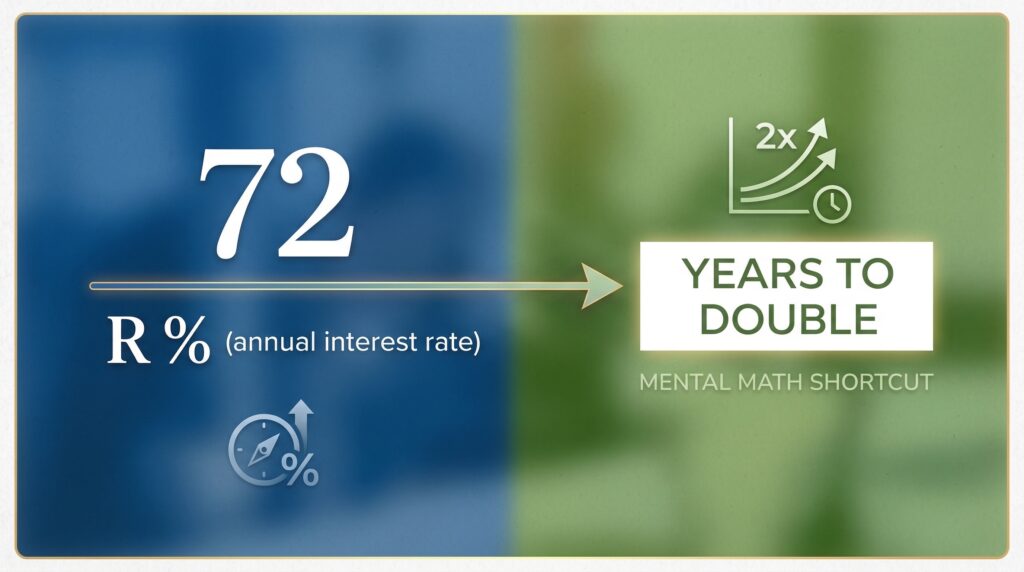
The Rule of 72 is a financial formula used to estimate how long it will take for an investment to double, given a fixed rate of return. It works by dividing 72 by the annual rate of return (expressed as a percentage).
For example, if the rate of return on your investment is 6%, the formula would be:
This means that it’ll take approximately 12 years for your money to double at a 6% rate of return. The Rule of 72 is a quick estimation tool, particularly helpful for long-term investment planning in assets like stocks, ETFs, and even mutual funds.
How to Use the Rule of 72 for Doubling Time Calculation
To calculate the time it’ll take to double your investment, simply divide 72 by the rate of return. The doubling time formula is incredibly easy to use, making it a popular choice among investors looking for quick estimates without the need for complex calculations.
How to Double Your Money with the Rule of 72
If you’re wondering how to double your money, the Rule of 72 is an excellent tool for estimating the time required for your investments to grow. It can be applied to a variety of investments, including stocks, ETFs, and index funds. For example, if you invest in stocks with an average rate of return of 8%, the Rule of 72 suggests that it will take approximately 9 years to double your investment.
The Rule of 72 is especially useful for those investing in index funds or ETFs, where the returns are generally more stable. These types of investments often offer long-term growth potential with a more consistent rate of return, making them ideal for doubling your money in the long run.

Applying the Rule of 72 to the Stock Market
The Rule of 72 is widely used in stock market investments, providing an easy way to gauge how long it will take for a stock or portfolio to double in value based on expected rate of return. Stocks, with their higher returns but also increased market volatility, can benefit from the Rule of 72 for long-term growth projections.
Example with S&P 500 Average Return
The S&P 500, a widely-followed stock market index, has historically offered an average annual return of about 7% to 10% after adjusting for inflation. This makes the Rule of 72 highly applicable when estimating how long it will take for investments in the stock market to double.
For example, with an 8% rate of return, the Rule of 72 would tell you:
This means that your S&P 500 investment would double in approximately 9 years at an 8% average return.
Dividend Stocks vs. Growth Stocks
When applying the Rule of 72 to stocks, it’s important to understand the difference between dividend stocks and growth stocks. Both benefit from the power of compound interest, but their doubling times differ due to their distinct growth strategies. Dividend stocks provide regular payouts that are reinvested, leading to faster growth through compound interest. On the other hand, growth stocks tend to focus more on capital appreciation and are generally more volatile.
When considering ETFs vs individual stocks, it’s important to note that individual stocks can be more volatile and their returns may vary greatly year to year, potentially altering the doubling time. In contrast, ETFs are more stable due to their diversification, making the Rule of 72 more reliable for these investment types.
How the Rule of 72 Works for ETFs
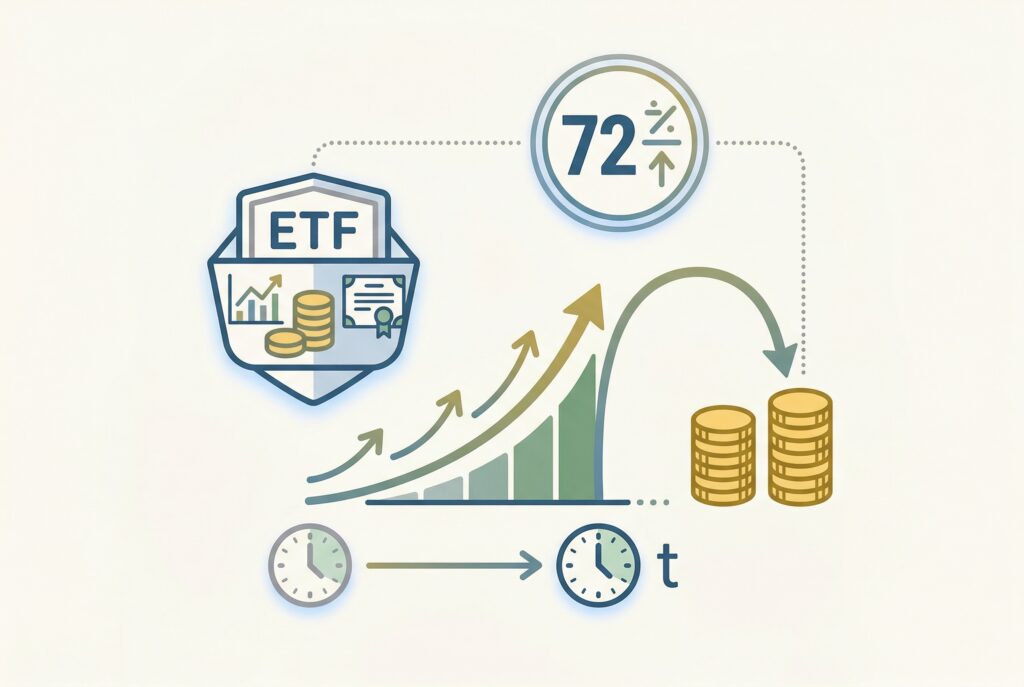
The Rule of 72 is also highly applicable to ETFs (Exchange-Traded Funds), especially those that track indices or follow a specific sector. ETFs provide diversification, which can lead to more stable returns over time compared to individual stocks.
Since ETFs typically offer a consistent rate of return over the long term, the Rule of 72 works effectively for investors looking for reliable estimates of their portfolio’s growth.
Why ETFs Are Ideal for the Rule of 72
Unlike individual stocks, which can experience wild fluctuations, ETFs are generally more stable due to their diversification. As such, the Rule of 72 can offer a more reliable estimate of the doubling time for ETFs, especially those that track broad market indices like the S&P 500.
For example, if you’re investing in an S&P 500 ETF with an average annual return of 7%, using the Rule of 72 gives you the following estimate:
So, it’ll take about 10.29 years for your ETF investment to double at a 7% return.
The Reality Check: Market Volatility and Inflation
While the Rule of 72 provides a quick and useful estimate, it’s important to acknowledge its limitations. The formula assumes a fixed rate of return, which doesn’t account for the market volatility that can significantly impact stocks and ETFs over time.
Market Volatility
Stock market volatility is one of the key factors that can affect the doubling time. The Rule of 72 is based on the assumption of consistent growth, but in reality, stocks and ETFs can see periods of rapid growth followed by declines. For example, the stock market may return 20% one year and lose 15% the next. This fluctuation can distort the accuracy of the Rule of 72 in short-term investments.
Inflation and Its Impact
Inflation is another factor the Rule of 72 doesn’t account for. Even though your investment may double in nominal terms, inflation can erode the purchasing power of that doubled amount. Over the long term, inflation can significantly reduce the real value of your returns, meaning your investment’s value may not be as impressive as it seems.

FAQs About the Rule of 72 in Investing
Is the Rule of 72 accurate for day trading?
No, the Rule of 72 is not suitable for day trading. This formula is best used for long-term investments that offer stable rates of return. Day trading involves high volatility and short-term fluctuations, which makes it inappropriate for this type of calculation.
Can I use the Rule of 72 for cryptocurrencies?
Cryptocurrencies are highly volatile and don’t follow stable growth patterns, making the Rule of 72 unsuitable for predicting the doubling time of cryptocurrency investments. The crypto market experiences significant fluctuations, which makes this formula ineffective for such assets.
Conclusion & Next Steps
The Rule of 72 is a fantastic tool for estimating how long it will take for your investments in stocks and ETFs to double. It’s easy to use and offers a quick way to understand investment growth over time. However, always remember that factors like market volatility, inflation, and taxes can impact the accuracy of this formula.
If you’re ready to apply the Rule of 72 to your own investment portfolio, we recommend using our Rule of 72 calculator to see how your investments can grow based on your expected rate of return.

