



What is equity? In the simplest sense, equity means ownership value. The equity meaning changes slightly depending on context, but the core idea stays the same: it’s what you own after subtracting what you owe. In investing, equities are shares of ownership in a company. When you buy equities, you aren’t lending money like a bondholder. You are buying a small piece of a business, with the chance to benefit if that business grows.
The Universal Meaning of Equity
Equity is a broad finance term. In business, it can mean ownership value. In real estate, it can mean the part of your home you truly own. In investing, it usually means stocks or shares.
A simple definition is:
Equity = Assets − Liabilities
If a business owns $500,000 in assets and owes $200,000 in liabilities, the owners equity is $300,000. That is the remaining ownership value after debts are removed. This basic equity formula is useful because it explains why equity is connected to both ownership and risk. Equity holders benefit from growth, but they also stand behind creditors if things go wrong.
Equity in Other Financial Contexts
Owners Equity and Accounting
What is equity in accounting? It’s the owner’s claim on a company’s assets after liabilities are paid. On a balance sheet, this may appear as shareholders’ equity, stockholders’ equity, retained earnings, or book value. For a small business owner, owners equity shows how much value remains in the business after debts. For investors, it helps show whether a company is financially strong or heavily burdened by liabilities.
Home, Brand, and Private Equity
Home equity is the difference between your home’s market value and your mortgage balance. If your home is worth $400,000 and you owe $250,000, your home equity is $150,000.
Brand equity is less physical. It refers to the value a company gains from reputation, trust, customer loyalty, and recognition. Private equity refers to ownership in companies that aren’t publicly traded. These investments are usually available to institutions or wealthy investors and often involve buying, restructuring, or growing private businesses.
What Are Equities in Investing?

What are equities? In investing, equities are stocks or shares issued by a company. When you buy a stock, you own a fraction of that company. If the company performs well, your shares may rise in value. If the company struggles, your shares may fall. This is why equity investments are powerful but risky. They offer long-term growth potential, but their value can move sharply in the short term. Stock prices respond to earnings, interest rates, economic conditions, investor sentiment, competition, and company news.
How Equity Investors Make Money
Dividends
Some companies share profits with shareholders through dividends. A dividend is a cash payment, usually paid quarterly, although not every company pays one. Mature, profitable businesses are more likely to pay dividends, while fast-growing companies may reinvest profits instead. Dividends can provide income, but they aren’t guaranteed. A company can reduce or stop dividends if profits weaken.
Capital Gains
Capital gains happen when you sell an equity investment for more than you paid. If you buy a stock at $50 and sell it at $80, your gain is $30 per share before taxes and fees. Capital gains are a major reason investors buy equities. Over long periods, successful companies can grow revenue, profits, and market value, which may push share prices higher.
Equities vs Fixed Income
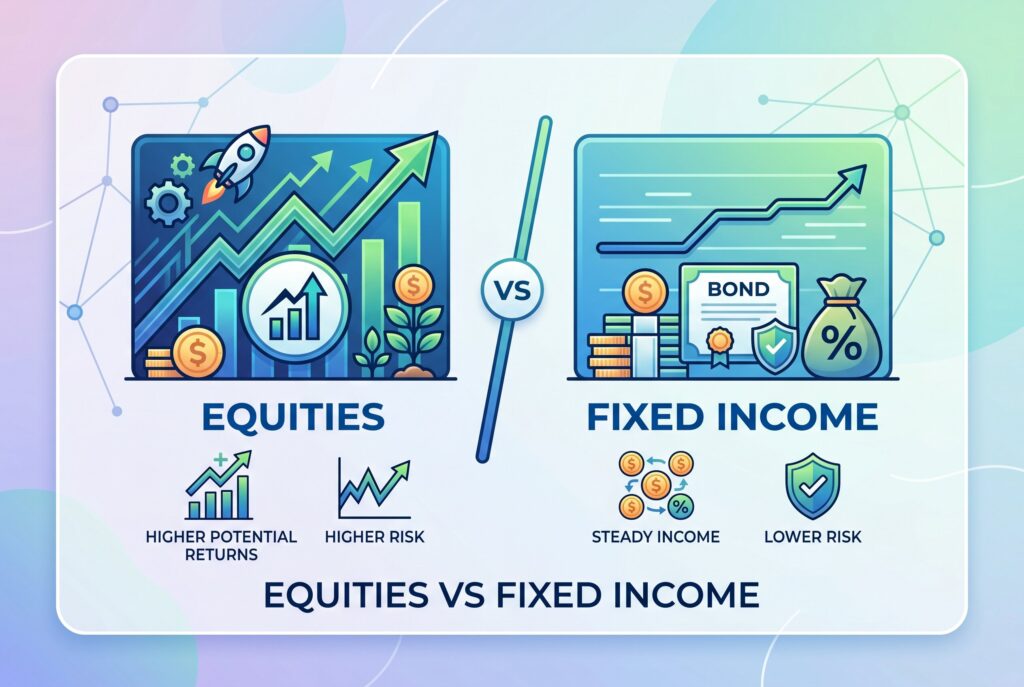
Equities represent ownership. Bonds represent debt. When you buy a bond, you are lending money to a company or government. In return, you usually receive interest and expect repayment at maturity. When you buy equities, you become an owner. There is no guaranteed repayment, but the upside can be much larger. Equities usually have higher long-term growth potential than bonds, but they also bring more volatility. Bonds may provide more stability and income, while equities may drive portfolio growth. Many investors use both.
Key Investing Concepts for 2026 Beginners
Market Value of Equity
Market value of equity is the total stock market value of a company. It’s often called market capitalization, or market cap.
Formula:
Market Value of Equity = Share Price × Shares Outstanding
If a company has 100 million shares and each share trades at $20, the market value of equity is $2 billion. Market cap helps investors understand company size. Large-cap companies are usually more established. Small-cap companies may have more growth potential but often carry more risk.
Investment Risk and Reward
Equities can build wealth, but they don’t move in a straight line. A strong company can still drop during a market correction. A popular stock can become overpriced. A weak business can destroy shareholder value. The reward for accepting this uncertainty is the possibility of higher long-term returns. That is why equities are often used for goals that are years away, such as retirement, education savings, or long-term wealth building.
Beginners shouldn’t treat equity trading like a shortcut to quick money. Short-term trading requires skill, discipline, and risk control. Long-term investing is usually more forgiving because it gives good businesses time to grow.
How to Get Started With Equity Investments
Individual Stocks
Buying individual stocks gives you direct ownership in specific companies. This can be exciting because you can choose businesses you understand and believe in. The downside is concentration risk. If you own only a few stocks and one performs badly, your portfolio can suffer. Individual stock investing requires research into earnings, debt, valuation, competition, management, and industry trends.
Equity Funds
Equity funds include mutual funds and ETFs that hold many stocks at once. This gives beginners instant diversification. Instead of betting on one company, you can own a basket of companies across industries or even the entire market. For many beginners, equity funds are the cleaner starting point. They reduce single-company risk and make portfolio building simpler.
Your First Equity Purchase
Start by opening a brokerage account. Then decide whether you want individual stocks, equity ETFs, mutual funds, or a mix. Next, choose how much of your portfolio should go into equities based on your age, goals, time horizon, and risk tolerance. A younger investor saving for retirement may hold more equities because they have time to recover from downturns. Someone near retirement may prefer a more balanced mix with bonds and cash.
Conclusion
Equity means ownership value. In investing, equities are stocks or shares that give you ownership in a company. They can create wealth through dividends and capital gains, but they also carry risk because prices can rise and fall.
The smartest beginner approach is to understand the basics first, then invest gradually. Learn the equity formula, understand market value of equity, compare equities with bonds, and consider diversified equity funds before jumping into individual stock picking. Equities aren’t magic. They are ownership. When you invest in them thoughtfully, you give your money a chance to grow alongside real businesses.

