
In finance, asset management means professionally managing investment portfolios such as stocks, bonds, ETFs, real estate funds, and alternative investments for clients. In operations, asset management means tracking and maintaining physical assets such as equipment, buildings, vehicles, and machinery to reduce downtime and control costs. This guide focuses mainly on financial asset management, but it also explains how asset management solutions and software support both financial portfolios and physical assets.
The Two Meanings of Asset Management
Asset management always starts with the same goal: protect and grow the value of assets over time.
In financial asset management, the asset is capital. Investors give money to an asset manager or asset management firm, and that manager builds a portfolio designed to meet a specific objective. That objective may be income, growth, capital preservation, inflation protection, or long term retirement funding.
In operational asset management, the asset is physical. A company may need to manage HVAC systems, delivery vehicles, manufacturing machines, IT hardware, medical equipment, or retail store fixtures. The goal isn’t investment return in the stock market. It’s reliability, safety, maintenance efficiency, and lower total cost of ownership.
Both meanings matter because modern businesses often need both. A pension fund must manage financial capital, while a hospital must manage both investment reserves and expensive equipment.
The Role of a Financial Asset Manager: What Do They Actually Do?

A financial asset manager doesn’t simply buy and sell stocks. The role is much broader and more disciplined.
Asset Allocation
Asset allocation determines how capital is distributed across asset classes such as stocks, bonds, cash, real estate, commodities, and alternative investments. It plays a major role in shaping a portfolio’s overall risk and return profile.
Risk Assessment
Asset managers evaluate how portfolios may perform under different market conditions, including recessions, inflation, interest rate changes, currency fluctuations, and market downturns. The goal is to balance potential returns with acceptable levels of risk.
Portfolio Construction
Portfolio construction involves selecting and combining securities, funds, sectors, regions, and strategies into a cohesive investment framework. A well-constructed portfolio is designed to work as an integrated system rather than a collection of individual investments.
Monitoring and Rebalancing
Because markets constantly change, portfolios can drift away from their target allocations. Monitoring and rebalancing help maintain the desired risk level and investment objectives over time.
Client Communication and Reporting
Asset managers regularly communicate portfolio performance, risks, fees, and strategic updates to clients or investment committees, ensuring transparency and informed decision-making.
Active vs Passive Management
One of the biggest debates in asset management is active vs passive management.
Active management means the manager tries to beat a benchmark through research, security selection, market timing, or tactical positioning. For example, an active equity manager may try to outperform the S&P 500 by selecting better companies. Passive management means the portfolio tracks an index at low cost. Instead of trying to beat the market, it aims to match market performance efficiently.
Neither approach is perfect. Active management can add value, but fees are higher and outperformance isn’t guaranteed. Passive management is cheaper and transparent, but it won’t protect investors from broad market declines. Many investors now use both. They may hold low cost index funds for core exposure and use active strategies in less efficient markets.
Top Asset Management Firm Examples
To understand the difference between Active Management and Passive Management, it helps to look at some of the world’s largest asset managers as case studies.
BlackRock is often associated with both approaches. Through its iShares ETF business, it is one of the largest providers of passive investment products, while also managing actively managed portfolios for institutional and individual investors.
Vanguard is widely known as a pioneer of passive investing. Its low-cost index funds and ETFs are designed to track market indexes rather than attempt to outperform them through active security selection.
Fidelity Investments provides a useful example of a firm with a strong active management heritage. Many of its mutual funds rely on portfolio managers and research teams to select investments and seek returns above benchmark indexes, although the company also offers index funds and ETFs.
State Street Global Advisors (SSGA), another major global asset manager, is best known for its SPDR ETF lineup and large-scale passive investment strategies.
These firms illustrate how asset management companies can differ in their strategic focus. Some place greater emphasis on passive investing, where portfolios aim to replicate market performance through index tracking. Others have traditionally emphasized active investing, where investment professionals make decisions intended to outperform a benchmark. In practice, many of the world’s largest asset managers operate across both approaches, but their histories and product offerings often highlight different philosophies within the asset management industry.
Asset and Wealth Management: Breaking Down the Difference
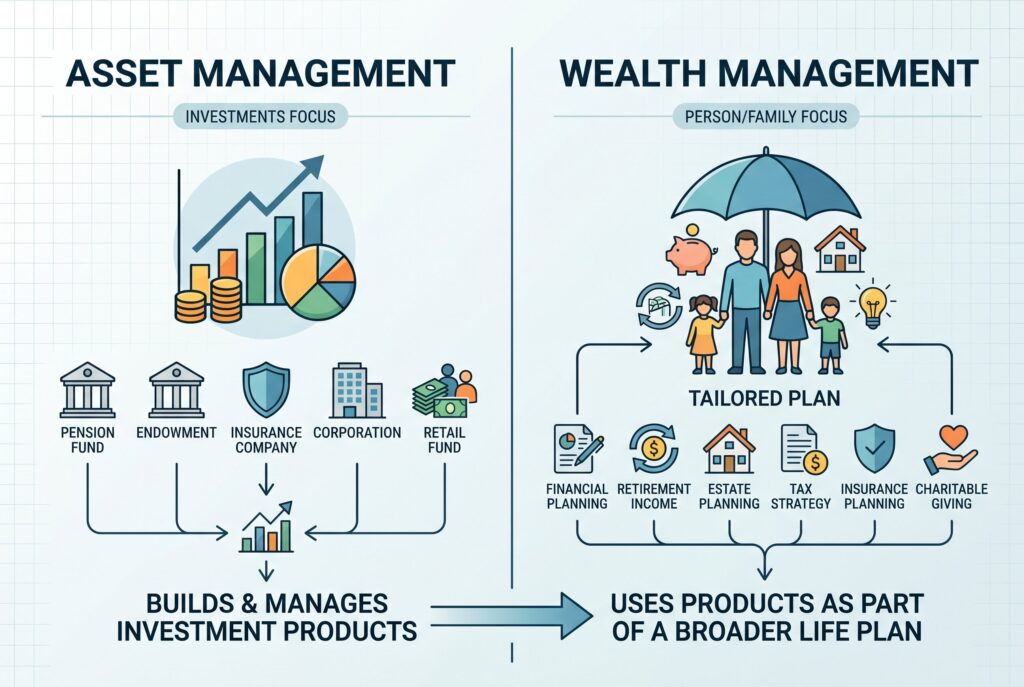
- Asset Management focuses on investing capital and managing investment portfolios for institutions or investors.
- Wealth Management takes a broader approach, helping individuals and families with investments, financial planning, retirement, taxes, estate planning, and other personal financial goals.
In short, the difference between asset and wealth management is: asset management manages investments, while wealth management integrates those investments into an overall financial strategy.
Modern Asset Management Solutions and Software
Technology plays a central role in modern asset management. In financial services, portfolio management platforms help automate reporting, portfolio analysis, rebalancing, compliance, and performance tracking. Common functions include risk modeling, account aggregation, trade management, and client reporting. For physical assets, organizations often use CMMS and EAM systems to manage asset records, preventive maintenance, work orders, inspections, and equipment performance. The required technology varies by asset type. Financial firms focus on portfolio analytics, while facilities, manufacturers, and healthcare organizations prioritize maintenance, lifecycle management, and compliance tracking.
Why Asset Management Matters
Asset management matters because unmanaged assets lose value.
- In finance, poor asset management can expose investors to unnecessary risk, high fees, weak diversification, and emotional decision making. Over decades, those mistakes can cost huge amounts of wealth.
- In operations, poor asset management creates downtime, emergency repairs, safety problems, duplicate purchases, and shortened equipment life.
Good asset management creates discipline. It turns assets from passive holdings into actively managed sources of value.
Conclusion
Asset management is the structured process of maximizing value while controlling risk. In finance, it means managing investment portfolios for individuals, institutions, and funds. In operations, it means tracking and maintaining physical assets across their lifecycle.
The strongest asset managers combine strategy, data, risk control, and clear execution. The best asset management solutions do the same through software, automation, reporting, and disciplined workflows. Whether you’re managing a billion dollar portfolio or a fleet of machines, the principle is the same: know what you own, understand the risks, measure performance, and make each asset work harder for the future.