


When people ask what is an efficiency ratio, they often run into two different meanings. In banking, the efficiency ratio is one specific metric that shows how much operating expense a bank spends to generate revenue. Lower is better. In regular businesses, efficiency ratios are a family of activity ratios that measure how well a company uses inventory, receivables, payables, working capital, and assets to produce sales. So, a good score depends entirely on context. A bank wants a lower expense to revenue ratio. A retailer wants fast inventory turnover. A manufacturer wants strong asset utilization without starving operations.
Part 1: The Bank Efficiency Ratio
For banks and financial institutions, the bank efficiency ratio answers one practical question:
How many cents does the bank spend to earn one dollar of revenue?
The efficiency ratio formula for banking is:
Efficiency Ratio = Noninterest Expense RevenueNoninterest expense includes salaries, branch rent, technology costs, marketing, compliance, professional fees, and administrative overhead. It doesn’t include interest paid to depositors or bondholders.
Revenue usually includes net interest income plus noninterest income. Net interest income comes from lending activity after funding costs. Noninterest income may include service fees, card fees, wealth management fees, trading income, and other operating revenue.
For example, if a bank has $300 million in noninterest expense and $600 million in revenue:
Efficiency Ratio = $300 million ÷ $600 million = 50%
This means the bank spends 50 cents to generate each dollar of revenue.
What Is a Good Score for a Bank?
For efficiency ratio banking, lower is generally better.
- A ratio below 50% is often considered excellent. It suggests the bank is lean, scalable, and able to convert revenue into profit efficiently.
- A ratio between 50% and 60% is usually acceptable for many banks, especially community banks or institutions investing heavily in growth.
- A ratio above 65% can become a warning sign. It may indicate bloated overhead, weak revenue generation, underused branches, high staffing costs, or outdated systems.
However, don’t judge the number alone. A bank investing in digital transformation may temporarily carry higher expenses. A community bank with relationship heavy service may naturally run less lean than a large national bank. The trend and peer comparison matter as much as the headline figure.
Part 2: Business Efficiency Ratios
For non-bank businesses, efficiency ratios aren’t one number. They’re a set of operating metrics that show how effectively a company turns resources into revenue and cash. These ratios are especially useful for CFOs, controllers, investors, lenders, and business owners because they reveal where cash gets stuck inside the operating cycle.
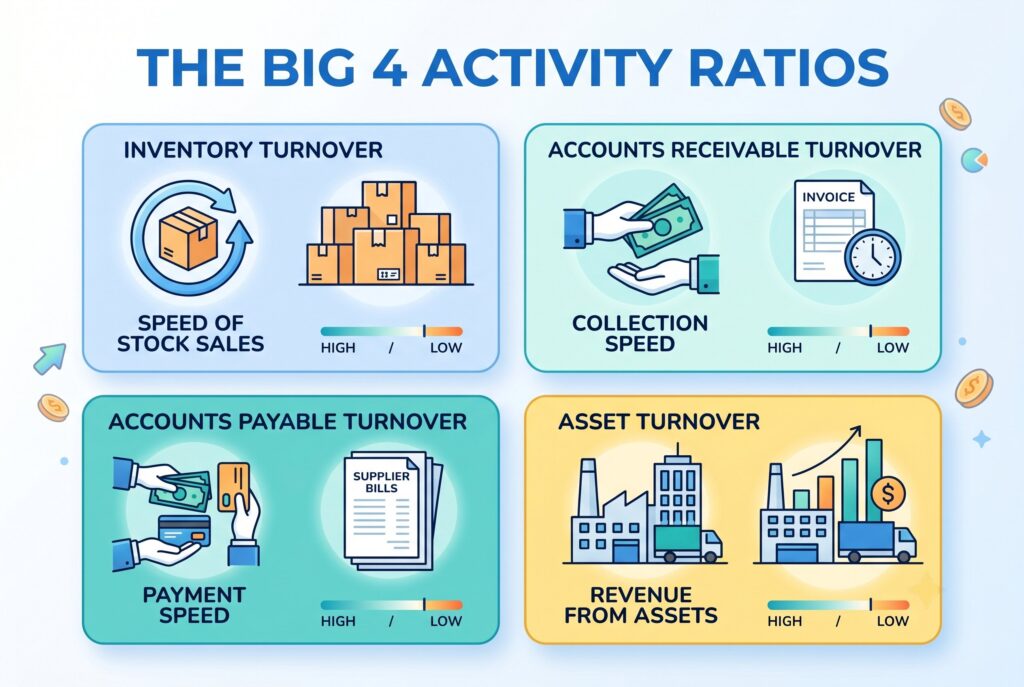
1. Inventory Turnover
Inventory turnover measures how many times a company sells and replaces inventory during a period.
Inventory Turnover = Cost of Goods Sold Average InventoryA higher ratio usually means products are selling quickly and cash isn’t trapped in slow moving stock. A low ratio may suggest excess inventory, weak demand, poor forecasting, or obsolete goods. But high isn’t always good. If inventory turnover is too high, the company may be understocked and losing sales. A grocery chain may need very high turnover. A heavy machinery business may operate well with a much lower ratio because products are expensive and sales cycles are longer.
2. Accounts Receivable Turnover
Accounts receivable turnover measures how quickly a company collects cash from customers.
Accounts Receivable Turnover = Net Credit Sales Average Accounts ReceivableA high ratio means customers are paying quickly. That supports liquidity, reduces credit risk, and improves cash flow. A low ratio may mean customers are delaying payments, credit terms are too loose, or the collections process isn’t strong enough. This ratio matters because revenue on paper isn’t the same as cash in the bank. A company can look profitable and still run into trouble if receivables pile up.
3. Accounts Payable Turnover
Accounts payable turnover measures how quickly a company pays suppliers.
Accounts Payable Turnover = Supplier Purchases Average Accounts PayableA very high ratio may mean the company pays suppliers quickly, which can preserve relationships and capture early payment discounts. A very low ratio may suggest the company is stretching payables to conserve cash. That can help short term liquidity, but it may also damage supplier trust or signal cash stress. The best answer depends on negotiating power, supplier terms, and cash strategy.
4. Asset Turnover
Asset turnover measures how much revenue a company generates for each dollar of assets.
Asset Turnover = Net Sales Average Total AssetsA higher asset turnover ratio usually means the company uses assets efficiently to produce sales. This ratio is especially useful when comparing businesses in the same industry. A retailer may naturally have higher asset turnover than a utility company because utilities require huge infrastructure investments.
Operating Efficiency vs Profitability
Efficiency ratios don’t directly measure profit. They measure activity and resource use. A company can have strong inventory turnover but weak margins. Another company can have slower turnover but excellent pricing power. That is why efficiency ratios should be read alongside gross margin, operating margin, return on assets, return on equity, free cash flow, and working capital trends. Efficiency tells you how fast the machine runs. Profitability tells you whether the machine actually creates value.
The CFO Playbook: How to Improve a Bad Score
If inventory turnover is too low, the business may have too much cash trapped in stock. Management can improve demand forecasting, reduce overordering, discount obsolete inventory, renegotiate supplier lead times, or adopt just in time inventory practices.
If accounts receivable turnover is too low, customers are using the company as a free lender. Management can tighten credit policies, shorten payment terms, automate invoicing, follow up faster, offer early payment discounts, or use factoring for selected receivables.
If accounts payable turnover is too high, the company may be paying suppliers faster than necessary. Management can negotiate longer terms while still protecting supplier relationships.
If asset turnover is weak, the company may own underused assets. Management can sell idle equipment, outsource noncore activities, improve capacity utilization, or close underperforming locations.
If a bank efficiency ratio is too high, leadership may need to reduce branch costs, automate manual processes, improve digital adoption, increase noninterest income, or redesign staffing models.
Conclusion
The efficiency ratio is powerful because it shows how well a business converts resources into revenue. In banking, it measures overhead discipline against revenue. In operating companies, efficiency ratios reveal how quickly inventory, receivables, payables, and assets move through the business.
There is no single score that is considered good for every company. What looks strong for one business may be weak for another, depending on the industry, operating model, growth stage, and management strategy. That is why effective analysis goes beyond simply calculating a ratio. It focuses on understanding what caused the number to change, whether competitors are experiencing similar trends, and what actions management can take to improve performance going forward.
