



What is annual revenue? Annual revenue meaning is simple: it is the total money a business brings in over a 12-month period before expenses are deducted. Lenders and investors don’t only want to know your monthly sales. They want a clear view of your annual business revenue so they can judge size, stability, loan eligibility, and growth potential.
How To Calculate Annual Revenue: Formulas By Industry
The total revenue formula depends on how your business earns money. The basic revenue equation is still simple: price multiplied by quantity.
For retail or ecommerce:
Annual Revenue = Total Units Sold In A Year × Average Selling Price
If an online store sells 8,000 products at an average price of $60, annual revenue is $480,000.
For a service business:
Annual Revenue = Total Billable Hours In A Year × Hourly Rate
If a consultant bills 1,200 hours at $150 per hour, annual revenue is $180,000.
For SaaS or subscription companies:
Annual Revenue = Monthly Recurring Revenue × 12
If a software company has $50,000 in monthly recurring revenue, its annual revenue is $600,000. In subscription businesses, this is often called Annual Recurring Revenue, or ARR.
This is how to calculate total revenue clearly: identify what you sell, count how much you sold over 12 months, then multiply by the price.
Gross Vs. Net Annual Revenue: What’s The Difference?

Gross annual revenue is every dollar collected from sales before deductions. It shows the largest view of business activity. Net revenue is different. Net annual revenue equals gross revenue minus customer refunds, product returns, discounts, and allowances. It doesn’t subtract operating expenses like rent, payroll, software, taxes, or marketing. For example, if a retailer has $500,000 in gross annual revenue but gives $20,000 in refunds and $10,000 in discounts, net annual revenue is $470,000. Net revenue isn’t the same as net profit. Net revenue adjusts sales. Net profit subtracts all business expenses.
Annual Revenue Vs. Profit: The Ultimate Trap

Revenue vs profit is one of the most important business comparisons. Revenue proves customers are buying. Profit proves the business model is sustainable. A company can earn $1 million in total revenue and still lose money. If its expenses are $1.1 million, the company has a $100,000 loss. The top line may look impressive, but the bottom line shows trouble.
So how does revenue affect profit? Revenue creates the opportunity for profit, but costs decide how much money survives. Higher sales can improve profit if margins are healthy. But if discounts, shipping, labor, or advertising costs rise too fast, profit can shrink even while annual revenue grows. That is why founders should track revenue and profit together.
Cash Vs. Accrual Accounting: When Does Revenue Count?
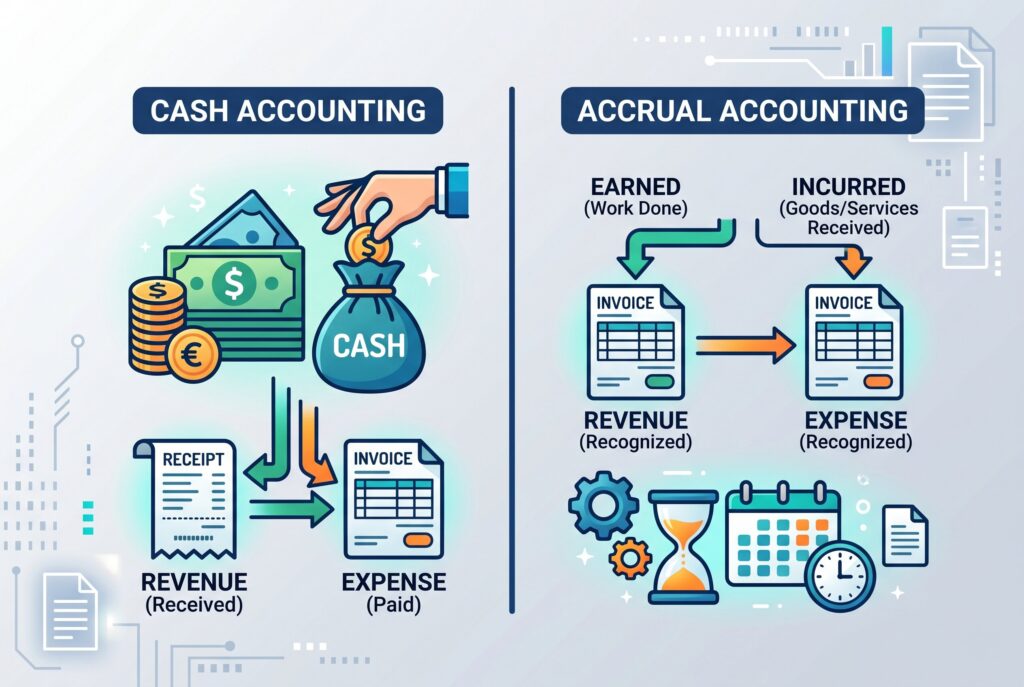
Revenue timing depends on the accounting method. Under cash accounting, revenue is counted when money is received. Underaccrual accounting, revenue is counted when it is earned. Suppose you close a $12,000 contract in December 2026, complete the work that month, but the client pays in January 2027. Under accrual accounting, the revenue belongs to 2026 because the work was earned in December. Under cash accounting, it belongs to 2027 because the cash arrived in January.
This distinction matters for taxes, reporting, investor updates, and lender documents. A business with delayed invoices may have strong revenue but weak cash flow. A business with prepaid subscriptions may have strong cash flow but must recognize revenue over time.
What Is Revenue In Business?
What is revenue in business? It is the money generated by selling products or services before expenses are deducted. It usually appears at the top of the income statement, which is why people call it the top line. Annual business revenue helps answer basic questions: Is demand growing? Are sales channels working? Is pricing strong enough? Is the company large enough for a loan, investor round, or expansion plan? Still, revenue shouldn’t be judged alone. Strong annual revenue with poor margins can hide financial risk. Weak revenue with strong profit margins may show a smaller but healthier business.
Why Investors And Lenders Care About Annual Revenue

Investors use annual revenue to estimate scale and market traction. A company with growing annual revenue may appear more attractive because it shows customers are consistently buying. Lenders use annual revenue to judge repayment capacity. If a business wants a loan, banks may review annual revenue, cash flow, profit margin, debt obligations, and tax returns. Revenue alone isn’t enough, but it is one of the first numbers they check. For founders, annual revenue also supports forecasting. It helps with hiring plans, inventory purchases, marketing budgets, and expansion decisions.
Conclusion
Annual revenue is one of the clearest ways to measure business scale. It tells you how much money came in over a 12-month period before expenses. But annual revenue is still a top-line metric. It doesn’t prove the company is profitable, efficient, or safe. These days, founders should use annual revenue to measure growth, but they must also monitor net revenue, profit margins, and cash flow. A business doesn’t survive on impressive sales alone. It survives when those sales turn into sustainable profit.

