
What is revenue in business? Revenue is the total money a company brings in from selling products or services before expenses are deducted. Before a founder can worry about profit, margins, or growth, the business first needs a healthy top line. Understanding what is revenue helps you measure sales performance, compare business models, and avoid confusing money earned with money actually kept.
Revenue Vs. Profit: What’s The Difference?
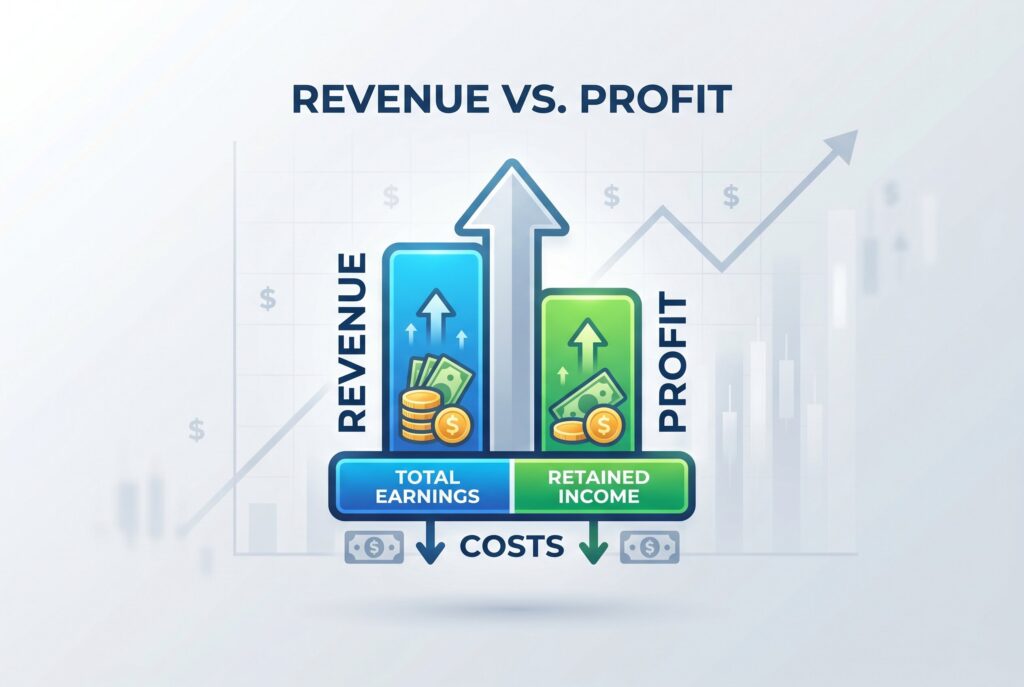
Revenue vs profit is one of the most common business finance questions. Revenue is the total money brought in from sales. Profit is what remains after paying costs, taxes, payroll, rent, marketing, software, shipping, and other operating expenses.
For example, if your store earns $100,000 in revenue but spends $75,000 running the business, your profit is $25,000. Revenue shows business activity, but profit shows financial health. That is why people say revenue is vanity, profit is sanity. A company can have strong sales and still struggle if expenses are too high.
The Revenue And Profit Margin Simulator
A revenue and profit margin simulator helps you see how price, volume, and costs affect the top line and bottom line. If you raise prices but sell fewer units, revenue may rise or fall depending on the change in demand. For example, selling 1,000 units at $50 creates $50,000 in revenue. Selling 800 units at $70 creates $56,000 in revenue. However, profit depends on the cost of producing, delivering, and supporting those sales. This is why founders should not only chase higher revenue. They should test how pricing decisions affect both revenue and profit margin.
The Total Revenue Formula: How To Calculate It
The total revenue formula depends on your business model, but the core logic stays the same: multiply what you sell by the price you charge.
For a product business:
Revenue = Units Sold × Price Per Unit
If an ecommerce shop sells 2,000 candles at $25 each, total revenue is $50,000.
For a service business:
Revenue = Billable Hours × Hourly Rate
If a consultant works 120 billable hours at $150 per hour, revenue is $18,000.
For a SaaS or subscription business:
Annual Revenue = Monthly Recurring Revenue × 12
If a software company earns $40,000 in monthly recurring revenue, its annual revenue is $480,000. This is how to calculate revenue in the simplest way. The key is using the right revenue formula for the way your business actually earns money.
Gross Revenue Vs. Net Revenue
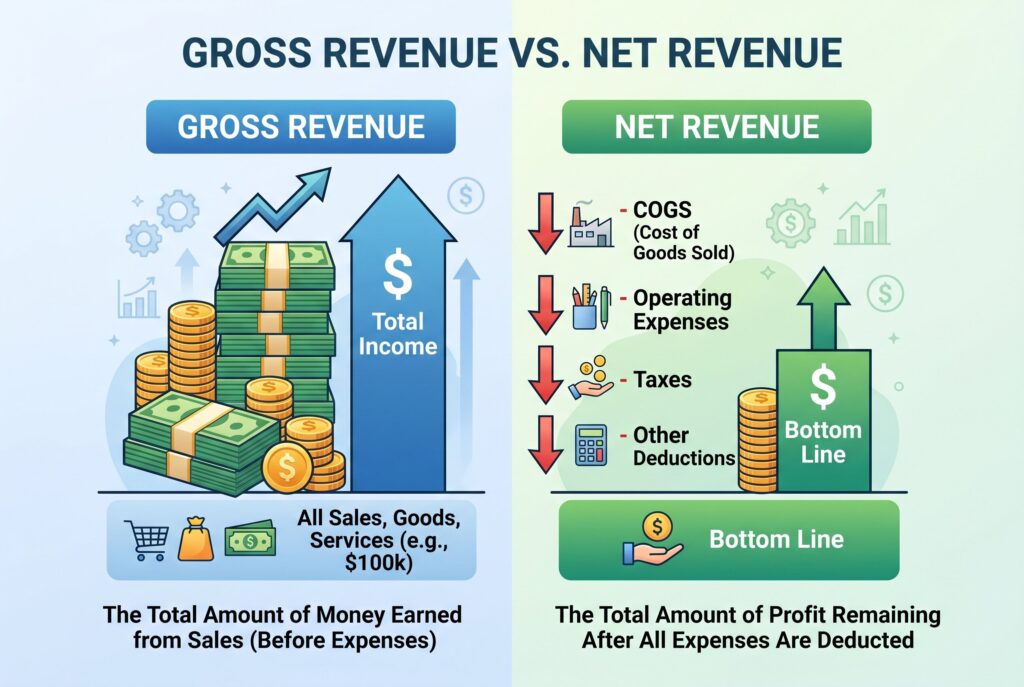
Gross revenue is the absolute total of all sales before deductions. It shows the full sales activity of the business. Net revenue is gross revenue minus returns, refunds, discounts, and allowances. This number is often more useful because it shows the revenue the business actually keeps from customers before expenses. For example, if a clothing brand has $100,000 in gross revenue but issues $8,000 in returns and $2,000 in discounts, its net revenue is $90,000. Net revenue is not the same as profit. Profit comes after subtracting business expenses. Net revenue only adjusts sales for customer-facing deductions.
Revenue Vs. Income Vs. Cash Flow
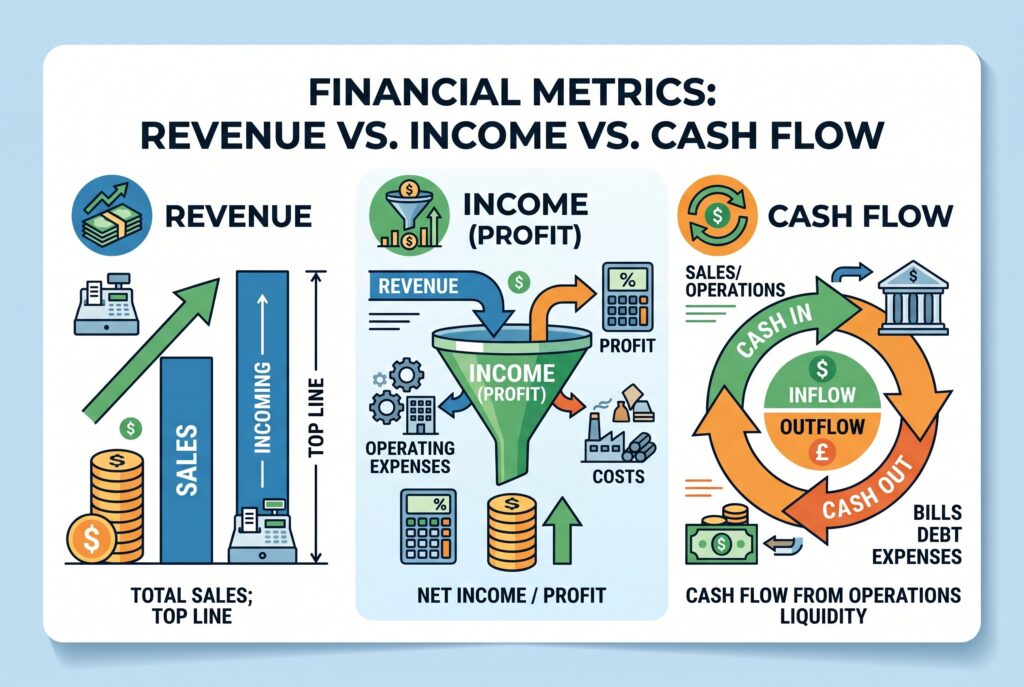
Revenue vs income can be confusing because people use the words loosely. Revenue usually refers to money generated from core business operations. Income often means profit, especially net income, after expenses are deducted.
Income can also include non-operating income, such as interest earned from a bank account or money from selling an old company vehicle. That income may be real, but it doesn’t come from normal sales activity. Cash flow is different again. Cash flow tracks the timing of money entering and leaving the bank account. A business can have high revenue but poor cash flow if customers haven’t paid invoices yet. For example, an agency may complete $30,000 of work in March and record revenue, but if the client pays in May, March cash flow may still be tight. Revenue measures performance. Cash flow measures liquidity.
What Is Annual Revenue? And Why Investors Care
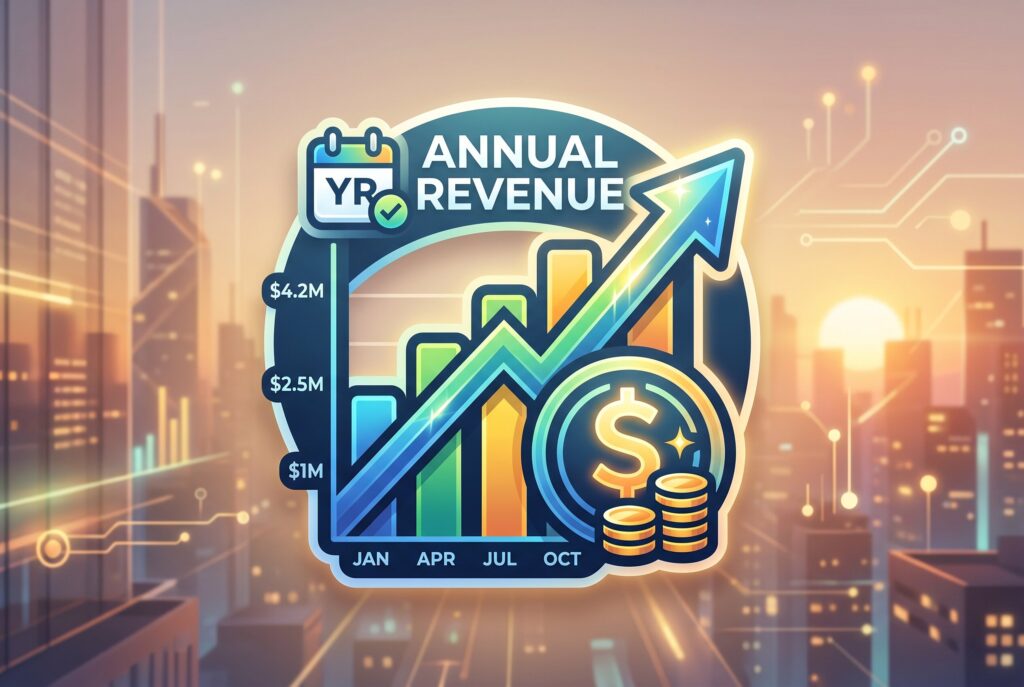
Annual revenue is the total revenue a business generates over a 12-month period. Annual business revenue helps investors, lenders, and owners understand company size, market demand, and growth speed. For startups, annual revenue can influence valuation. A company with growing annual revenue may look more attractive because it shows traction. For lenders, annual revenue helps measure whether the business can support debt payments.
Annual revenue is also useful for planning. It helps businesses set budgets, forecast hiring, compare year-over-year growth, and decide whether a new product line is working. Still, annual revenue should not be viewed alone. Investors often compare revenue with gross margin, profit margin, retention, customer acquisition cost, and cash flow. Strong revenue growth is valuable only when the business model can eventually support sustainable profit.
Conclusion
Revenue is the starting point of business performance. It tells you how much money your company generates before expenses, and it sits at the top of the income statement for a reason. But total revenue is only one part of the story. Business owners should also track net revenue, profit, income, and cash flow. In 2026, the strongest companies will protect their top line while improving pricing, reducing waste, and building revenue that turns into real profit.