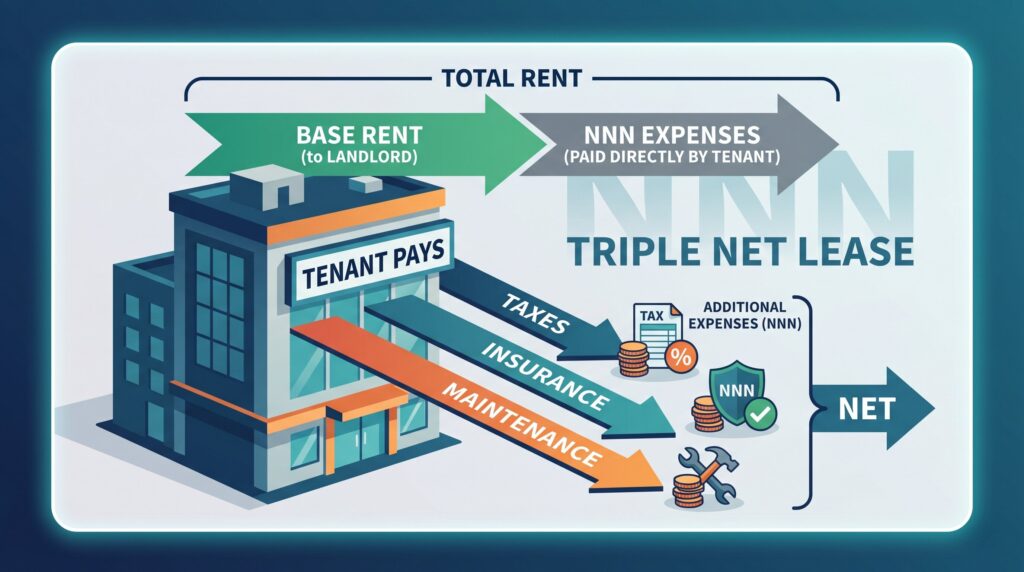
NNN stands for Triple Net, a commercial lease structure where the tenant pays the base rent plus three key property expenses: property taxes, building insurance, and common area maintenance (CAM). The NNN meaning in real estate refers to this “triple net” responsibility, meaning net of taxes, net of insurance, and net of maintenance costs. In other words, most of the ongoing operating expenses are transferred from the landlord to the tenant.
While the triple net lease meaning can seem complex at first, the concept is simple. Tenants often benefit from a lower base rent, but in exchange, they take on a larger share of the property’s expenses. This structure is commonly used in commercial properties such as retail stores, office buildings, and standalone investment properties.
What is a Triple Net NNN Lease? The 3 Nets Explained
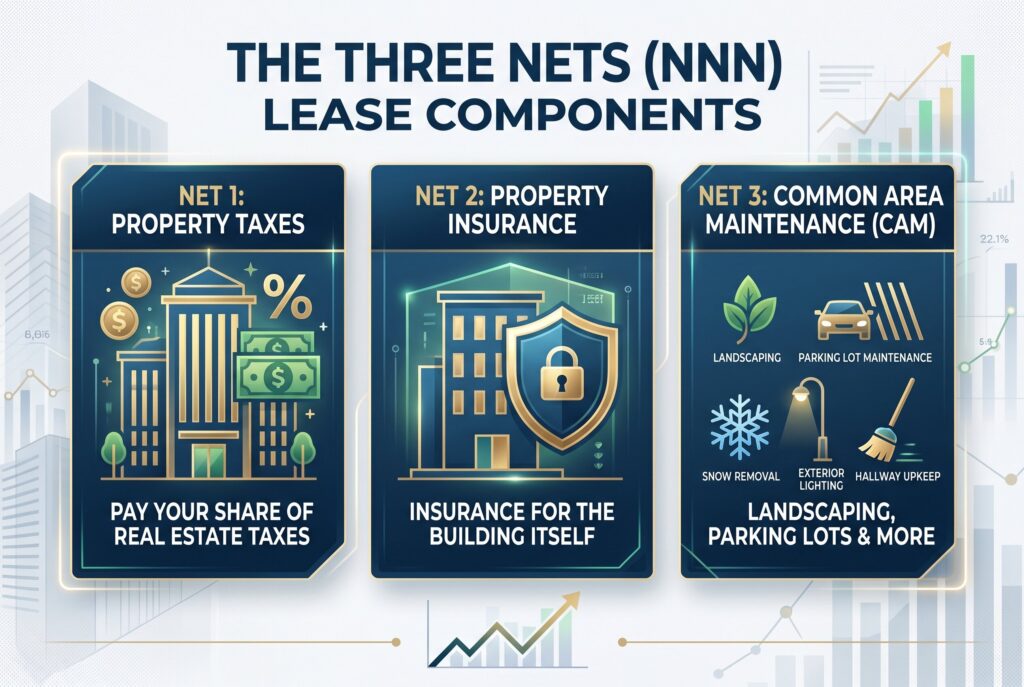
What is a triple net lease? A triple net lease is a commercial lease where the tenant pays rent plus three extra categories of property costs. This is why the NNN lease meaning matters so much before signing. The advertised rent may look low, but the total monthly cost can be much higher once expenses are included.
The first net is property taxes. In many NNN leases, the tenant pays their share of real estate taxes. If the building has multiple tenants, each tenant may pay a pro rata share based on the space they occupy.
The second net is property insurance. This usually refers to insurance for the building itself, not just the tenant’s own business liability policy. Tenants should check exactly what coverage is included and what separate insurance they must carry.
The third net is common area maintenance, often called CAM. CAM may include landscaping, parking lot maintenance, snow removal, exterior lighting, shared hallway upkeep, security, and other property operations. Together, these three nets turn a simple rent number into a full occupancy cost.
Gross Lease vs. NNN Lease Cost Calculator
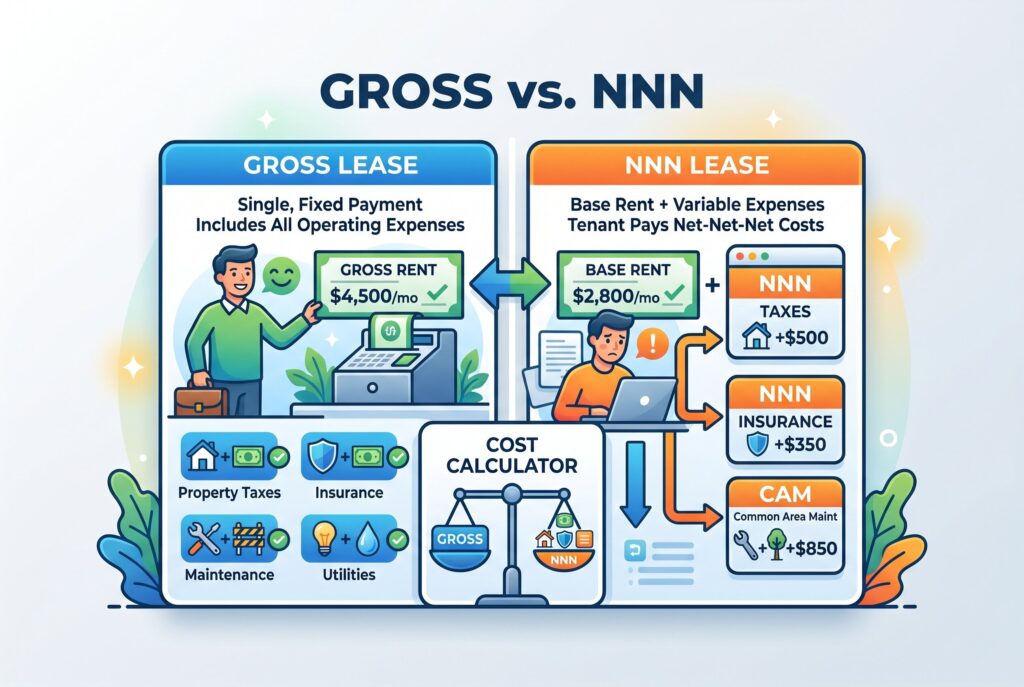
To understand an NNN lease, you need to calculate total monthly rent, not just base rent. For example, imagine a gross lease costs $6,000 per month. That price includes most property expenses, so the tenant pays one predictable amount.
Now compare that with an NNN lease showing only $4,500 in base rent. At first, it looks cheaper. But if monthly property taxes are $700, insurance is $250, and CAM is $900, the real monthly cost becomes $6,350.
That means the “cheaper” NNN lease is actually more expensive than the gross lease. A good calculator should include base rent, square footage, taxes, insurance, CAM, and any estimated annual increases. Without that full calculation, tenants can easily underestimate their budget.
Gross Lease Cost Calculator
Use this calculator to estimate the total cost of a gross lease. In a gross lease, the tenant usually pays one fixed rent amount, while many property expenses are included in the lease structure.
Total Monthly Cost = Monthly Gross Rent + Expected Monthly Increase
Estimated Annual Cost = Total Monthly Cost × 12
Total Lease Term Cost = Total Monthly Cost × Lease Term + One-Time Fees
Average Monthly Cost Including Fees = Total Lease Term Cost ÷ Lease Term
NNN Lease Cost Calculator
Use this calculator to estimate the real cost of a triple net lease. Enter base rent plus pass-through expenses such as property taxes, insurance, CAM charges, utilities, HVAC obligations, and expected increases.
Monthly Pass-Through Expenses = Taxes + Insurance + CAM + Utilities + HVAC
Total Monthly NNN Cost = Base Rent + Pass-Through Expenses + Expected Monthly Increase
Estimated Annual Cost = Total Monthly NNN Cost × 12
Total Lease Term Cost = Total Monthly NNN Cost × Lease Term + One-Time Fees
NNN vs. Gross Lease vs. Modified Gross Lease
Gross Lease
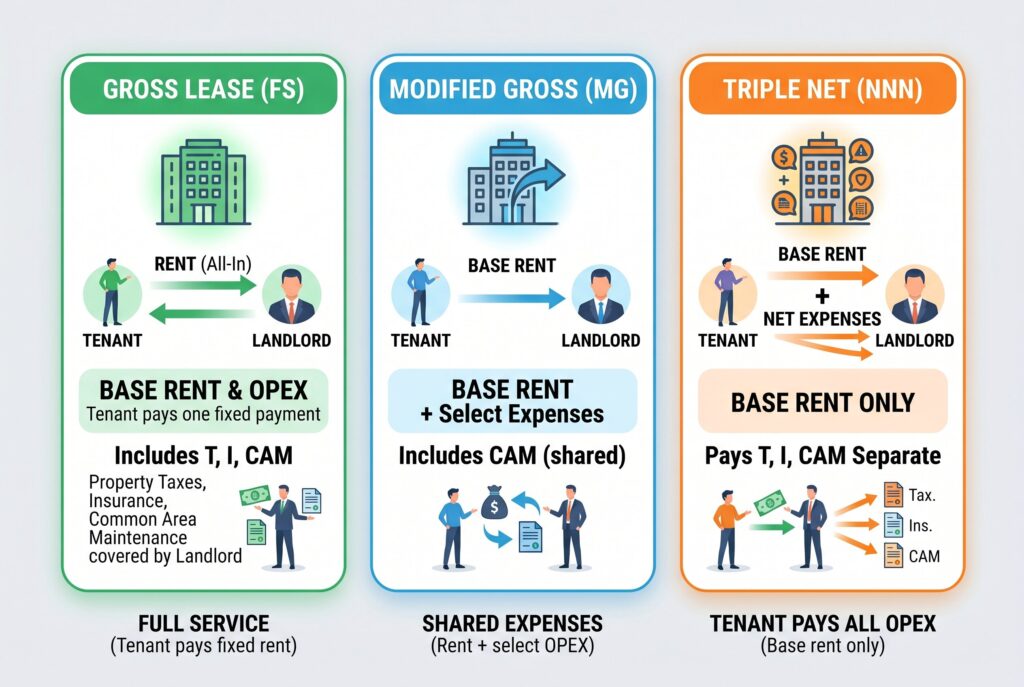
A gross lease is the simplest and most straightforward lease structure. Under this arrangement, the tenant pays a single fixed rent amount, and the landlord is responsible for most, if not all, property-related expenses. These typically include property taxes, insurance, and maintenance costs. Because all major expenses are bundled into one payment, the rent is usually set at a higher level compared to other lease types. However, this structure offers strong cost predictability, allowing tenants to plan their budgets with minimal concern about unexpected increases in operating expenses.
Modified Gross Lease
A modified gross lease represents a middle ground between a gross lease and a net lease. In this structure, the tenant pays a base rent along with certain additional expenses that are agreed upon in the lease terms. These expenses may include utilities, janitorial services, or a portion of the building’s operating costs. The exact division of responsibilities can vary widely depending on the lease agreement, making it essential for tenants to review the contract carefully. This type of lease provides a balance between predictability and cost-sharing, offering more flexibility than a full gross lease while still limiting the tenant’s exposure to some expenses.
Triple Net Lease
A triple net lease, often referred to as an NNN lease, places the majority of financial responsibility on the tenant. In addition to paying base rent, the tenant is required to cover most property operating expenses, including property taxes, insurance, and maintenance costs. These expenses are passed through separately from the base rent, which is why it is categorized as a net lease. While the base rent in a triple net lease is typically lower than in a gross lease, the total cost can fluctuate depending on changes in taxes, insurance premiums, and maintenance requirements. This structure shifts more risk to the tenant, who must be prepared to handle variations in operating expenses over time.
Key Difference and Risk Consideration
The primary difference among these lease types lies in how costs and risks are allocated between the landlord and the tenant. Gross leases offer the highest level of predictability, making them attractive for tenants who prefer stable and consistent expenses. Modified gross leases introduce shared responsibility, creating a more balanced arrangement. Triple net leases, on the other hand, may provide lower base rent but expose tenants to greater financial risk due to variable operating costs. As a result, tenants must carefully evaluate their risk tolerance and financial flexibility when choosing the most suitable lease structure.
Pros and Cons of an NNN Lease
Pros of an NNN Lease
An NNN lease offers several advantages for both landlords and tenants, particularly in terms of financial structure and control. For landlords and investors, one of the biggest benefits is the potential for stable and predictable income. Because tenants are responsible for paying most operating expenses, including property taxes, insurance, and maintenance, the landlord is largely shielded from fluctuations in these costs. This reduces the need for active management and can make the investment feel more passive, especially when the tenant is financially strong and reliable. For tenants, an NNN lease often comes with a lower base rent compared to other lease types, which can make the initial deal more attractive. It also provides greater transparency into the actual costs of operating the property, allowing tenants to better understand where their money is going. In some cases, particularly with single tenant buildings, tenants may gain more control over how the property is maintained and managed.
Cons of an NNN Lease
Despite its advantages, an NNN lease also carries notable risks, particularly related to cost variability and tenant stability. For landlords, the primary concern is tenant risk. If operating expenses such as taxes, insurance, or maintenance increase significantly, a financially weaker tenant may struggle to keep up with the total cost burden, potentially leading to late payments or even default. This means that an NNN lease is not automatically low risk, especially if the tenant’s financial strength is uncertain. For tenants, the main disadvantage is the lack of cost predictability. While the base rent may be lower, the total occupancy cost can fluctuate over time. Property taxes may rise due to reassessments, insurance premiums can increase, and common area maintenance charges may spike following major repairs or upgrades. As a result, a lease that initially appears affordable can become significantly more expensive, creating financial pressure and making long term budgeting more challenging.
3 Crucial Negotiation Traps in a Triple Net Lease
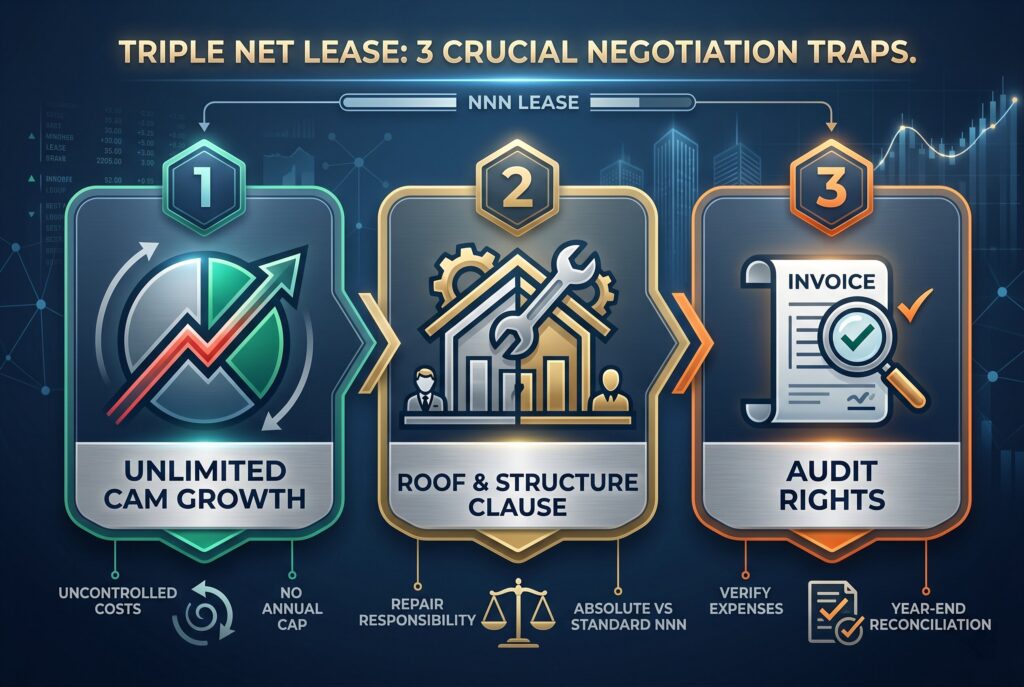
The first trap is unlimited CAM growth. Tenants should try to negotiate a CAM cap, which limits how much maintenance charges can increase year over year. Without a cap, costs may rise faster than expected.
The second trap is the roof and structure clause. In a standard NNN lease, major structural repairs may still belong to the landlord. In an absolute NNN lease, the tenant may be responsible for almost everything, including roof, structure, and major systems. This difference can be expensive, so the lease language needs careful review.
The third trap is audit rights. Tenants should request the right to review actual expense receipts and year end reconciliations. If the landlord estimates expenses at the start of the year, the tenant should be able to verify what was actually spent. These details can make the difference between a manageable lease and a costly surprise.
Conclusion
NNN leases aren’t automatically good or bad. They’re simply more detailed than they look. The base rent is only one part of the total cost. Tenants should calculate taxes, insurance, CAM, caps, exclusions, and structural repair responsibilities before signing. Investors should focus on tenant credit quality, lease terms, and expense pass through language. In commercial real estate, the real question isn’t just “What is the rent?” It’s “Who pays for what, and how much can that cost change over time?”
Related Articles
Commercial Property for Lease: NNN Hidden Costs Business Owners Miss