If you are comparing a job offer, planning a raise, or trying to understand what your paycheck really means, converting salary to hourly pay is the fastest way to see the truth. A $60,000 salary may sound strong, but the real value changes depending on your weekly hours, unpaid time off, overtime, benefits, and taxes. The standard shortcut is simple: full-time work is usually calculated as 40 hours per week for 52 weeks, or 2,080 hours per year. That single number powers most hourly to salary and salary to hourly calculations.
The 2,080-Hour Rule
The 2,080-hour rule assumes you work 40 hours per week for 52 weeks. That means 40 × 52 = 2,080 paid work hours per year.
Hourly to salary formula:
Hourly Wage × 2,080 = Annual Salary
Salary to hourly formula:
Annual Salary ÷ 2,080 = Hourly Wage
This is a gross pay calculation, not take-home pay. It does not subtract federal taxes, state taxes, Social Security, Medicare, health insurance, retirement contributions, or unpaid time off.
Static Pay Conversion Matrix
| Hourly Wage | Daily 8h | Weekly 40h | Biweekly 80h | Monthly Avg | Annually 2,080h |
| $15 | $120 | $600 | $1,200 | $2,600 | $31,200 |
| $18 | $144 | $720 | $1,440 | $3,120 | $37,440 |
| $20 | $160 | $800 | $1,600 | $3,467 | $41,600 |
| $23 | $184 | $920 | $1,840 | $3,987 | $47,840 |
| $25 | $200 | $1,000 | $2,000 | $4,333 | $52,000 |
| $30 | $240 | $1,200 | $2,400 | $5,200 | $62,400 |
| $35 | $280 | $1,400 | $2,800 | $6,067 | $72,800 |
| $40 | $320 | $1,600 | $3,200 | $6,933 | $83,200 |
| $50 | $400 | $2,000 | $4,000 | $8,667 | $104,000 |
How to Convert Salary to Hourly
To convert salary to hourly, divide your annual salary by 2,080. This helps you compare a salaried job to hourly work more honestly. For example, $60,000 a year ÷ 2,080 = $28.85 an hour. A $50,000 salary equals about $24.04 an hour. A $70,000 salary equals about $33.65 an hour. This matters because salary can hide long workweeks. If a $60,000 salaried role regularly requires 50 hours a week, your real hourly value drops.
Salary to Hourly Calculator
Use this calculator to convert annual salary into an hourly wage. The standard calculation divides annual salary by 2,080 hours, which assumes 40 hours per week for 52 weeks per year.
Standard Hourly Rate = Annual Salary ÷ 2,080
Actual Hourly Rate = Annual Salary ÷ (Weekly Hours × 52)
Example:
$60,000 ÷ 2,080 = $28.85 per hour
Salary can sometimes hide long workweeks. If a salaried role consistently requires more than 40 hours per week, the real hourly value of the job may be much lower than expected.
How to Convert Hourly Wage to Annual Salary
To convert hourly wage to annual salary, multiply your hourly rate by 2,080. This assumes full-time work with paid weeks all year. For example, $30 an hour is $62,400 annually. $20 an hour is $41,600 annually. $35 an hour is $72,800 annually. These numbers are before taxes. They are useful for comparing job offers, but they are not the exact amount that will hit your bank account.
What Is Annual Income?

Annual income usually means the total money you earn in one year. Employers often discuss gross annual income, which is your pay before deductions. Net income, also called take-home pay, is what remains after taxes, benefits, insurance premiums, retirement contributions, and other deductions. This is the number that matters most for budgeting rent, groceries, savings, debt payments, and monthly bills.
The Unpaid Reality: Time Off Changes Everything
The 2,080-hour formula works best for W-2 employees who receive paid time off. If you are paid hourly but do not receive paid vacation, sick time, or holidays, your true annual income may be lower. For example, $30 an hour equals $62,400 if you are paid for all 52 weeks. But if you take two unpaid weeks off, you only work 2,000 hours. That makes your annual income $60,000 instead of $62,400. This is especially important for freelancers, contractors, seasonal workers, and part-time employees.
Salaried vs. Hourly: Which Is Better in 2026?
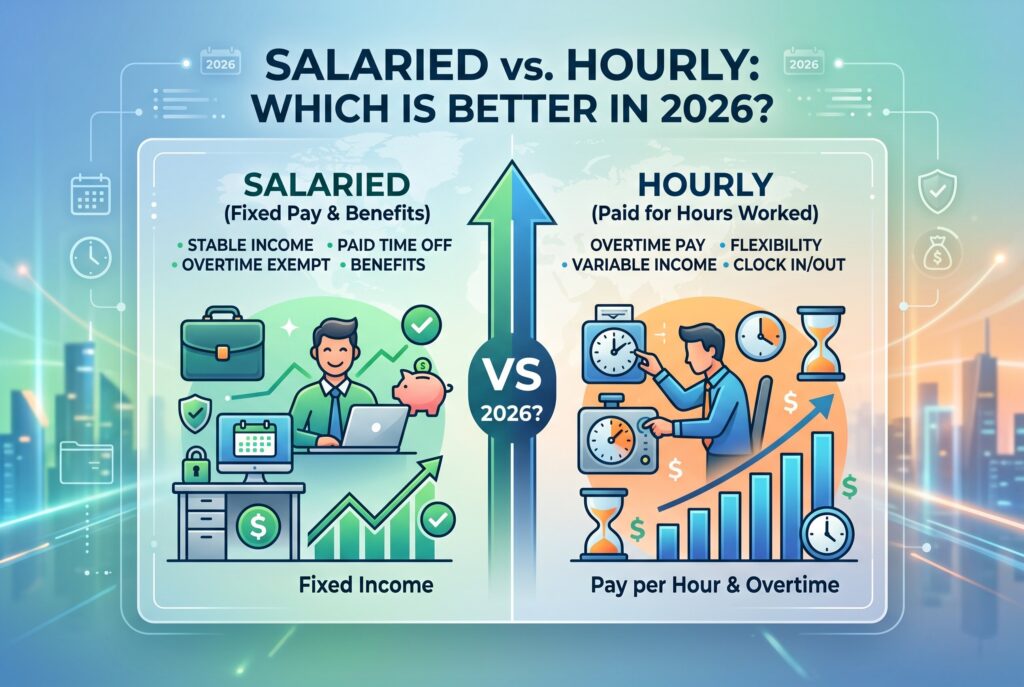
Salaried jobs usually offer predictable income. You may also receive benefits such as health insurance, paid time off, retirement plans, bonuses, and career growth opportunities.
Hourly jobs can be better when overtime is common. Nonexempt hourly workers may receive time-and-a-half when they work more than 40 hours per week, depending on applicable labor rules. The better choice depends on your schedule, benefits, overtime, job stability, and personal priorities. A higher salary isn’t always better if it comes with unpaid overtime and burnout. A lower hourly wage may be stronger if overtime, flexibility, and benefits are solid.
Final Thoughts
A salary to hourly calculator gives you more than a number. It helps you understand the real value of your time. Use 2,080 hours as your starting point, then adjust for unpaid time off, overtime, taxes, and benefits. The smartest career decision isn’t always the offer with the biggest annual number. It is the one that gives you the best balance of income, stability, time, and quality of life.