


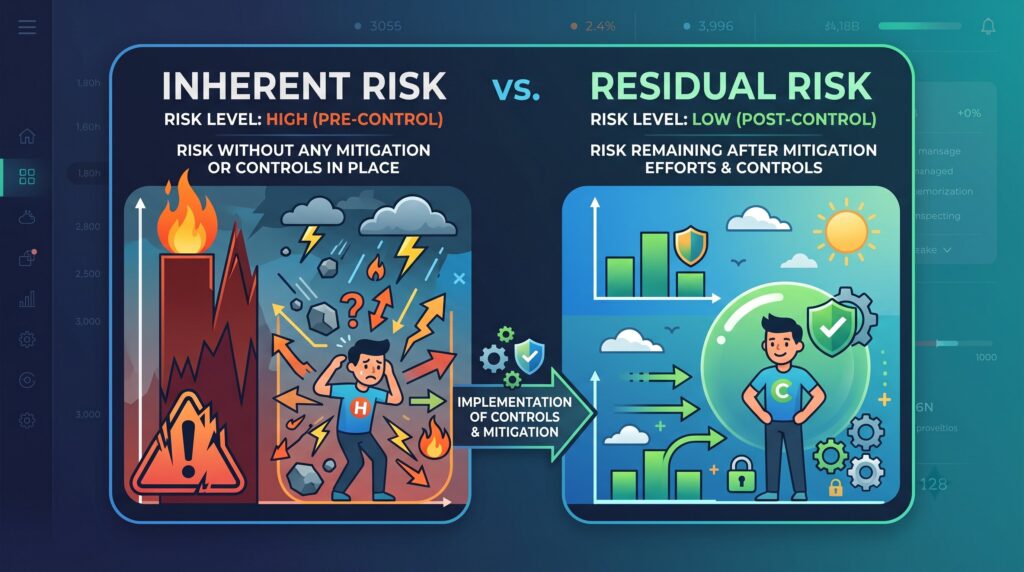
To understand inherent risk vs residual risk, imagine a room full of confidential files. Inherent risk is the danger that exists when the door is wide open, with no lock, no camera, and no guard. Residual risk is the danger that still remains after you install locks, cameras, access cards, and monitoring.
In simple terms, inherent risk is the original exposure before controls. Residual risk is the remaining exposure after security controls, mitigation, and monitoring are applied. The difference matters because no organization can remove risk completely. The real goal of risk management isn’t perfection. It’s knowing how large the gap is, how effective the controls are, and whether the remaining risk fits the company’s risk tolerance.
The Key Differences: A Head to Head Comparison
Inherent risk is the starting point. It answers the question: how bad could this be before we apply protection? Residual risk answers a different question: how much danger is still left after protection is in place? Think about crossing a busy street. The inherent risk is the original danger of stepping into traffic. Looking both ways, waiting for the signal, wearing bright clothing, and using a crosswalk are controls. The residual risk is the remaining chance that a distracted driver still causes harm.
In business, the same logic applies. A company storing sensitive customer data has high inherent risk because the data is valuable. Encryption, access limits, MFA, employee training, and vendor reviews reduce that exposure. Yet residual risk remains because phishing, insider mistakes, misconfiguration, and new attack methods can still bypass controls. The practical difference is timing. Inherent risk is assessed before controls or before additional controls. Residual risk is assessed after controls. Inherent risk helps prioritize what deserves attention. Residual risk helps decide whether the organization is safe enough to proceed.
| Aspect | Inherent Risk | Residual Risk |
| Definition | The level of risk that exists before any controls or safeguards are applied. | The level of risk that remains after controls and safeguards are implemented. |
| Key Question | How bad could this be if nothing were done to reduce the risk? | How much risk remains after protection is in place? |
| Timing | Assessed before controls or before additional controls are introduced. | Assessed after controls have been applied. |
| Purpose | Helps identify and prioritize the most significant threats. | Helps determine whether the remaining risk is acceptable. |
| Example: Crossing a Street | The danger of stepping into traffic. | The remaining chance of harm after using a crosswalk, following signals, and staying visible. |
| Example: Customer Data Storage | The risk associated with holding valuable sensitive customer data. | The remaining risk after encryption, MFA, access controls, training, and vendor reviews are implemented. |
| Influencing Factors | Asset value, threat likelihood, and potential impact. | Control effectiveness, human behavior, system weaknesses, and emerging threats. |
| Typical Use | Risk identification and prioritization. | Risk acceptance, treatment decisions, and ongoing monitoring. |
| Business Value | Highlights where protection is most needed. | Indicates whether the organization can safely operate with the remaining exposure. |
The FAIR Institute Nuance: Is Zero Controls Realistic?
The traditional definition says inherent risk is risk with no controls at all. That sounds clean, but it isn’t always realistic. Most organizations never operate with zero controls. Even a young company usually has passwords, payment approvals, vendor contracts, cloud defaults, insurance, or basic policies. If a risk analyst imagines a completely control free environment, almost every cybersecurity scenario can look catastrophic.
A more practical approach is to define exactly which controls are included in the assessment. In some cases, inherent risk can mean current risk under the existing control environment. Residual risk can then mean the risk level after planned new controls are applied. This distinction is important for GRC teams and CISOs because vague assumptions create bad decisions. If one team defines inherent risk as no controls, while another defines it as current state risk, their scores won’t match. A good risk assessment should clearly state the control assumptions before comparing inherent and residual risk.
The Third Party Trap: Why Residual Risk Never Sleeps
Third party risk management is one of the clearest places to see the gap between inherent risk and residual risk.
Imagine a financial services firm using a cloud storage vendor to hold regulated customer files. The inherent risk is high because the vendor handles sensitive data, supports important operations, and may be subject to strict compliance rules. If that vendor is breached, the financial impact, legal exposure, and reputational damage could be severe. The company may apply strong controls. It may require encryption, MFA, access reviews, audit reports, contract clauses, security questionnaires, and incident notification terms. These controls reduce the risk, but they don’t erase it.
Residual risk still exists. The vendor’s employee may fall for phishing. A subcontractor may introduce a vulnerability. A cloud setting may be misconfigured. A new attacker may exploit a zero day weakness. This is why vendor risk can’t be checked once and forgotten. Continuous monitoring is essential. Vendor risk changes as technology, threats, staff, financial health, and compliance obligations change.
5 Steps to Bridge the Gap
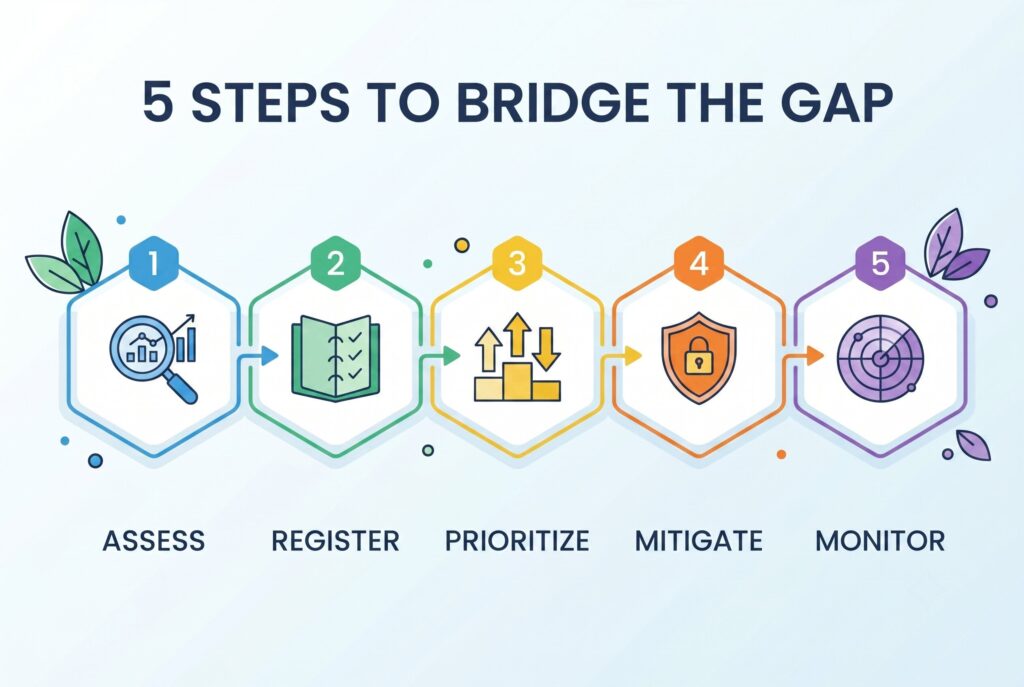
- The first step is to assess. Identify the inherent risk by scoring likelihood and impact before considering new controls. Ask what could happen, how often it could happen, and how severe the damage could be.
- The second step is to register. A risk register should document the risk owner, risk description, inherent score, existing controls, planned controls, residual score, review date, and approval status. Without a risk register, decisions become scattered and hard to defend.
- The third step is to prioritize. Not every risk deserves the same budget or urgency. A low impact office process doesn’t need the same treatment as a cloud vendor storing customer payment data. High likelihood and high impact risks should move first.
- The fourth step is to mitigate. Controls may include security tools, policies, approvals, insurance, staff training, encryption, vendor clauses, backup systems, or access restrictions. The goal isn’t to add controls randomly. It’s to reduce the specific cause of exposure.
- The fifth step is to monitor. Residual risk isn’t static. A control that worked last year may weaken as threats evolve. Monitoring helps teams see whether residual risk still sits within risk tolerance.
Common Mistakes When Comparing the Two
- The first mistake is treating residual risk as a totally separate risk. It usually isn’t. It’s often the same risk after controls have changed its likelihood or impact.
- The second mistake is assuming residual risk must always stay low. A system upgrade, vendor breach, regulatory change, or failed control can make residual risk rise again.
- The third mistake is scoring risk without explaining assumptions. A score is only useful when people understand what controls were considered, what evidence was used, and what level of uncertainty remains.
- The fourth mistake is ignoring business context. A startup, hospital, bank, manufacturer, and software company may all define acceptable residual risk differently.
Conclusion
You can’t remove every risk from a business. You also can’t pretend that installing controls makes danger disappear. Inherent risk shows the raw exposure. Residual risk shows what remains after action. The strongest GRC programs use both. They identify inherent risk, apply controls, calculate residual risk, document decisions in a risk register, and monitor changes over time.
The real question isn’t whether risk exists. It always does. The better question is whether the remaining risk is visible, measured, owned, and acceptable. When leadership can answer that clearly, the organization isn’t just reacting to threats. It’s managing them with discipline.

