When searching for commercial property for lease, many business owners focus on the base rent first. But in a triple net lease, that number is only the surface. The real monthly cost can include taxes, insurance, maintenance, repairs, utilities, and other charges that change over time. Understanding NNN meaning before signing helps you avoid a lease that looks affordable but quietly strains your cash flow.
What is a Triple Net NNN Lease? Beyond the Base Rent
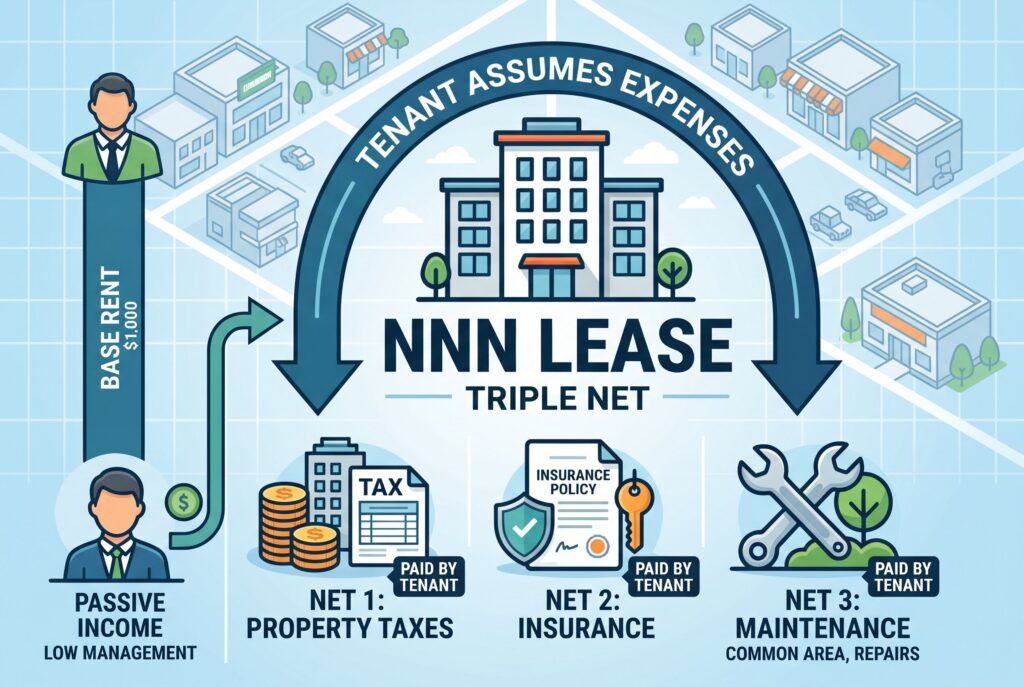
What does NNN mean? NNN stands for triple net, which means the tenant pays base rent plus three major operating expenses: property taxes, building insurance, and common area maintenance, often called CAM. The triple net lease meaning is simple but important. In this structure, the landlord shifts many property operating costs to the tenant. A triple net lease may offer a lower advertised rent than other lease types, but the tenant carries more risk if expenses rise.
So, what is a triple net lease in everyday terms? It is a net lease where your business doesn’t just rent the space. It also helps pay for the cost of owning and operating the property.
The Hidden Triple: Breaking Down NNN Costs
Property Tax Increases
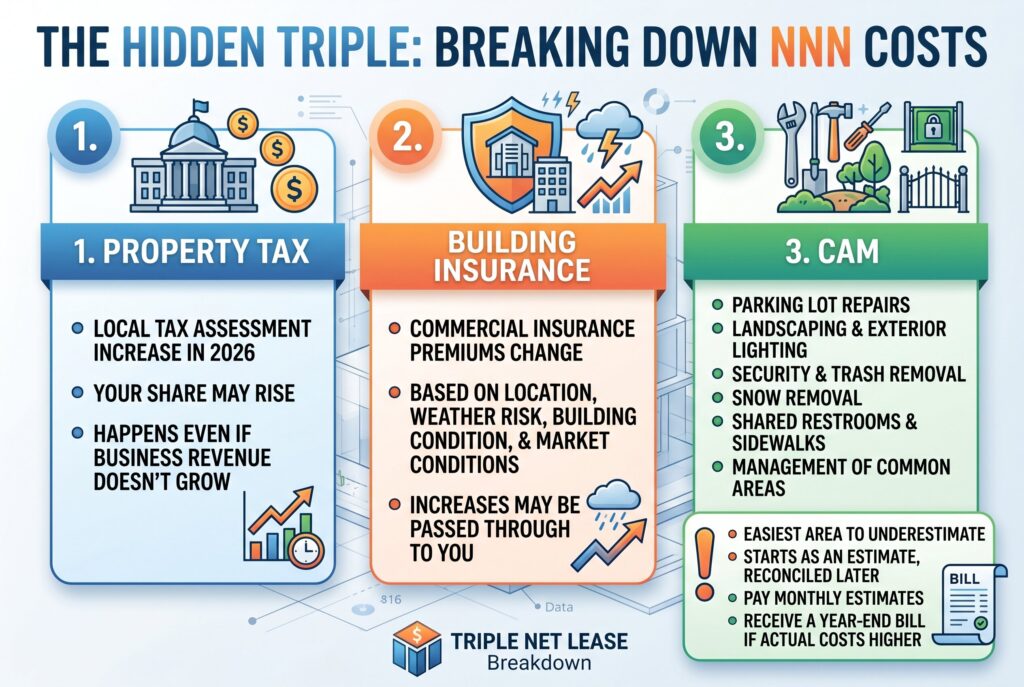
If the local tax assessment rises, your share of property tax may increase as well, even if your business revenue stays the same.
Building Insurance Costs
Commercial insurance premiums can change based on location, weather risk, building condition, and market conditions. In a net lease, these increases are often passed through to the tenant.
CAM Expenses
CAM includes costs like parking lot repairs, landscaping, security, lighting, trash removal, and shared facilities. It often starts as an estimate and is reconciled later, which means you could face an additional bill at the end of the year if actual costs are higher.
Interactive Tool: Total Occupancy Cost Calculator
A total occupancy cost calculator should include base rent, property taxes, insurance, CAM, utilities, maintenance, administrative fees, and expected annual rent increases. For example, a space may advertise base rent of $5,000 per month. But if taxes add $900, insurance adds $300, CAM adds $1,100, utilities add $500, and maintenance averages $400, the real monthly cost becomes $8,200.
That’s the number business owners should use for budgeting. Not the base rent. A good calculator should also show best case, expected case, and worst case scenarios. This helps you see whether the lease is still affordable if CAM rises, taxes increase, or repairs appear unexpectedly.
Total Occupancy Cost Calculator
Use this calculator to estimate the true monthly cost of a commercial lease. Add base rent, property taxes, insurance, CAM, utilities, maintenance, administrative fees, and expected annual rent increases. The tool also shows best-case, expected-case, and worst-case scenarios.
Monthly Cost Inputs
Scenario Assumptions
Expected Monthly Cost = Base Rent + Taxes + Insurance + CAM + Utilities + Maintenance + Administrative Fees
Expected Annual Cost = Expected Monthly Cost × 12
Future Monthly Cost = Expected Monthly Cost + Base Rent × Annual Rent Increase Rate
Best Case = Expected Monthly Cost − Variable Expenses × Best-Case Reduction Rate
Worst Case = Expected Monthly Cost + Variable Expenses × Worst-Case Increase Rate
5 Costly Hidden Charges Most Business Owners Miss
Administrative Fees On CAM
Some landlords add a management or administrative percentage on top of maintenance expenses. This fee may seem small, but it can add up significantly over a multi-year lease.
Capital Expenditure Gaps
A lease may require tenants to contribute to major repairs or replacements, such as a new roof, repaved parking lot, or upgraded building systems. It’s important to know whether these costs are excluded, capped, amortized, or fully passed through.
Rent Escalation
Many leases include annual rent increases. A 3% yearly bump may seem manageable, but over five or ten years it can significantly raise your total occupancy cost.
Tenant Improvement Allowance Gaps
A landlord may offer money for buildout, but costs like construction, permits, signage, flooring, plumbing, electrical work, and design can exceed the allowance. The tenant is responsible for covering the difference.
HVAC Maintenance Vs Replacement
Some leases require tenants to handle HVAC maintenance, while others also pass on repair or replacement costs. Since replacing a major HVAC unit can be expensive, the lease language should clearly define responsibilities.
Commercial Lease Comparison: NNN vs. Gross vs. Modified Gross
A gross lease is usually the simplest. The tenant pays one fixed rent amount, and the landlord pays most property expenses. It offers budget stability, but the base rent is usually higher.
A triple net lease has lower base rent, but the tenant pays taxes, insurance, and CAM separately. It gives more cost transparency, but it also creates more monthly uncertainty. A modified gross lease sits between the two. The tenant may pay base rent plus utilities or certain operating expenses, while the landlord covers other costs. This structure depends heavily on the commercial lease agreement.
For small businesses, the best choice depends on cash flow. A gross lease may be better for predictable budgeting. A triple net lease may work if the business understands the expenses, negotiates protections, and can handle cost changes.
Red Flags to Audit Before Signing Your Commercial Lease Agreement
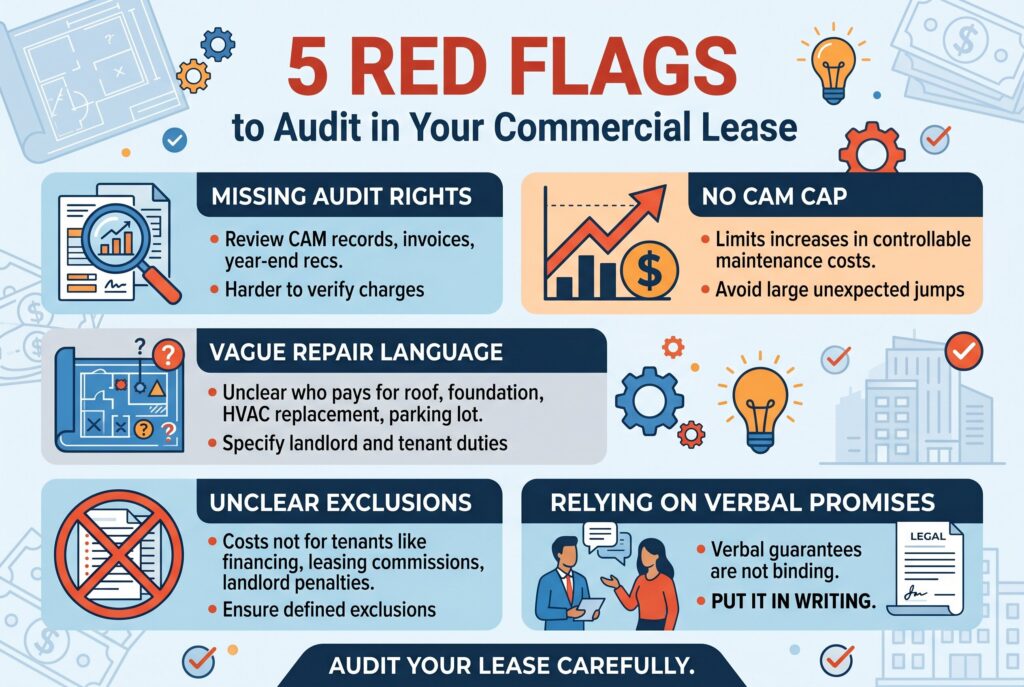
- Missing Audit Rights: You should have the right to review CAM records, invoices, and year-end reconciliations. Without audit rights, it’s harder to verify whether charges are accurate.
- No CAM Cap: A CAM cap limits how much controllable maintenance costs can increase each year. Without a cap, you may face significant cost increases.
- Vague Repair Language: Make sure the lease clearly states who pays for the roof, structure, foundation, parking lot, plumbing, electrical systems, and HVAC replacement.
- Unclear Exclusions: Some costs shouldn’t be passed through to tenants, such as landlord financing costs, leasing commissions, penalties caused by landlord negligence, or improvements for other tenants.
- Verbal Promises: If a landlord says a cost won’t be charged, make sure it is put in writing. Verbal assurances won’t protect your business later.
Conclusion
Never sign a commercial lease based only on base rent. In a triple net lease, the real cost includes taxes, insurance, CAM, repairs, utilities, escalation clauses, and possible buildout gaps. Before committing to any commercial property for lease, take the time to fully understand your total occupancy cost.
Start by requesting historical expense data and reviewing CAM details so you know what you’re likely to pay. From there, negotiate expense caps to limit future increases, confirm your audit rights to ensure transparency, and clearly define maintenance as well as structural repair responsibilities. A well-structured lease doesn’t just secure a space, it gives your business cost predictability, reduces unexpected expenses, and creates a stronger foundation for long-term growth.