


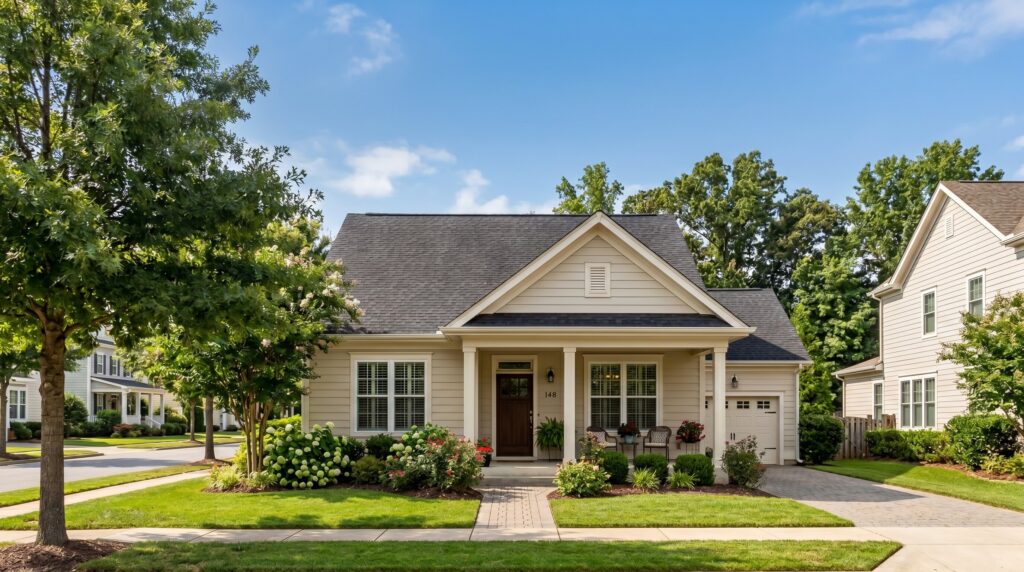
The average homeowners insurance cost for a $150,000 home depends on whether that figure represents the home’s purchase price, market value, or replacement cost. Insurers calculate premiums based on the cost to rebuild the home, not what you originally paid for it. If $150,000 is your dwelling coverage, the average premium may be around $1,511 per year.
However, if rebuilding would cost $250,000 because of higher labor and material costs, premiums could increase to about $3,467 annually. Your homeowners insurance cost also varies by location, deductible, claims history, roof age, and any additional coverage for risks such as floods or earthquakes. The right policy gives you enough coverage when you need it most.
The 150,000 USD Question: Market Value vs. Replacement Cost

The biggest mistake homeowners make is assuming a 150,000 USD house only needs 150,000 USD of insurance. That may be true in some cases, but it isn’t guaranteed.
Market value is the price a buyer would pay for the property. It includes land, neighborhood demand, school district, location, and local housing conditions. Replacement cost is different. It only asks what it would cost to remove debris, buy materials, hire workers, follow building codes, and rebuild the physical house. For example, you may buy a home for 150,000 USD, but the land may account for 50,000 USD of that value. In that case, the structure itself may seem like it only needs 100,000 USD in coverage. But if rebuilding that same structure with today’s labor and material prices costs 250,000 USD, then a 150,000 USD dwelling limit could leave you severely underinsured.
That’s why homeowners insurance should be based on what it would actually cost to rebuild your home, not what you paid for it. While your mortgage lender may require a certain amount of coverage to protect its loan, that amount isn’t always enough to fully cover reconstruction costs if your home is severely damaged or destroyed.
Why Different Websites Give Different Numbers
You may see one estimate saying home insurance costs about $1,511 per year and another saying it costs more than $3,000. That doesn’t always mean one number is wrong. It usually means the assumptions are different.
One estimate may use $150,000 in dwelling coverage. Another may assume a $150,000 home needs $250,000 in dwelling coverage because reconstruction costs exceed market value. Some estimates assume good credit, a clean claims history, and a $1,000 deductible. Others may use different policy limits, different states, or different insurer samples.
This is why averages are useful but incomplete. Before trusting a quote, compare the dwelling coverage, personal property limit, liability limit, deductible, loss settlement method, and exclusions. A lower premium may simply mean weaker protection.
The Deductible Lever: How to Instantly Lower Your Rate
Your deductible is the amount you pay out of pocket before insurance starts paying for a covered claim. It is one of the fastest ways to change your premium. A lower deductible feels safer because you pay less after a loss. But it usually increases your annual premium. A higher deductible shifts more risk to you, so the insurer may charge less. For example, a homeowner with a $150,000 house might pay around $1,200 per year with a $500 deductible. Increasing the deductible to $2,000 could reduce the premium to about $1,000 annually. While the exact savings vary by insurer and location, the lower premium can make a meaningful difference for homeowners looking to reduce their monthly housing expenses.
Still, don’t choose a high deductible just because it makes the quote look cheaper. If you couldn’t comfortably pay $2,000 after a storm, theft, or fire, that deductible may create stress at the worst possible time. The best deductible is the highest amount you can safely afford without draining emergency savings.
The Location Penalty: Why Your ZIP Code Dictates the Price
Home insurance by state can change the entire story. A $150,000 home in Vermont may cost only a few hundred USD per year to insure, while a similar home in Florida may cost several thousand USD because of hurricane exposure. Texas, Oklahoma, Mississippi, Louisiana, and other storm prone states can also face higher premiums because of wind, hail, tornado, and severe weather risk.
Even within one state, ZIP code matters. Insurers may look at wildfire exposure, coastal distance, crime rates, local construction costs, distance to a fire station, roof age patterns, and claim frequency in your area. Two homes with the same price can receive very different quotes if one sits inland near a fire hydrant and the other sits near a coastline with an older roof. This is why the cheapest states for home insurance tend to be places with lower catastrophe risk and lower rebuilding costs. It’s also why your quote may not match a national average, even if your house price does.
Coverage Details That Matter More Than the Premium

Most homeowners choose based on price first. That’s understandable, but dangerous. A standard HO 3 policy may cover many common risks, but it still has exclusions. Flood damage and earthquake damage usually aren’t included. If you live in a flood zone or earthquake prone region, you may need separate policies.
Also check whether your belongings are covered at replacement cost or actual cash value. Actual cash value subtracts depreciation, so an older sofa, laptop, or TV may be paid at a much lower amount than the cost to buy a new one. Replacement cost coverage is usually stronger. Personal property coverage, loss of use coverage, liability protection, and other structures coverage also matter. A cheap policy with low liability limits and weak personal property protection can leave major gaps.
How to Lower the Cost Without Weakening Protection
- Start by comparing at least three quotes with the same coverage limits. Don’t compare one policy with $150,000 dwelling coverage against another with $250,000 and assume the cheaper one is better.
- Next, ask about discounts. You may qualify for savings through bundling, newer roofs, security systems, smoke detectors, claims free history, automatic payments, or impact resistant materials.
- Finally, review your deductible and endorsements carefully. Raising the deductible can help, but skipping flood, earthquake, or replacement cost protection in a risky area may cost far more later.
Conclusion
So, how much is homeowners insurance on a $150,000 house? The real cost depends on replacement cost, not just the home’s market value. If your dwelling coverage is truly $150,000, your premium may be near $1,511 per year. If rebuilding the home would require $250,000 in coverage, the premium could be significantly higher.
Averages are a useful starting point, but they don’t tell the whole story. Check your home’s rebuild cost, compare deductible options, consider your state’s risk factors, and make sure the policy covers the disasters most likely to affect your property. A low premium may look attractive, but real value comes from having coverage that fits your home, your location, and the risks you actually face as a homeowner.
Related Articles
How Much Is Homeowners Insurance on a $400,000 House? 2026 Hidden Costs

