

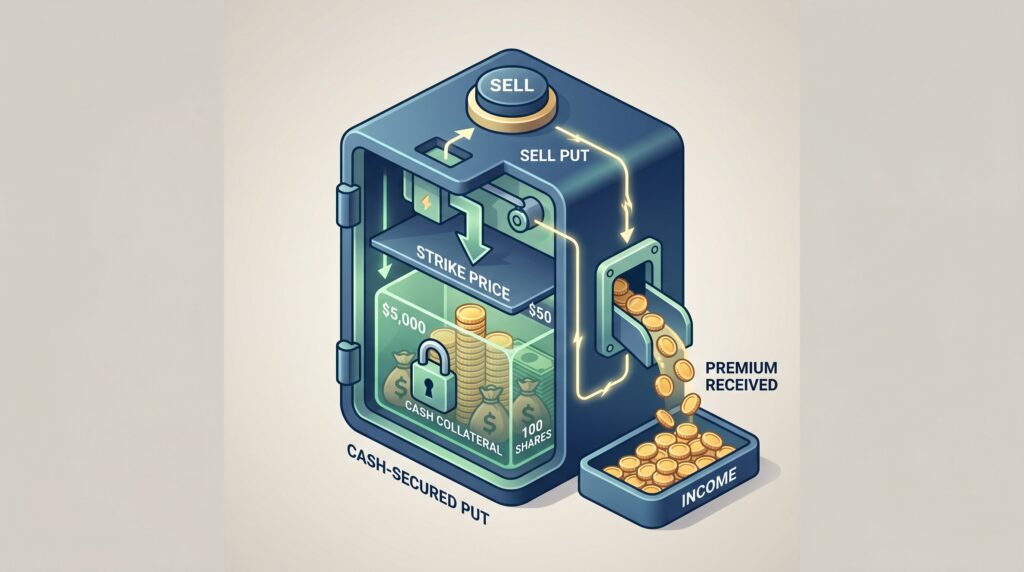
A cash-secured put is an options strategy where you agree to buy 100 shares of a stock at a chosen price while keeping enough cash available if assigned. In return, you collect an option premium upfront.
Rather than chasing a stock at its current price, you set a price you’d be happy to pay and earn income while you wait. When you sell a put, you receive a premium but accept the obligation to buy the stock if it falls below the strike price. This strategy is best suited for investors who already want to own the stock and are willing to buy it at a lower price.
Interactive Tool: The Annualized ROI & Discount Calculator
Annualized ROI & Discount Calculator
Evaluate a cash-secured put trade by calculating premium income, simple return, annualized ROI, breakeven stock price, and effective discount from the current stock price.
Used
Cash Secured = Strike Price × Shares
Simple ROI = Premium Received ÷ Cash Secured
Annualized ROI = Simple ROI × (365 ÷ Days to Expiration)
Breakeven Price = Strike Price − Premium
Discount = (Current Price − Breakeven Price) ÷ Current Price
The premium from a cash-secured put can look small until you calculate the return on the cash being reserved. Suppose a stock trades at $52. You sell one put option with a $50 strike price and collect $1.00 per share. Since one standard options contract controls 100 shares, you receive $100 in premium. To secure the trade, you reserve $5,000 in cash. If the option expires worthless in 30 days, your simple return is $100 on $5,000, or 2%. Annualized, that’s roughly 24% before fees and taxes.
The formula is:
A calculator helps you see whether the trade is worth the capital it locks up. This matters because cash used as collateral can’t be used elsewhere. A high premium may still be unattractive if the capital is tied up too long or the stock carries too much downside risk.
The Mechanics: What Is a Cash-Secured Put?
In the world of call and put options, a put option gives the buyer the right to sell 100 shares at the strike price before expiration. The seller receives premium and takes on the obligation to buy those shares if assigned. Cash-secured means you keep enough cash available to fulfill that obligation. If you sell one put with a $40 strike price, you need $4,000 set aside. If you sell two contracts, you need $8,000.
This is very different from a naked put. With a naked put, the seller doesn’t have enough cash reserved and may rely on margin. That can create dangerous losses if the stock collapses.
A cash-secured put has two main outcomes.
- First, the stock stays above the strike price. The option expires out of the money, and you keep the entire premium. You don’t buy the shares.
- Second, the stock falls below the strike price. The option expires in the money, and you may be assigned. Assignment means you must buy 100 shares per contract at the strike price. Your effective cost basis is reduced by the premium collected.
For example, if you sell a $50 put and collect $1.50, your effective cost basis is $48.50 before fees. You agreed to buy at $50, but the premium lowers the real entry price.
Put vs Call: Why Sell Puts Instead of Buying Calls?

Calls vs Puts are often viewed as bullish vs bearish, but the bigger difference is buying vs selling.
- Buying a call requires the stock to rise enough to offset the premium paid. Time decay works against you, so a sideways market can lead to losses.
- Selling a cash-secured put can profit if the stock rises, stays flat, or only drops slightly above the strike price. Time decay works in your favor.
That’s why many value investors prefer selling puts: they collect income while waiting to buy a stock at a price they already like.
Neither strategy is inherently better. Buying calls suits traders seeking leveraged upside, while selling puts suits investors comfortable owning the stock and generating income.
The Golden Rule: Only Sell What You Want to Own

The most important rule for selling puts is simple: only sell puts on stocks or ETFs you’d be happy to own. High premiums can be tempting. Risky companies often pay rich premiums because the market expects large price swings. That doesn’t make them good trades. A large premium can become a trap if assignment leaves you holding a weak business that keeps falling.
A safer approach starts with stock selection. Look for companies or ETFs you understand, with strong liquidity, reasonable valuation, and long-term appeal. Then choose a strike price where you’d genuinely want to buy. This rule changes the emotional experience of the assignment. If you sell a put on a stock you hate just to collect a premium, assignment feels like punishment. If you sell a put on a company you want to own at a discount, assignment becomes an acceptable outcome. That mindset is the difference between disciplined income investing and reckless options trading.
Advanced Tactics: Managing the Trade
Selling a put isn’t finished once the order is filled. Good trade management can reduce risk, free up capital, and prevent small wins from turning into stressful positions. One popular tactic is the 50% profit rule. If you sell a put for $2.00 and later buy it back for $1.00, you’ve captured half the maximum profit. Closing early can make sense because the remaining premium may not be worth the risk of waiting until expiration.
Buying to close also releases your cash collateral. Instead of leaving capital tied up for a small remaining profit, you can move on to a better opportunity. Another tactic is rolling the put. If the stock falls near or below your strike and you don’t want assignment yet, you may buy back the current put and sell a new put with a later expiration date, a lower strike price, or both. Traders often call this rolling out and down.
Rolling can collect additional premiums and give the stock more time to recover. Still, it isn’t magic. Rolling a poor trade can delay a loss rather than fix it. Use it only when you still believe in the stock and the new trade makes sense on its own.
Conclusion
A cash-secured put lets you earn a premium while waiting to buy quality stocks at a lower price. You receive income upfront and, if assigned, can purchase shares at an effective cost below the current market price. However, it isn’t free money. You need enough cash to buy 100 shares per contract, understand assignment risk, and choose stocks you’d be happy to own long term.
Start small, calculate the return relative to the capital required, and avoid chasing high premiums on weak companies. Used wisely, cash-secured puts can turn idle cash into productive income. Used carelessly, they can leave you owning stocks you never wanted. Success comes down to preparation, position sizing, and discipline.