
What is a put option? Put option gives the buyer the right, but not the obligation, to sell an asset at a fixed strike price before expiration. The buyer pays a premium for this right. They are commonly used to hedge against market declines, making them a form of portfolio protection. They can also generate income through strategies such as cash secured puts, where investors collect premium while potentially buying stocks at a desired price.
How to Hedge Downside Risk in Your Portfolio With Put Options
Market downturns are an inevitable part of investing. While diversification can help reduce risk, it doesn’t eliminate the possibility of significant portfolio losses during periods of market stress. This is where put options can play an important role as a hedging tool.
A put option allows investors to establish a minimum selling price for a stock or ETF they already own. By purchasing a put, investors gain the right to sell the underlying asset at a predetermined strike price before expiration. If the market declines sharply, the value of the put option typically rises, helping offset losses in the underlying investment. For example, imagine you own 100 shares of a stock trading at $100 per share. Concerned about potential short-term volatility, you purchase a put option with a $95 strike price. If the stock falls to $80, the put option gives you the right to sell at $95, significantly reducing your downside exposure. While you still incur the cost of the premium, the put acts as a form of insurance against a severe decline.
Investors commonly use puts to hedge:
- Individual stock positions ahead of earnings announcements or major news events.
- Broad market exposure through index ETFs during periods of economic uncertainty.
- Concentrated portfolios where a large portion of wealth is tied to a single investment.
- Unrealized gains that investors want to protect without immediately selling their holdings.
The tradeoff is cost. Just as insurance premiums reduce overall returns when no claim is made, purchasing put options can lower portfolio performance if the market continues to rise. Therefore, investors should carefully evaluate the amount of protection needed, the strike price selected, and the premium paid. When used strategically, put options can help investors stay invested during volatile markets, reduce emotional decision-making, and create a more defined risk profile. Rather than attempting to predict every market move, hedging with puts focuses on preserving capital when unexpected declines occur.
The Put Option Breakeven Visualizer
Before buying any put option, you need to know the breakeven price. This is the point where the trade stops losing money and starts becoming profitable.
For a long put, the breakeven formula is simple:
Breakeven Price = Strike Price − Premium Paid
Suppose you buy a put option with a $100 strike price and pay a $4 premium. Your breakeven is $96. The stock must fall below $96 before the trade produces a net profit at expiration. This matters because a stock can move in the direction you expected and still leave you with a loss. If the price drops from $100 to $98, your bearish view was correct, but the move wasn’t large enough to cover the premium. A breakeven visualizer helps you see the real risk before entering the trade.
Call vs. Put: Understanding the Two Sides of Options
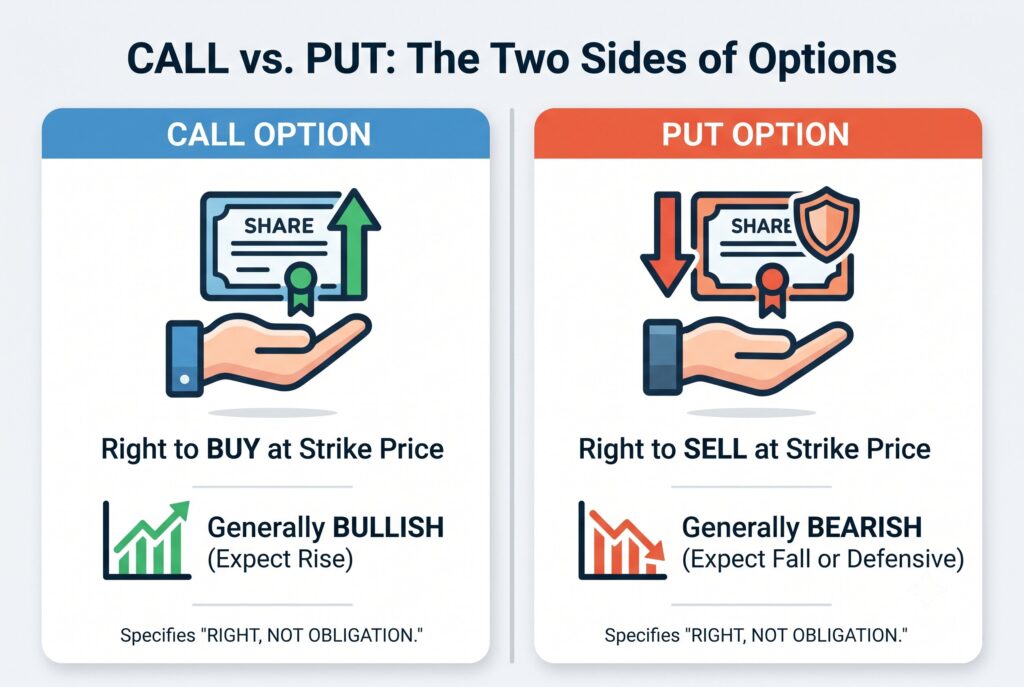
The options market revolves around two core contracts: calls and puts. A call option gives the buyer the right to buy a stock at a strike price and is generally used when investors expect prices to rise. A put option gives the buyer the right to sell a stock at a strike price and is often used when investors expect prices to fall or want portfolio protection.
In simple terms, calls are typically bullish, while puts are bearish or defensive. Both can be used for speculation, income, or risk management. The key distinction is that buying an option gives you a right, while selling an option creates an obligation. For bearish investors, buying a put can be less risky than short selling because the maximum loss is limited to the premium paid.
Common Put Option Strategies
Strategy 1: The Protective Put
The protective put strategy is designed for investors who already own shares and want downside protection without selling their position.
Imagine you own 100 shares of a stock trading at $150. You like the company long term, but you’re worried about a weak earnings report. Instead of selling the shares, you buy one put option with a $140 strike price. If the stock falls to $100, the put gives you the right to sell your shares at $140. You still take some loss from $150 to $140, plus the premium paid, but the damage is controlled. Without the put, your shares would reflect the full decline to $100. This is why a put option can act like insurance. You hope you don’t need it, but you’re glad to have it when the market moves against you.
The Rule of 100 is important. One standard options contract controls 100 shares. If the quoted premium is $2.00, the real cost is $200 because $2.00 times 100 shares equals $200. For hedging portfolio risk, protective puts are most useful when you want to stay invested but reduce panic selling. They can protect gains, limit downside, and give you time to make decisions calmly.
Strategy 2: Selling Puts With a Cash Secured Put
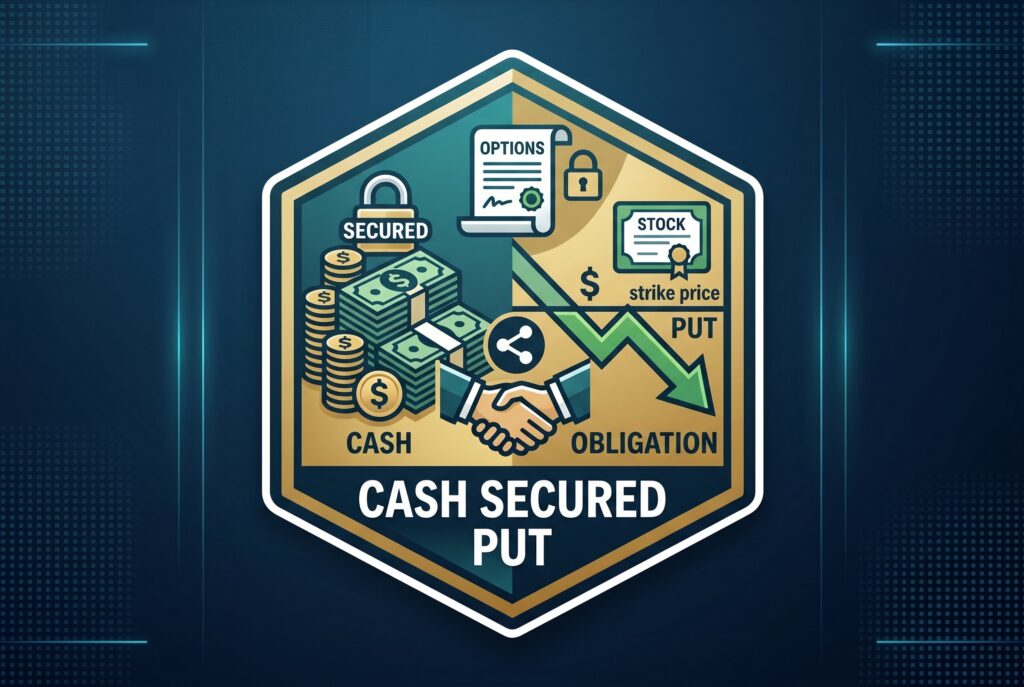
Buying puts is only one side of the market. Selling puts is a very different strategy. When you sell a put, you collect a premium upfront. In exchange, you accept the obligation to buy 100 shares at the strike price if the buyer exercises the contract or if assignment occurs.
A cash secured put means you keep enough cash in your account to buy the shares if assigned. For example, if you sell one put with a $50 strike price, you should have $5,000 available because one contract controls 100 shares. Selling a put can make sense when you’re willing to buy a stock at a lower price. Suppose a stock trades at $55, but you’d be happy to own it at $50. You sell a $50 put and collect a premium. If the stock stays above $50, the option may expire worthless and you keep the premium. If the stock falls below $50, you may be required to buy the shares at $50, which was your target entry price.
Cash secured puts can generate income, but they aren’t risk-free. If the stock collapses to $30, you may still be required to buy at $50. The premium softens the loss, but it doesn’t eliminate it. Never treat selling puts as free money. The strategy works best on stocks you genuinely want to own and can afford to buy.
The Math Behind the Contract: Pricing and The Greeks
A put option premium isn’t random. It usually includes intrinsic value and time value. Intrinsic value is the real value the option would have if exercised immediately. If a put has a $100 strike price and the stock trades at $90, the option has $10 of intrinsic value. Time value reflects the possibility that the option may become more valuable before expiration. More time usually means a higher premium. Higher expected volatility can also increase the premium because the stock has a greater chance of moving sharply.
The basic payoff formula for a long put at expiration is:
Payoff = max(0, Strike Price − Stock Price) − Premium Paid
Theta, also called time decay, measures how much value an option may lose as expiration gets closer. A put buyer fights time decay. A put seller may benefit from it, assuming the stock doesn’t fall too far. This is why selling a put can feel attractive. Time works in favor of the seller, but only if the position is properly cash secured and the investor understands the assignment risk.
Conclusion
Put options can help investors hedge downside risk, speculate on falling prices, or generate income through cash secured puts. Still, options aren’t suitable for everyone.
Before trading call and put options, most brokerages require options approval. You may need to answer questions about income, net worth, trading experience, risk tolerance, and investment objectives. Some strategies require a higher approval level than others. Start small. Learn the breakeven price before entering any trade. Understand the Rule of 100. Don’t buy a put without knowing how much the stock must fall to make the trade worthwhile. Don’t begin selling puts unless you have enough cash to buy the shares.
A put option can be a powerful risk management tool when used carefully. The goal isn’t to predict every market drop perfectly. The goal is to define your risk, protect your capital, and make portfolio decisions with more control.