


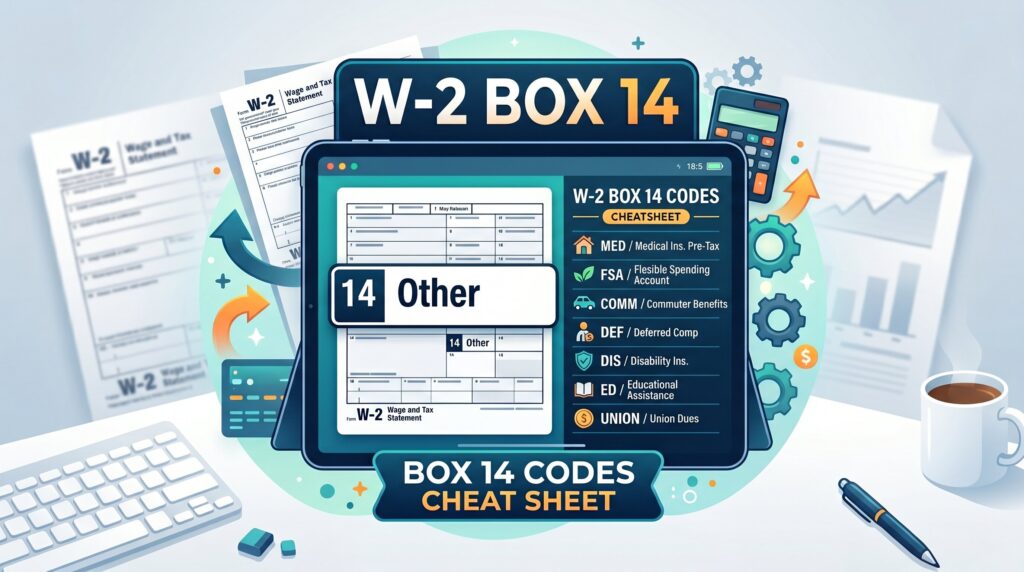
If box 14 W-2 details are making you nervous, that’s completely normal. W-2 box 14 is one of the most confusing parts of the form because the IRS doesn’t standardize it the way it standardizes other sections. That means two employees at different companies can both have Box 14 entries that look totally different, even when the underlying idea is similar. The good news is that most of the time, Box 14 isn’t a crisis. It’s usually an informational field that helps explain a deduction, contribution, or employer-reported item.
What matters is knowing which entries affect your return and which ones are mostly there for your records. Once you understand that distinction, Box 14 becomes much less intimidating.
The Catch All Box: What Is Box 14 on a W-2?
Box 14 is basically a flexible reporting space on the W-2. Unlike Box 12, which uses strict IRS code rules, Box 14 has no universal official code list. Employers can use it to report a wide variety of deductions, insurance items, retirement contributions, allowances, or other payroll details they want employees to see.
That’s why one employer may write SDI, another may write VPDI, and another may spell something out in full. It’s also why Box 14 can feel so inconsistent. The payroll department often decides what abbreviation appears, not the IRS.
This is the most important thing to remember: Box 14 isn’t one specific tax category. It’s a catch-all box that can contain many different types of information. Some entries matter for state returns or itemized deductions. Some are just reminders. Some may help explain why your taxable wages look the way they do. And some won’t affect your return at all.
The Ultimate W-2 Box 14 Codes Cheat Sheet
The easiest way to understand Box 14 is by grouping entries into categories instead of trying to memorize random abbreviations.
State Taxes and Insurance: SDI, SUI, FLI, VPDI
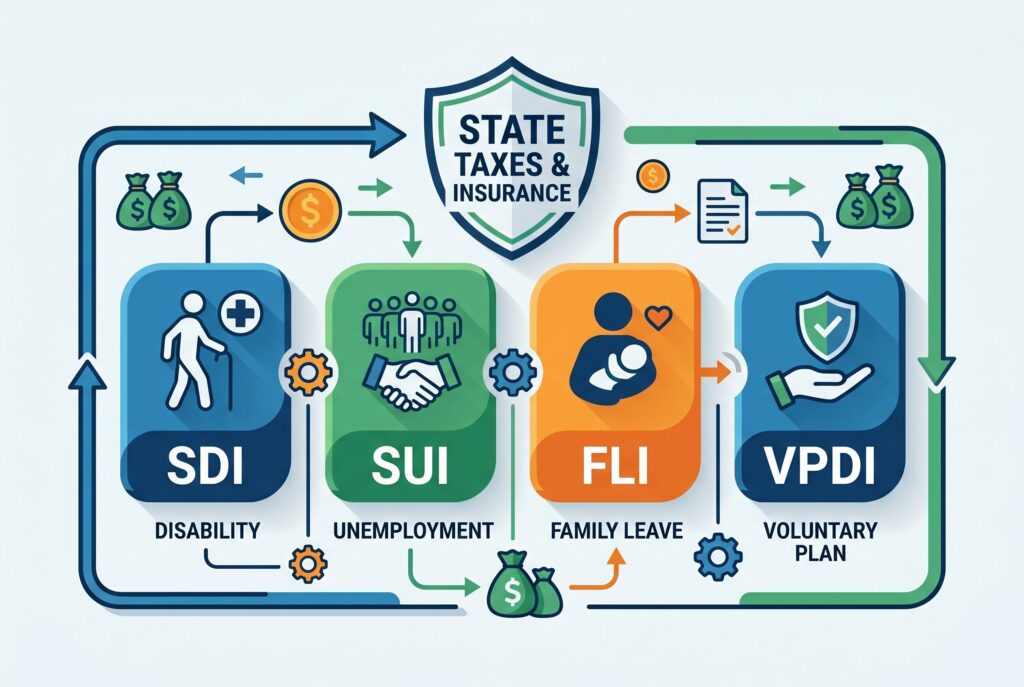
These are some of the most common Box 14 items people see. SDI usually refers to State Disability Insurance. SUI often refers to State Unemployment Insurance, though not every state handles it the same way on employee forms. FLI usually means Family Leave Insurance. VPDI often means Voluntary Plan Disability Insurance.
These items are generally tied to state-level payroll systems rather than federal tax rules. In some cases, they may matter for a state return or for itemized deductions. In many other cases, they’re mostly informational unless your filing situation makes them relevant. That’s why you shouldn’t assume every insurance-style abbreviation changes your refund automatically.
Public Sector Retirement: 414(h)
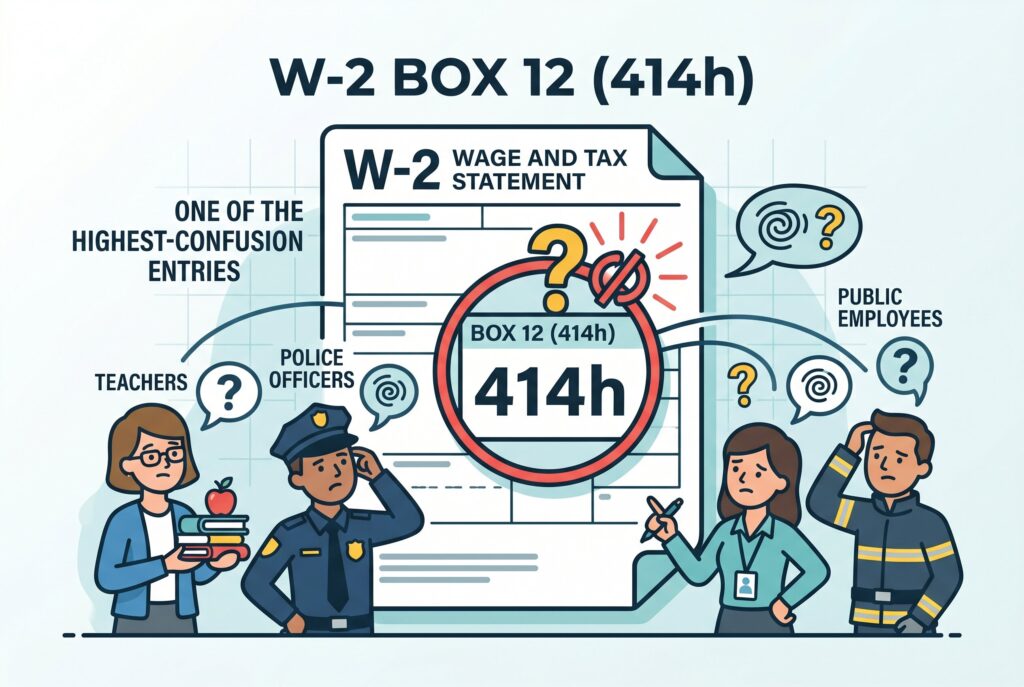
414(h) on W-2 is one of the highest-confusion entries, especially for teachers, police officers, and other public employees. In most cases, 414(h) refers to a mandatory public retirement contribution that is treated under special tax rules. It’s usually tied to employer pick-up contributions in a government retirement system, and it’s generally federally tax-deferred.
That means the amount may already be reflected in your wage treatment for federal purposes. But depending on your state, there may still be a separate state tax issue to watch for. So if you see 414(h) in Box 14, don’t panic. It’s common in public-sector payroll and usually points to retirement plan treatment, not a random tax problem.
Union Dues and Uniform Fees: UNION, DUES, UNIFORM
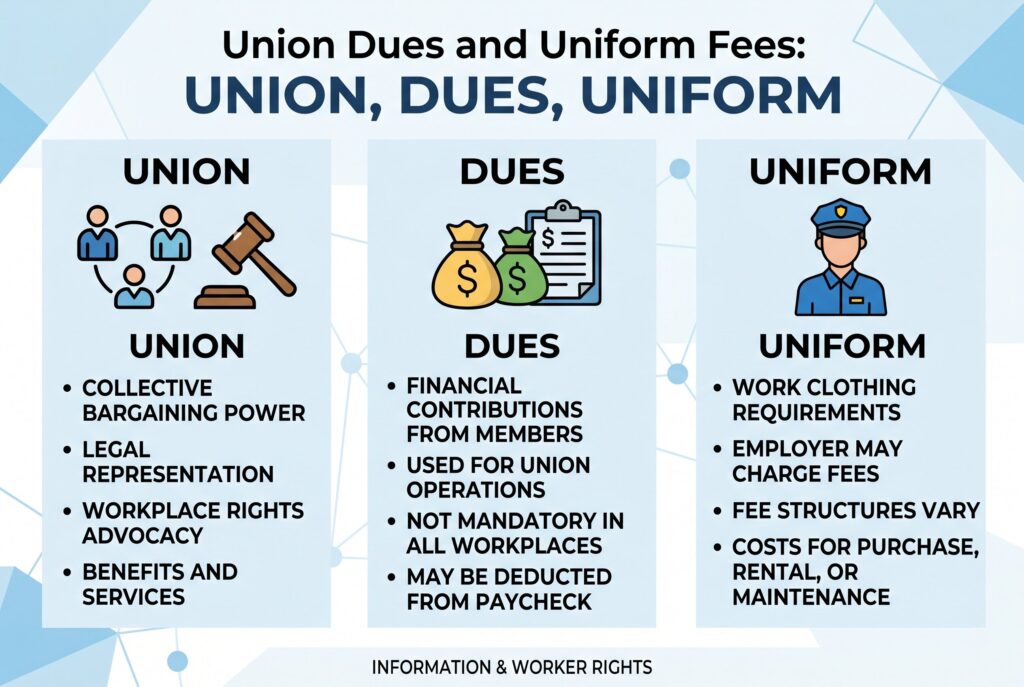
Some employers use Box 14 to report union dues, work uniform costs, or similar out-of-pocket employment expenses. These items are usually straightforward in meaning, but their tax usefulness depends on your filing situation and current tax rules.
For many employees, these entries are mainly informational. For others, especially in more specialized state or deduction situations, they may matter more. The key point is that seeing dues or uniform-related wording in Box 14 doesn’t automatically mean you get a federal tax break for it.
Special Allowances: CLERGY, TUITION, CHARITY
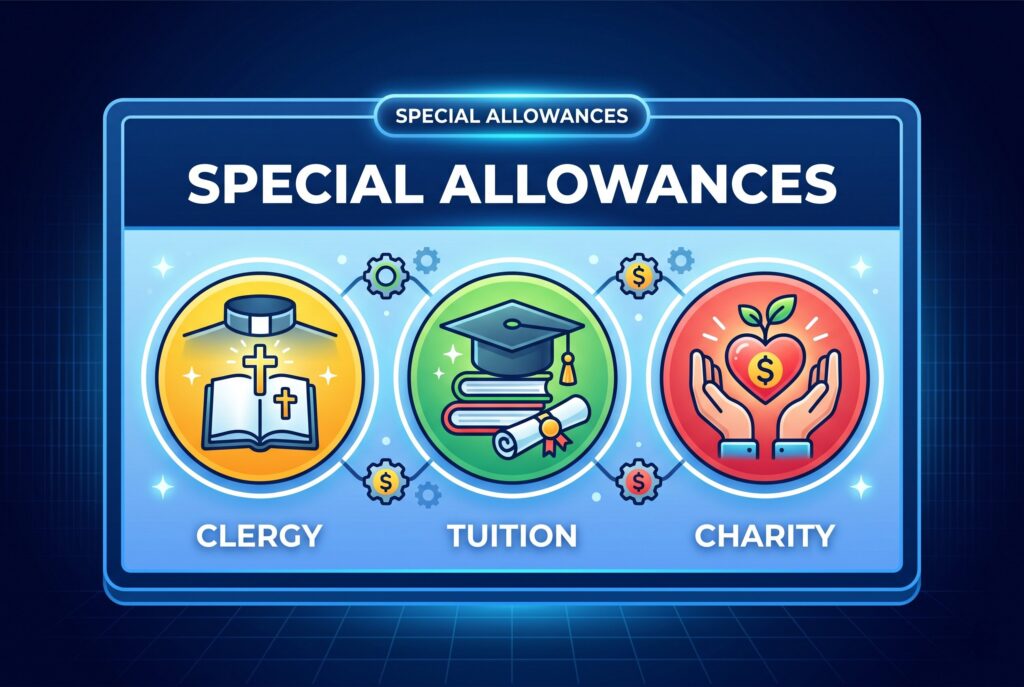
Certain Box 14 entries reflect more specialized payroll or benefit items. Clergy-related housing allowances may appear here. Employer-paid tuition or educational assistance may also show up in some payroll systems. Charity-related payroll deductions, such as United Way or other workplace giving, can also appear.
These are the kinds of Box 14 entries that remind you why there’s no master universal code book. Employers use the box for all sorts of payroll notes, and the exact wording can vary widely.
Interactive Box 14 Decoder Tool
The reason a Box 14 decoder tool is so appealing is simple. People don’t want theory first. They want to know what their exact code means and whether it changes anything on the return.
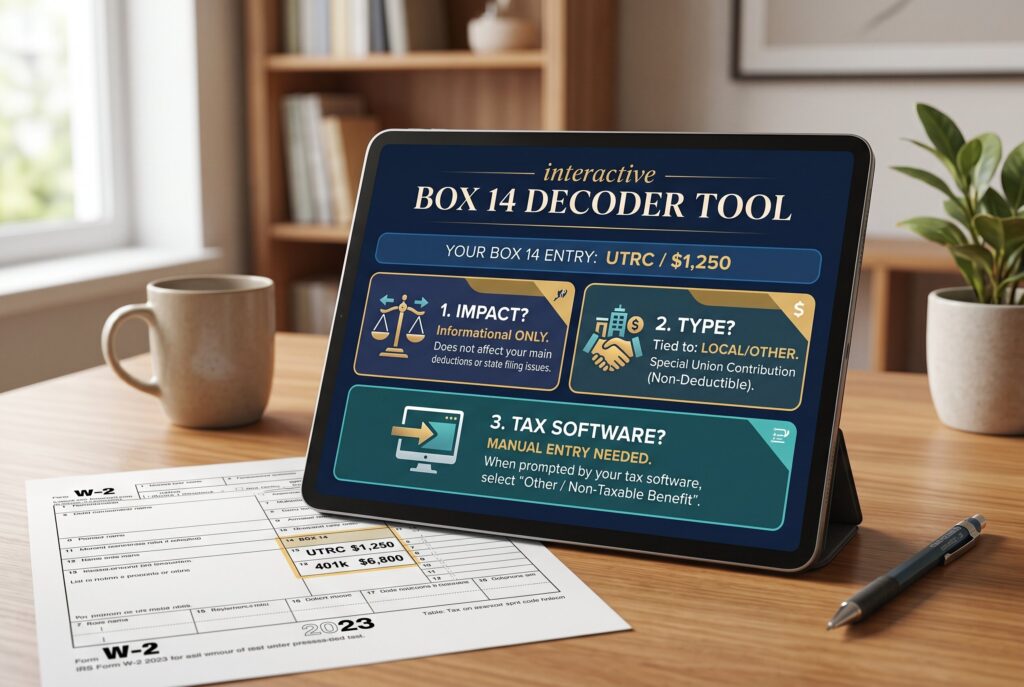
A strong mental shortcut is to ask three questions the moment you see a Box 14 entry. First, is this just informational, or does it change a deduction or state filing issue? Second, is it tied to state tax, retirement, or a special allowance? Third, does my tax software recognize it directly, or will I need to choose a category manually? That three-step approach works better than trying to memorize every abbreviation because Box 14 isn’t standardized enough for memorization alone to be reliable.
Do Box 14 Codes Actually Affect My Tax Return?
Sometimes yes. Sometimes not much at all. This is where many taxpayers overreact. Seeing an unfamiliar code doesn’t mean your return is broken. In many cases, Box 14 entries are informational only and won’t change the federal outcome for someone taking the standard deduction.
But there are situations where Box 14 matters. State disability-type items can matter on some state returns or in itemized tax contexts. Public employee retirement entries like 414(h) can matter because they relate to how income and retirement contributions are treated. Special allowances may matter because they need to be categorized correctly so they aren’t taxed incorrectly.
So the real answer is this: Box 14 matters when the item has a downstream filing consequence. It doesn’t matter nearly as much when it’s simply documenting a payroll fact for your records.
Box 12 vs. Box 14: Don’t Mix Them Up
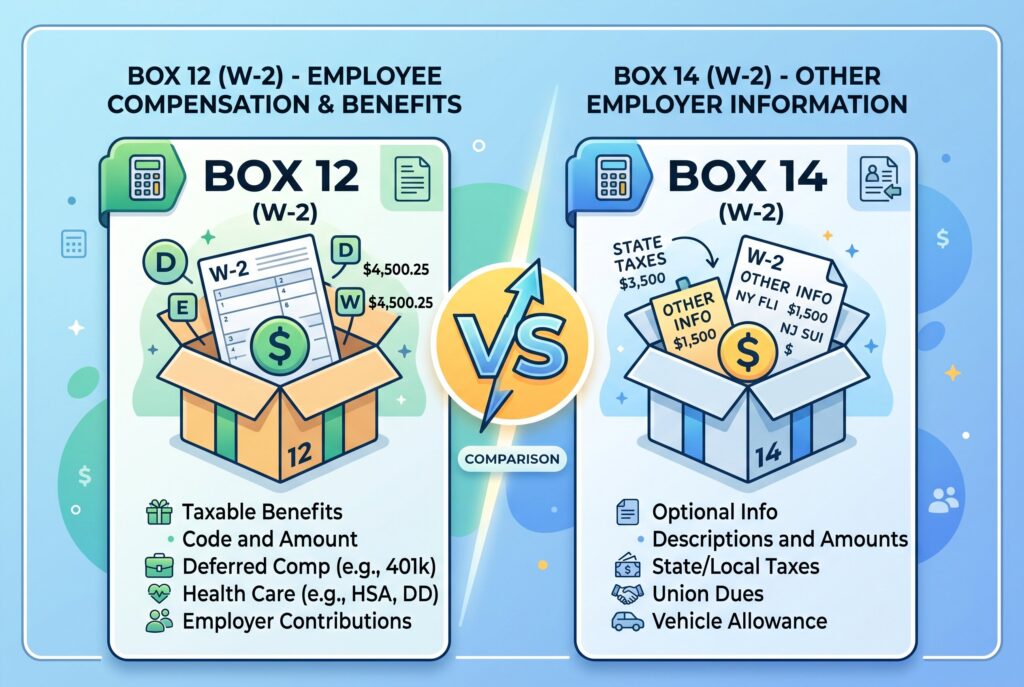
This is one of the easiest mistakes to make. W-2 box 12 codes are standardized. They use strict single-letter or double-letter IRS codes, and each code has a defined meaning. For example, DD on W-2 refers to employer-sponsored health coverage and belongs in Box 12, not Box 14.
Box 14 is different. It uses whatever wording or abbreviation your payroll department chooses. That means you should never assume a Box 14 label works like a Box 12 code. They aren’t interchangeable. If your software asks for Box 12 codes, don’t enter a Box 14 abbreviation there just because it looks like a code. That can create filing errors fast.
How to Report Box 14 in Tax Software
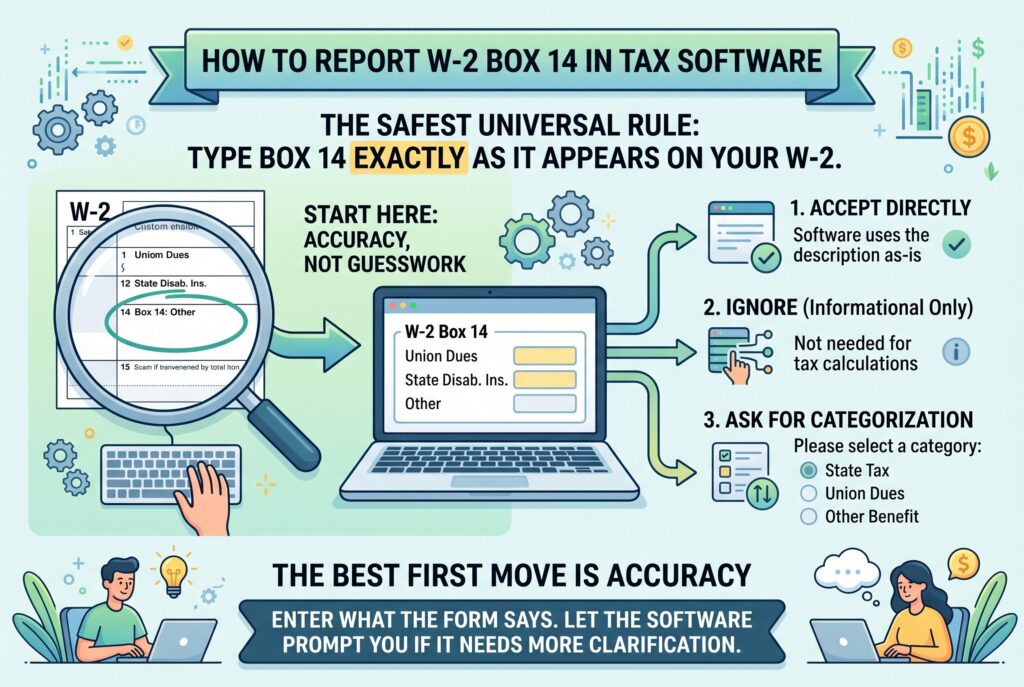
The safest universal rule is simple: type Box 14 exactly as it appears on your W-2. Most tax software will either accept the description directly, ignore it if it’s informational only, or ask you to categorize it into a broader bucket such as state tax, union dues, or other. That’s why the best first move is accuracy, not guesswork. Enter what the form says. Let the software prompt you if it needs more clarification.
If the description isn’t recognized, many programs will offer an “Other” or “Not Listed Here” option. If you still aren’t sure what the code means, the best source is often your employer or payroll department, since Box 14 labels are employer-created and nonstandard. That point matters more than people realize. Since there’s no official IRS master list for Box 14, your payroll office may be the only place that can tell you exactly what your employer intended by that abbreviation.
Conclusion
Box 14 W-2 entries look more intimidating than they usually are. The confusion comes from the lack of standardization, not from the box being inherently dangerous. Most entries are either informational or narrow enough that tax software can guide you once you enter them correctly.
The best approach is calm and practical. Use a cheat sheet mindset, identify the category, enter the wording exactly as printed, and let your software handle the next step where possible. If something still looks unclear, ask your employer before forcing a guess. That’s how you turn W-2 box 14 from a stress point into just another line on the form.

