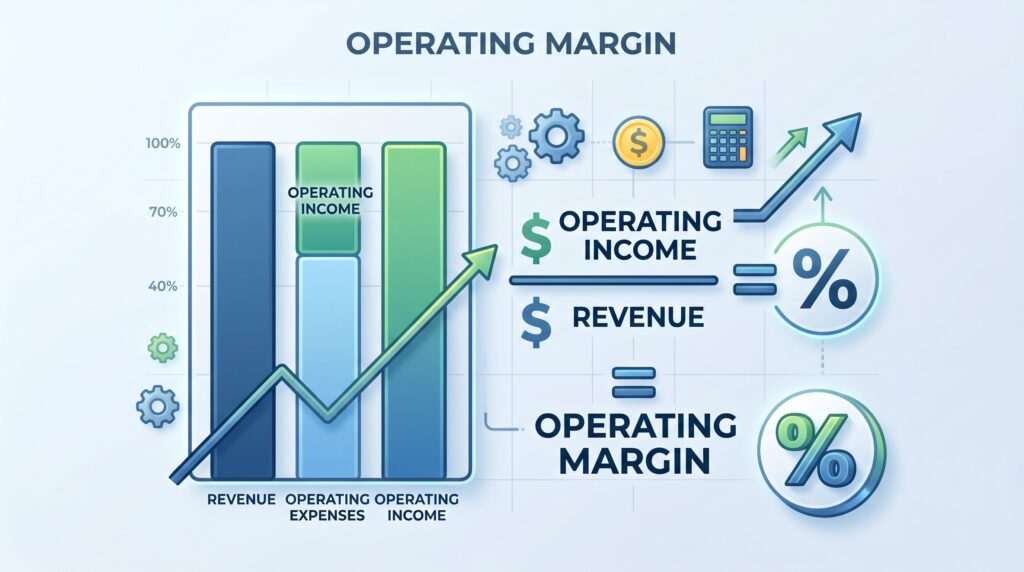
What is operating margin, and why does it matter so much? Operating margin is one of the clearest ways to see whether a business is truly efficient, not just busy. It shows how much profit a company keeps from each dollar of sales after covering the core costs of running the business, but before interest and taxes. For owners, managers, and financial teams, operating margin helps answer a simple question: is the business model strong enough to scale?
What is Operating Margin? The Ultimate Efficiency Metric
Operating margin measures how much operating profit a company generates from its revenue. In plain English, it shows how well your core business turns sales into profit after paying for direct costs, wages, rent, software, marketing, and other operating expenses.
This metric matters because revenue alone doesn’t tell the full story. A company can grow sales quickly and still become weaker if costs rise faster than income. Operating margin gives a cleaner view of day to day performance because it excludes interest, taxes, and many non operating items. For example, if a company earns $1,000,000 in revenue and has $180,000 in operating profit, its operating margin is 18%. That means the company keeps 18 cents in operating profit for every dollar of sales.
The Operating Margin Formula
The operating margin formula is simple:
Both versions usually point to the same idea. Operating income and operating profit refer to profit from the company’s normal business activities before interest and taxes.
To understand how to calculate operating income, start with revenue. Then subtract the cost of goods sold, also called COGS, and operating expenses.
Gross Profit = Revenue − COGS
Operating Income = Gross Profit − Operating Expenses
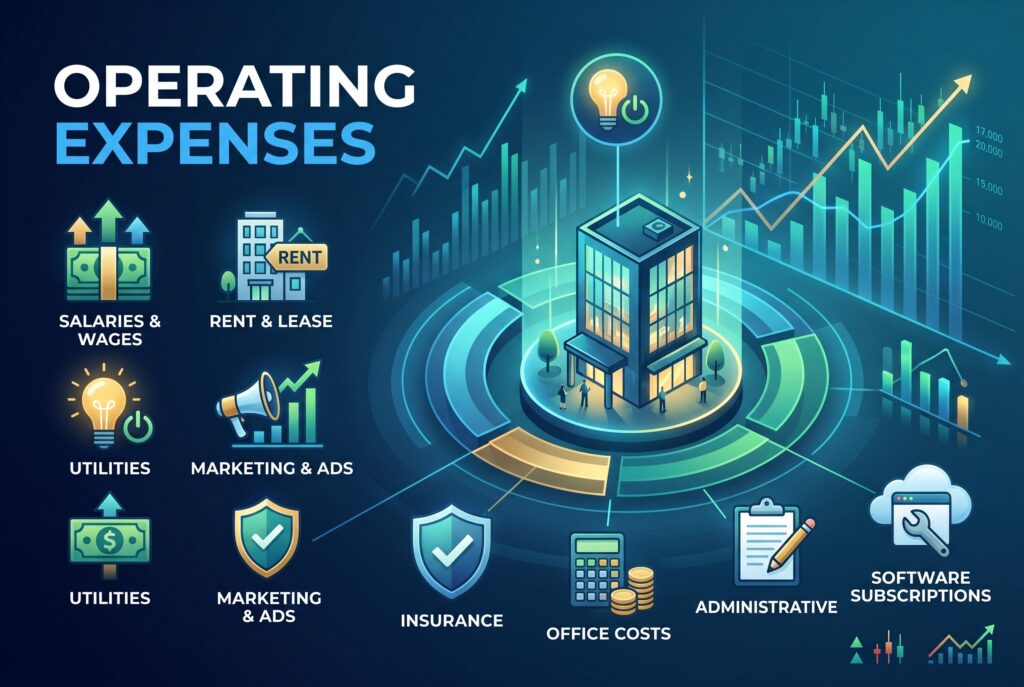
Operating expenses may include salaries, rent, utilities, marketing, insurance, office costs, administrative expenses, and software subscriptions. Once you have operating income, divide it by revenue and multiply by 100.
Here’s a quick example. A business has $500,000 in revenue, $220,000 in COGS, and $180,000 in operating expenses. Its operating income is $100,000. Divide $100,000 by $500,000, then multiply by 100. The operating margin is 20%. That 20% tells you the company keeps one fifth of every sales dollar as operating profit before interest and taxes.
Interactive Operating Margin Calculator
An interactive operating margin calculator should ask for three basic numbers: revenue, cost of goods sold, and operating expenses. From there, it can calculate operating income and operating margin automatically.
The calculator flow should look like this:
- Enter total revenue.
- Enter COGS.
- Enter operating expenses.
- Calculate operating income.
- Calculate operating margin percentage.
This kind of tool helps business owners move from theory to action. Instead of only reading the formula, they can test real numbers, compare monthly performance, and see how small cost changes affect profitability. For example, if operating expenses increase by $20,000 but revenue stays flat, the calculator would show the margin shrinking immediately. That makes the metric easier to understand and more useful for planning.
Operating Data
This calculator is for illustration purposes only. Results are based on your inputs and should be used as a general guide.
Results
$0
0.00%
Industry Benchmarks: What is a “Good” Operating Margin?
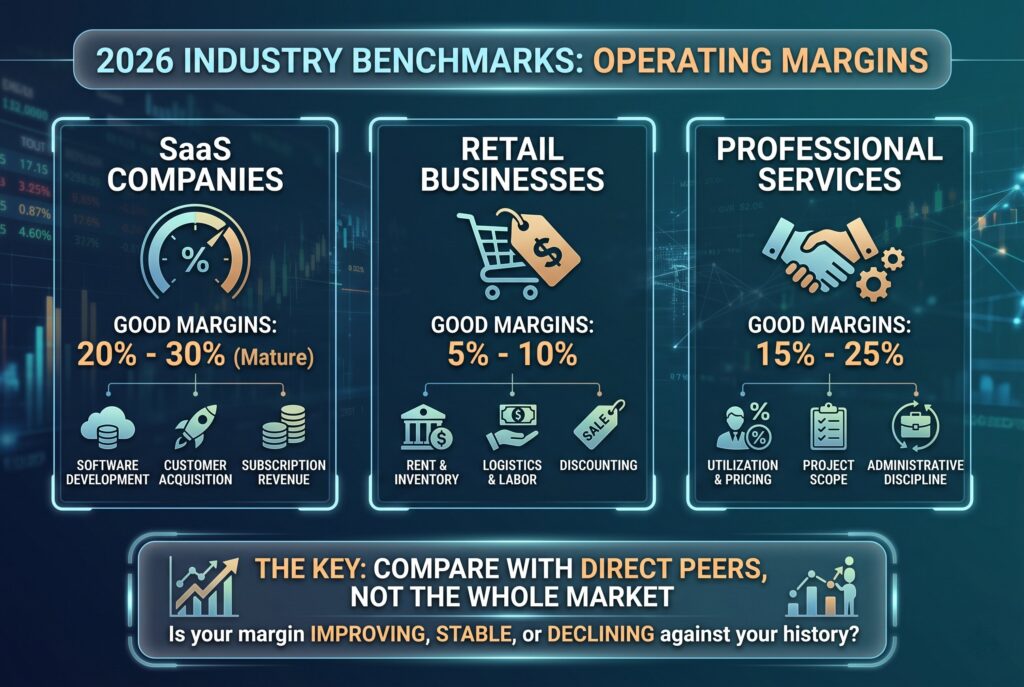
A good operating margin depends heavily on the industry. There isn't one perfect number for every business, because each sector has a different cost structure. SaaS companies often aim for operating margins around 20% to 30% once they mature. Their software development and customer acquisition costs can be high early on, but margins can improve as subscription revenue scales.
Retail businesses often operate with lower margins, commonly around 5% to 10%. Rent, inventory, labor, logistics, and discounting can limit profitability even when sales volume is strong. Professional services firms may target margins around 15% to 25%. Because these businesses depend heavily on people, their margin often comes down to pricing, utilization, project scope, and administrative discipline.
The key is to compare your business with similar companies, not with every company in the market. A 9% margin may be weak for a software company but solid for a retailer. The real question is whether your margin is improving, stable, or declining against your own history and your direct peer group.
Operating Margin vs. Net Margin: Understanding the Difference
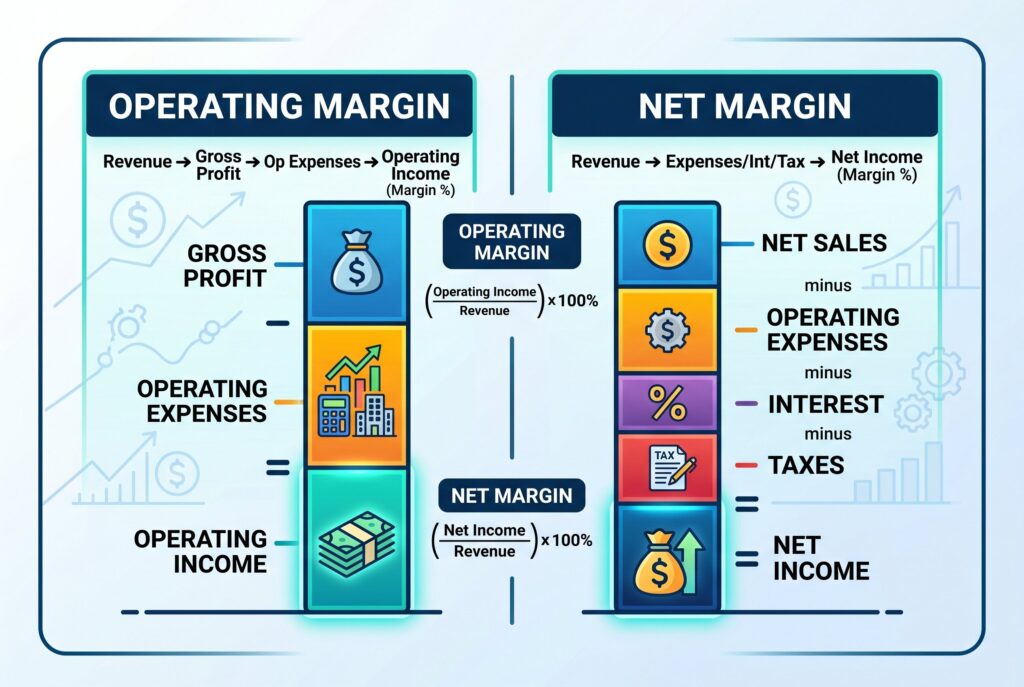
Operating margin and net margin are related, but they don't measure the same thing. Operating margin focuses on the profitability of core business operations. Net margin shows what remains after all expenses, including interest, taxes, and non operating costs. This is where operating income vs net income becomes important. Operating income tells you how profitable the business is before financing and tax effects. Net income tells you the final bottom line.
For example, a company may have strong operating income but weak net income because it carries heavy debt and pays high interest. Another company may have modest operating income but strong net income because it benefits from tax advantages or one time gains.
The annual net income meaning is simple: it’s the company’s total profit left over for the year after all expenses are deducted. However, it doesn't always show how efficient the core business is. That’s why operating margin is often better for judging management efficiency, pricing power, and cost control.
3 Operational Workflows to Improve Your Margin
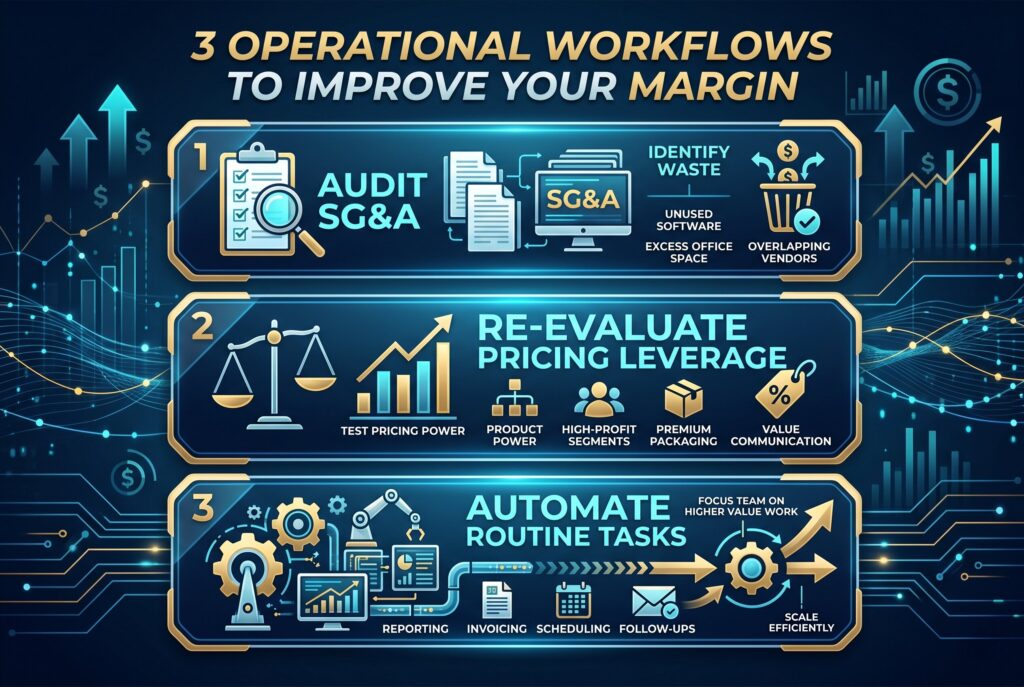
Audit SG&A
The first workflow is to audit SG&A. SG&A includes selling, general, and administrative expenses. Look for software tools nobody uses, office space that doesn't match current needs, overlapping vendors, and manual admin processes that consume staff time. Cutting waste here can improve operating margin without harming the customer experience.
Re-Evaluate Pricing Leverage
The second workflow is to re-evaluate pricing leverage. Many companies try to improve margin only by cutting costs, but pricing is often more powerful. Review which products, services, or customer segments create the strongest profit. Then test whether premium packaging, clearer value communication, or annual contracts could raise average revenue without increasing operating expenses at the same pace.
Automate Routine Tasks
The third workflow is to automate routine tasks. Repetitive reporting, invoicing, scheduling, customer follow ups, and internal approvals can quietly increase administrative headcount. Automation doesn't mean replacing good people. It means keeping the team focused on higher value work while preventing operating expenses from growing faster than revenue.
Conclusion

Operating margin is more than a finance formula. It’s a practical measure of competitiveness. It shows whether your business can convert revenue into operating profit after paying the real costs of serving customers and running the company.
Track operating margin monthly, not just once a year. A single month may not tell the whole story, but the trend line will. If your margin improves, your business may be gaining pricing power or cost discipline. If it declines, you can investigate the issue before it becomes a cash flow crisis. A strong business doesn't just sell more. It keeps more from every dollar it earns.