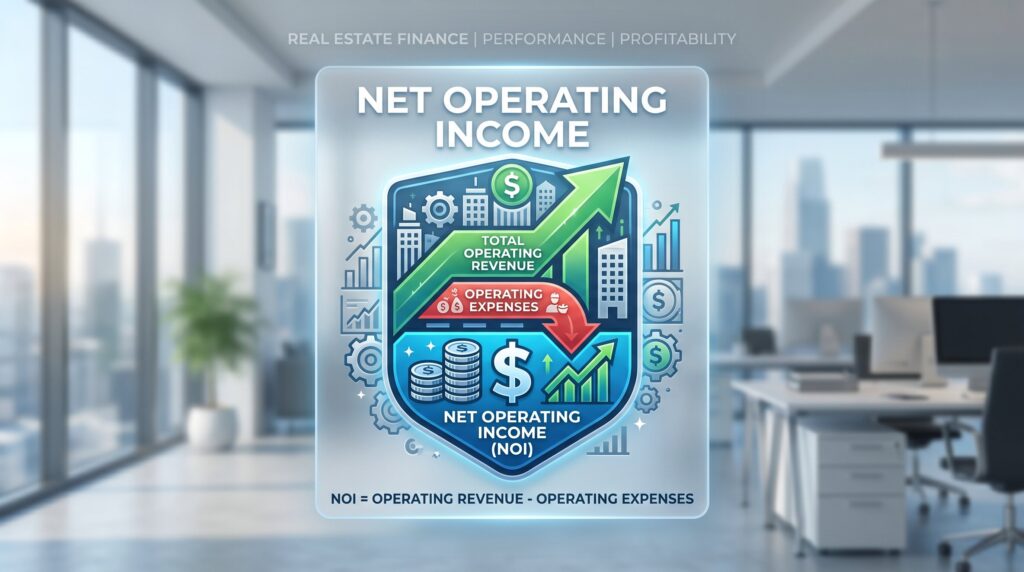
If you’ve been trying to understand what net operating income is, you’re probably looking for a cleaner way to judge whether an asset or business is actually performing well. That’s exactly why net operating income matters. It strips away financing noise and tax complications so you can focus on operational health. In the simplest sense, NOI tells you how much profit is left after normal operating expenses are paid, but before debt costs, taxes, and major capital spending enter the picture.
This is why investors and operators pay close attention to it. A property may look profitable until insurance, maintenance, and management fees start eating into the income. A business may show strong revenue but still struggle once recurring operating expenses are accounted for. NOI gives you a way to separate the asset itself from the financing wrapped around it. That makes it one of the most useful profitability metrics when you want a clearer operational view.
What Is Net Operating Income (NOI)?
NOI meaning is straightforward once the jargon is removed. Net operating income is the income generated by a property or business after subtracting normal operating expenses from gross operating income, but before subtracting interest, income taxes, and capital expenditures.
That last part matters a lot. NOI isn’t trying to tell you the final after everything profit number. It’s trying to show you the earning power of the operation itself. In real estate, that means the property’s ability to generate income before mortgage payments distort the picture. In a broader business setting, it points to the same idea: how healthy are the operations before financing and tax structure start affecting the result?
This is why investors like the metric. It helps them compare opportunities more fairly. One asset may be heavily financed and another may be debt free, but NOI lets you look past that and judge how the operation performs on its own.

The Net Operating Income Formula
The net operating income formula is:
NOI = Gross Operating Income − Operating Expenses
That is the cleanest and most widely accepted version of the formula. Gross operating income generally means the income produced by the asset before operating expenses are deducted. In a real estate example, that could include rent and other ordinary property income. In a broader business context, it may represent the revenue tied to the operation before those recurring costs are taken out.
Operating expenses are the recurring costs required to keep the asset or business running. The important thing is that they’re normal operating costs, not financing costs, not taxes, and not major capital investments. The formula looks simple, and it is. The real challenge is knowing what belongs inside operating expenses and what does not.
What to Include and Exclude in Operating Expenses

This is the part that usually determines whether your NOI calculation is useful or misleading. Operating expenses generally include recurring costs such as management fees, insurance, routine maintenance, utilities, payroll, and similar day to day operating costs. In a property context, property taxes are often included as well because they’re part of the ordinary cost of operating the asset.
What you should exclude is just as important. Debt service shouldn’t be included. Mortgage payments are financing decisions, not operating performance. Income taxes shouldn’t be included either because the goal of NOI is to isolate the asset before tax structure affects the result. Depreciation should also stay out of the metric in practical NOI use, and major capital expenditures like replacing a roof, rebuilding a system, or funding a large software overhaul shouldn’t be treated as normal operating expenses. This is one reason the metric becomes powerful. It forces you to separate recurring operational health from financing and long term capital planning.
Context Matters: Real Estate NOI vs. Corporate NOI

This is where confusion often starts. NOI is used most naturally in real estate, but some business oriented articles stretch it into broader corporate use. The concept is similar, but the terminology isn’t always equally standard across industries.
In commercial real estate, NOI is one of the most important performance numbers. Investors use it to judge how well a property is performing and to estimate value. It sits at the center of real estate underwriting because it captures the income the property itself can generate before mortgage structure gets involved.
In regular business or SaaS contexts, people more often say operating income or EBIT rather than NOI. The concepts overlap because all of them are trying to isolate operating performance before interest and taxes. But the standard language differs by industry. This is why articles that try to make NOI equally standard in SaaS can feel less precise. The underlying idea is understandable, but the terminology is much more at home in real estate than in mainstream corporate reporting.
NOI vs. Net Income
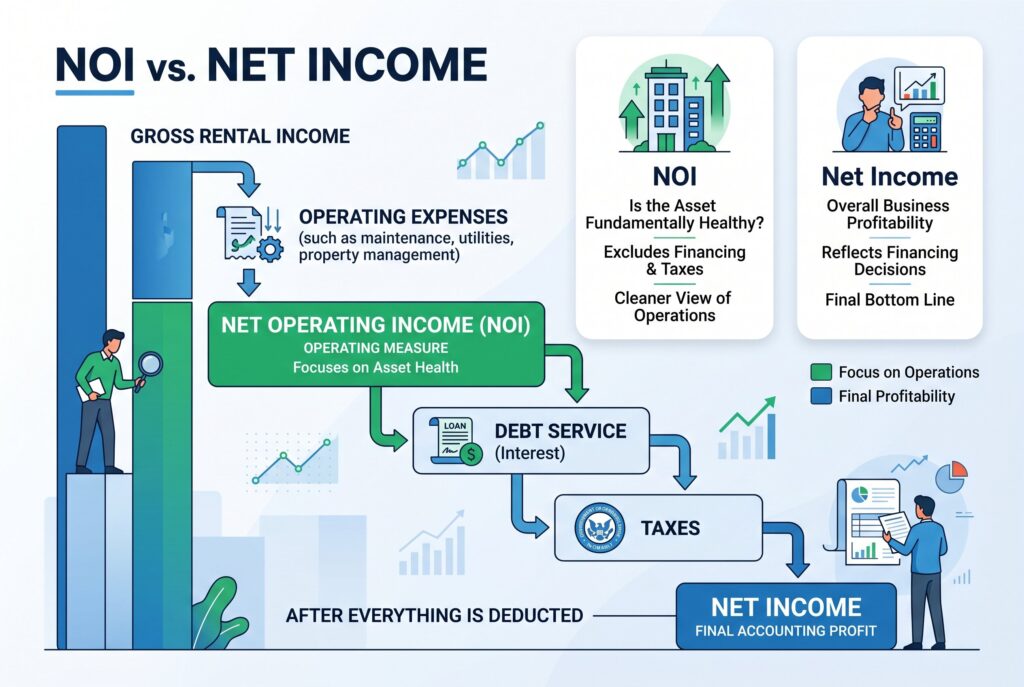
Net operating income and net income aren’t the same thing, even though the names sound similar. NOI stops before interest and taxes. Net income goes all the way to the bottom line after everything has been deducted. That means NOI is a cleaner operating measure, while net income is the final accounting profit number.
This difference is exactly why NOI is useful. If you want to know whether an asset is fundamentally healthy, net income can sometimes distract you because financing choices and taxes may cloud the result. NOI pulls those items out so you can focus on whether the operation works. A property with strong NOI but weak final cash flow might be carrying too much debt. That doesn’t automatically mean the property is bad. It may mean the financing structure is the problem rather than the asset itself.
3 Proven Ways to Increase Your NOI in 2026

The first way to improve NOI is to raise gross operating income. In real estate, that often means reducing vacancy and increasing occupancy quality. In a business context, it may mean strengthening retention and reducing churn so that more revenue stays in the system.
The second way is to control operating expenses more aggressively. Insurance, maintenance, payroll, utilities, and admin costs all put direct pressure on NOI. Small reductions in recurring expenses often matter more than people expect because they improve profitability without relying on new revenue.
The third way is to automate repetitive admin work where possible. In 2026, cost control is no longer only about cutting. It’s also about removing waste from recurring workflows. Better systems can improve NOI by lowering the cost of routine operations without reducing service quality.
Conclusion
Net operating income is one of the clearest ways to judge whether an asset or operation is truly healthy before taxes, debt, and major capital spending complicate the picture. That’s why it remains such a valuable metric for investors and operators alike. It shows the earning power of the operation itself, not just the accounting outcome after everything else has been layered on top.
If you want a more honest view of operational performance, calculate your NOI from your latest numbers and look carefully at what you are including and excluding. That single step often reveals much more than revenue alone ever could.
Related Articles
Operating Income vs. Net Income: Which Is Real Profit? (2026)