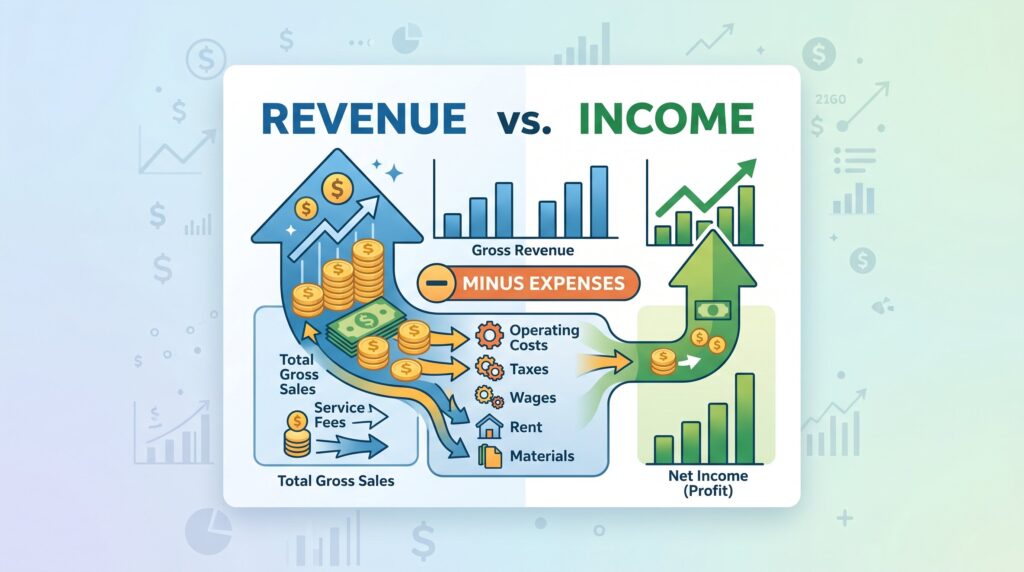
Revenue vs income is one of the most common and expensive points of confusion for new founders. What is revenue in business? It is the total money a company brings in before expenses. Income, on the other hand, is what remains after costs are deducted. These days, understanding this difference helps business owners avoid chasing flashy sales numbers while ignoring actual profitability.
What Is Revenue? Starting At The Top
What is revenue? Revenue measures how much money a business generates from selling goods or services. It is usually the first major line on an income statement, which is why people call it the top line.
The total revenue formula is:
Revenue = Price Per Unit × Total Units Sold
For example, if a business sells 2,000 units at $80 each, total revenue is $160,000. This number shows sales activity, but it doesn’t show whether the business is profitable.
Revenue can grow because prices rise, more units are sold, or new revenue streams are added. Still, revenue alone isn’t enough to judge financial health.
What Is Income? Finding The Bottom Line
Income usually refers to net income, or the profit left after expenses are paid. This includes costs such as materials, payroll, rent, marketing, shipping, interest, and taxes. If revenue shows how much money comes in, income shows how much the business actually keeps. That makes income one of the clearest measures of financial health. This also explains the profit vs revenue distinction. Profit isn’t the same as sales. A company can sell a lot and still lose money if costs rise faster than revenue.
Revenue vs. Income: The Comparison Table
| Feature | Revenue | Income |
| Also Known As | Top line | Bottom line |
| What It Measures | Total sales and business activity | True profitability and financial health |
| Deductions | Before expenses are subtracted | After all expenses are subtracted |
| Main Question | How much did we sell? | How much did we keep? |
| Primary Goal | Grow market share and sales | Improve operational efficiency |
This table shows why income vs revenue matters. Revenue tells you whether customers are buying. Income tells you whether the business model works.
Case Study: Calculating The Difference In A U.S. Retailer
Imagine a U.S.-based smart home organization retailer. The company sells 10,000 smart storage units at $150 each.
Total revenue is:
10,000 × $150 = $1,500,000
That sounds impressive. However, the business spends $600,000 on manufacturing, $300,000 on marketing, and $200,000 on payroll and shipping.
Total expenses are $1,100,000. Net income is:
$1,500,000 − $1,100,000 = $400,000
So how does revenue affect profit? Revenue creates the opportunity for profit, but costs determine how much profit survives. In this case, the business generates $1.5 million in revenue but keeps only $400,000 as income.
Gross vs. Net: Unpacking The Layers
Revenue (Gross Revenue vs. Net Revenue)
Gross revenue is every dollar collected from sales before any deductions. It is the broadest measure of sales activity. Net revenue is calculated by subtracting customer refunds, discounts, returns, and allowances from gross revenue. For example, if gross revenue is $100,000 and returns total $8,000, net revenue is $92,000. This distinction matters because net revenue reflects the true quality of sales, not just the total volume.
Income (Gross Income vs. Net Income)
Gross income is revenue minus the direct cost of goods sold (COGS). It shows whether the core product or service is profitable before considering broader operating expenses. Net income is what remains after all operational expenses, taxes, interest, and other costs are deducted. It is the final bottom-line figure of a business. These layers matter because gross income highlights product margin, while net income shows overall profitability and financial health.
Why High Revenue Can Hide Bad Business Health

High revenue can look exciting, but it can hide weak margins. A business might discount aggressively and sell more units, but if the discounts destroy profit, net income may fall. For example, a store may double sales during a promotion but earn less money because shipping, advertising, and product costs eat up the margin. This is why revenue growth should always be measured beside income.
Investors and lenders often care about revenue because it shows demand and scale. But they also care about income because it shows sustainability. A company with rising revenue and falling income may have a pricing problem, cost problem, or inefficient operating model. Healthy growth means the top line and bottom line improve together.
Conclusion
Revenue is important because every business needs sales to survive. It shows demand, scale, and market activity. But income shows whether the business is actually working. Tracking revenue without income can lead to bad decisions, overspending, and false confidence. Strong founders should watch both numbers closely: grow the top line, protect the bottom line, and make sure sales turn into real profit.