
What is net sales, and why does it matter? Net sales is the number that shows how much real sales revenue a business keeps after subtracting returns, allowances, and discounts. Looking only at gross sales can be misleading because it shows every sale before customers return products, receive refunds, or use promotions. Businesses need net sales to understand true sales performance, pricing quality, and customer behavior.
The Net Sales Formula: How to Calculate It
The net sales formula is:
Net Sales = Gross Sales − Sales Returns − Sales Allowances − Sales Discounts
Sales returns are refunds given when customers return products. This is common in e-commerce, apparel, electronics, and retail businesses.
Sales allowances are partial price reductions when a customer keeps a product but receives compensation because of a defect, delay, or service issue.
Sales discounts are price reductions, such as early payment discounts, seasonal promotions, coupon codes, or volume discounts. To understand how to calculate net sales, start with gross sales. Then subtract all three deduction categories. The result is the sales figure that better reflects real revenue quality.
Net Sales vs. Gross Sales: What’s the Difference?
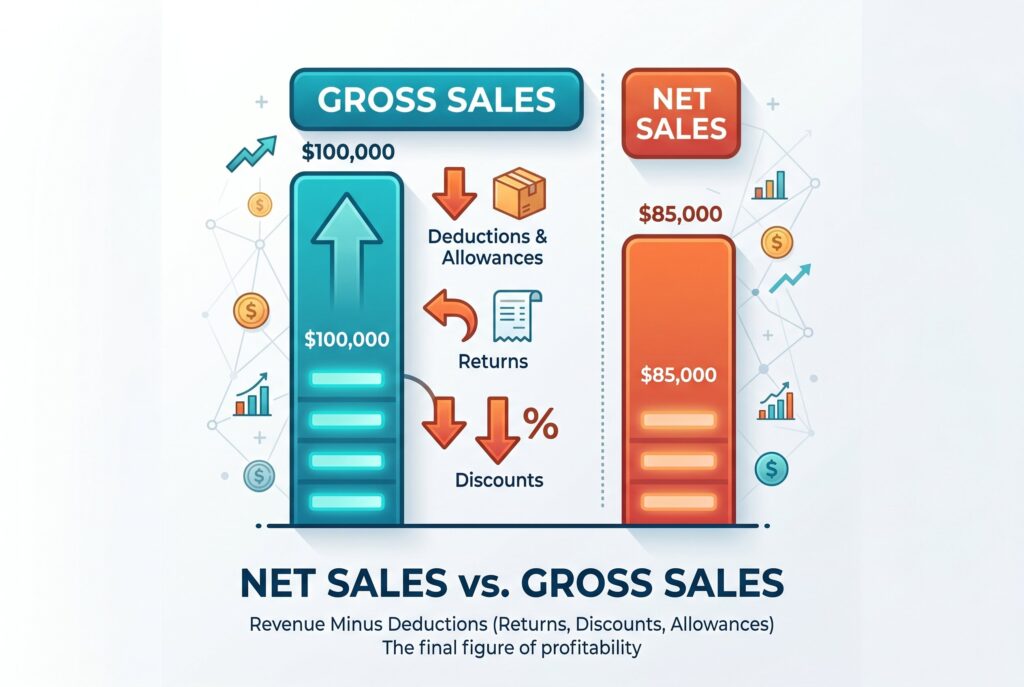
What is gross sales? Gross sales is the total value of all sales before deductions. It counts every sale at the original selling price, even if some items are later returned or discounted.
Gross sales vs net sales is the difference between a vanity number and a realistic number. Gross sales can make a business look stronger than it is. Net sales gives a cleaner picture because it removes returns, allowances, and discounts. For example, a store may report $200,000 in gross sales. But if customers return $30,000 of products and discounts reduce sales by $15,000, net sales are only $155,000. That gap matters because it may reveal product quality issues, aggressive discounting, or poor customer fit.
Is Net Sales the Same as Revenue?
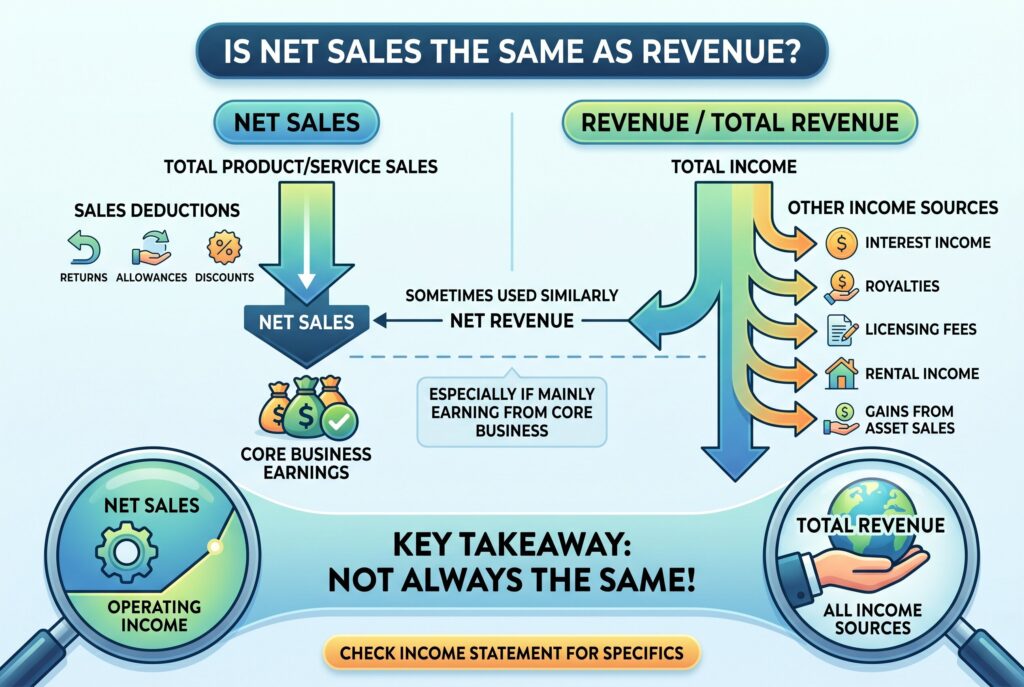
Is net sales the same as revenue? Not always. Net sales usually refers to money earned from core product or service sales after sales deductions. Revenue can be broader. Total revenue may include net sales plus other income, such as interest income, royalties, licensing fees, rental income, or gains from selling assets.
Net revenue is sometimes used similarly to net sales, especially when a company mainly earns money from selling products or services. However, the exact meaning depends on the business and reporting style. The safest approach is to read the income statement carefully and check what the company includes in each line.
Where Do Net Sales Appear on the Income Statement?
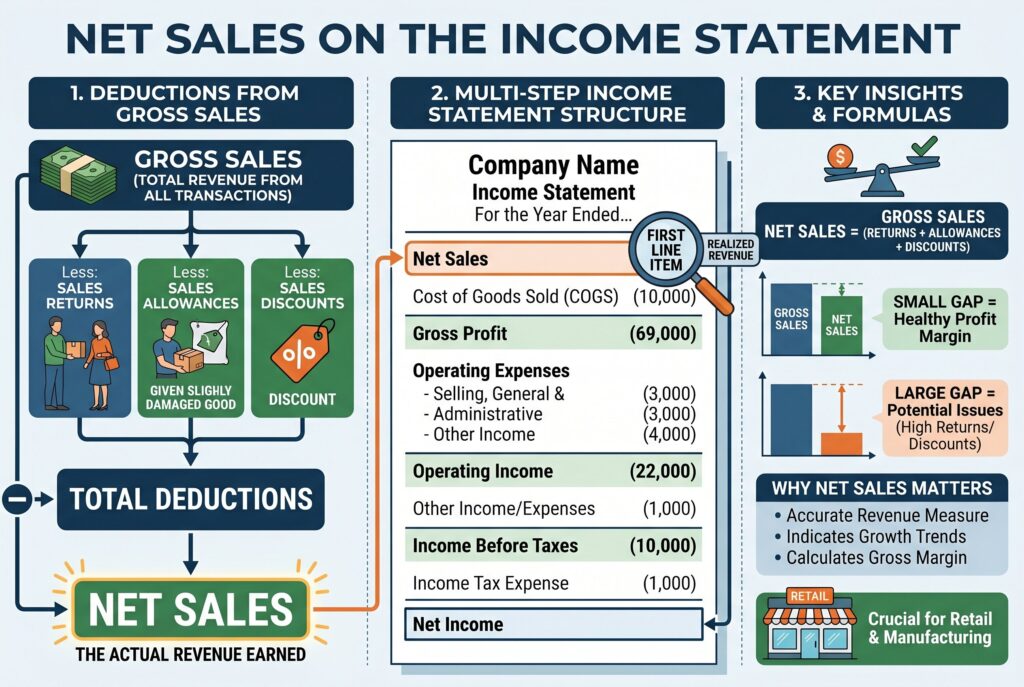
Net sales usually appear near the top of the income statement because they are part of revenue, not a cost.
A simplified income statement may look like this:
Gross Sales
Less: Sales Returns and Allowances
Less: Sales Discounts
Net Sales
Less: Cost of Goods Sold
Gross Profit
This matters because net sales aren’t the same as gross profit. Net sales subtract sales deductions only. Gross profit subtracts cost of goods sold, or COGS, from net sales.
For example, if net sales are $100,000 and COGS is $60,000, gross profit is $40,000. That’s a different metric.
Real-World Business Examples

Imagine an online clothing store with $100,000 in gross sales. The store offers free 30 day returns, so customers return $15,000 worth of items that didn’t fit. The store also gives $2,000 in holiday discounts.
Net sales are:
$100,000 − $15,000 − $2,000 = $83,000
The business didn’t really keep $100,000 from sales. It kept $83,000 before subtracting product costs, shipping, payroll, ads, and other expenses.
This is why e-commerce brands should track return rates and discount rates closely. High gross sales may look exciting, but weak net sales can signal pricing problems, product quality issues, sizing problems, or poor promotion strategy.
Conclusion
Net sales gives a more honest view of sales performance than gross sales. It shows what your business actually keeps after returns, allowances, and discounts. Track the gap between gross sales and net sales every month. If the gap is growing, investigate why. Too many returns may mean product problems. Too many allowances may mean fulfillment issues. Too many discounts may mean your pricing strategy isn’t strong enough. Healthy businesses don’t just sell more. They keep more of what they sell.