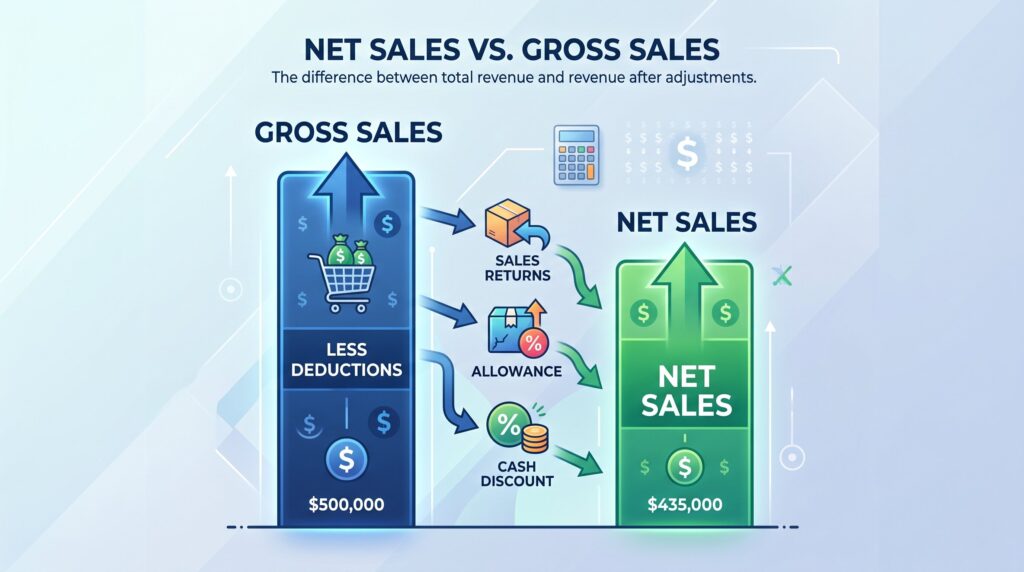
Net sales vs gross sales is the difference between what your business sells and what your business actually keeps. Gross sales show total sales volume before deductions. Net sales show real sales revenue after returns, discounts, and allowances. These days, this distinction matters because high gross sales doesn’t always mean strong business health. If too much revenue leaks away, the top line may look impressive while the real income statement tells a weaker story.
What is Gross Sales?

Gross sales are the total sales a business makes before subtracting anything. If you sell 1,000 products for $50 each, your gross sales are $50,000. This number is useful because it shows demand, sales volume, and market reach. If gross sales are rising, your product may be attracting more buyers, your sales team may be closing more deals, or your marketing may be generating stronger demand.
But gross sales don’t show what the business actually keeps. They don’t account for refunds, returns, discount campaigns, or customer allowances. That’s why gross sales can become a vanity metric. It looks impressive, but it may hide problems underneath.
What is Net Sales? The True Top Line
What is net sales? Net sales are gross sales minus returns, discounts, and allowances. It’s the cleaner number because it reflects the actual value of sales after customer-related deductions. Net sales matter to investors, lenders, managers, and owners because they show revenue quality. A company with $500,000 in gross sales and $490,000 in net sales has strong retention of sales value. A company with $500,000 in gross sales and only $350,000 in net sales may have serious issues with returns, discounts, pricing, or product quality.
Net sales don’t subtract COGS, payroll, rent, software, marketing, interest, or taxes. Those belong lower on the income statement. Net sales only adjust gross sales for sales-specific deductions.
Side-by-Side Comparison: Gross Sales vs. Net Sales
Gross sales answer: how much did we sell?
Net sales answer: how much did we keep?
The gross sales formula is:
Gross Sales = Price x Quantity Sold
The net sales formula is:
Net Sales = Gross Sales − Returns − Discounts − Allowances
Gross sales help measure market demand, sales team performance, and campaign reach. If gross sales are increasing, customers are buying more or your average order value is rising.
Net sales help measure product quality, pricing discipline, and customer satisfaction. If net sales are much lower than gross sales, your business may have too many refunds, too many promotions, or too many customer complaints. Both numbers sit near the top of sales reporting. However, net sales are usually more useful for serious financial analysis because they show the revenue that survives after sales adjustments.
How Gross Sales Becomes Net Sales
The gap between gross sales and net sales is called revenue leakage. It’s created by three main deductions. Returns happen when customers send products back or cancel purchases. High returns can signal poor product quality, unclear descriptions, bad sizing, shipping damage, or mismatched expectations.
Discounts reduce the price customers pay. They can help move inventory, increase volume, or encourage faster payment. For example, 2/10, n/30 means a buyer gets a 2% discount for paying within 10 days. But discounts can also weaken net sales if customers stop buying at full price.
Allowances are partial reductions given when customers keep the product but receive compensation for a problem. For example, a customer may keep a scratched item after receiving a $50 allowance. For example, if gross sales are $100,000, returns are $8,000, discounts are $5,000, and allowances are $2,000, net sales are $85,000. That means 15% of sales value leaked away.
Interactive Visualization: The Revenue Leakage Calculator
A revenue leakage calculator should let users enter gross sales, return rate, discount rate, and allowance rate. Then it should show a waterfall chart: gross sales at the top, deductions stepping down, and net sales at the end.
Example:
Gross Sales: $200,000
Returns: $20,000
Discounts: $12,000
Allowances: $3,000
Net Sales = $165,000
Revenue leakage = 17.5%
The insight text should say something like: “Your revenue leakage is 17.5%. If this trend continues, every $1 million in gross sales becomes only $825,000 in net sales.” That kind of tool helps business owners see the cost of returns and discounts instantly.
Revenue Leakage Calculator
See how returns, discounts, and allowances reduce your gross sales into net sales.
Revenue Waterfall
Revenue leakage includes returns, discounts, and allowances.
Is Net Sales the Same as Revenue?

Is net sales the same as revenue? Not always. Net sales come from core business sales after returns, discounts, and allowances. Revenue is broader. It can include net sales plus other income, such as interest, dividends, royalties, rental income, or licensing fees.
For a simple retail business, net sales and revenue may look almost identical. For a larger company with multiple income streams, revenue may include more than customer sales. This distinction matters because net sales show the strength of your core operations. Total revenue may look strong because of one-time or non-sales income, but that doesn’t always mean the sales engine is healthy.
Conclusion
Gross sales are useful, but they aren’t enough. They show demand, volume, and sales activity. Net sales show what your business actually keeps after customers return products, use discounts, or receive allowances. In 2026, investors, lenders, and smart operators won’t be impressed by inflated gross sales alone. They’ll look at net sales, gross margin, profit margin, and the gap between gross and net. Track both numbers monthly. Celebrate gross sales growth, but optimize net sales by improving product quality, reducing unnecessary discounts, and fixing customer dissatisfaction.