
What is gross sales, and why should a business owner track it? Gross sales is the total value of all sales transactions before subtracting returns, discounts, or allowances. It shows raw customer demand, sales team performance, and market reach. But gross sales isn’t the full story. It can look impressive while net sales and profit tell a very different truth.
The Gross Sales Formula: How to Calculate It
The gross sales formula is simple:
Gross Sales = Total Units Sold x Sales Price Per Unit
For example, if a US e-commerce brand sells 500 smart home organizers at $120 each, gross sales would be:
500 x $120 = $60,000
That means the business generated $60,000 in gross sales before refunds, discounts, allowances, shipping costs, product costs, or operating expenses. If a company sells multiple products, calculate each product category separately, then add them together. For example, if a store sells $20,000 in shelves, $15,000 in storage bins, and $10,000 in drawer organizers, total gross sales are $45,000.
Interactive Tool: The Gross-to-Net Sales Tracker
A gross-to-net sales tracker should show how your top-line sales become your reportable sales number. The tool should ask for gross sales, returns, discounts, and allowances.
For example:
Gross Sales: $100,000
Returns: $12,000
Discounts: $6,000
Allowances: $2,000
Net Sales = $100,000 − $20,000
Net Sales = $80,000
This helps you see whether your business has a revenue leakage problem. If gross sales are growing but net sales aren’t, your company may be relying too heavily on discounts or dealing with too many returns.
Gross-to-Net Sales Tracker
Gross Sales vs. Net Sales: Why the Gap Matters

Gross sales vs net sales is one of the most important comparisons in sales reporting. Gross sales measure total selling activity. They help you understand whether customers are buying, whether your sales campaigns are working, and whether your market reach is expanding.
Net sales measure revenue quality. They show what remains after returns, discounts, and allowances. This number is often more useful for financial reporting because it reflects sales the company actually keeps. A wide gap between gross sales and net sales is a warning sign. High returns may mean product quality issues. High discounts may mean customers only buy when prices are reduced. High allowances may mean customers are unhappy but choosing to keep the product after receiving compensation. Gross sales show momentum. Net sales show how much of that momentum survives.
Why US Small Businesses Need to Track Gross Sales
US small businesses need gross sales because it helps measure market demand. If your gross sales are rising year over year, your product may be gaining traction even before you analyze deductions. Gross sales also support inventory planning. Even if returns are high, you still need enough inventory to fulfill the original orders. A business that ignores gross sales may understock during peak demand periods.
Gross sales can also matter for tax and compliance tracking. Many US businesses monitor gross receipts for sales tax thresholds, state reporting, local licensing, or business activity analysis. Sales tax rules vary, so the accounting treatment should be checked carefully, but gross sales still plays a useful tracking role. Finally, gross sales help evaluate marketing performance. If a campaign increases gross sales but also increases returns, the message may be attracting the wrong customers. That’s why gross sales should always be reviewed with net sales.
Common Misconceptions: Gross Sales vs. Gross Profit
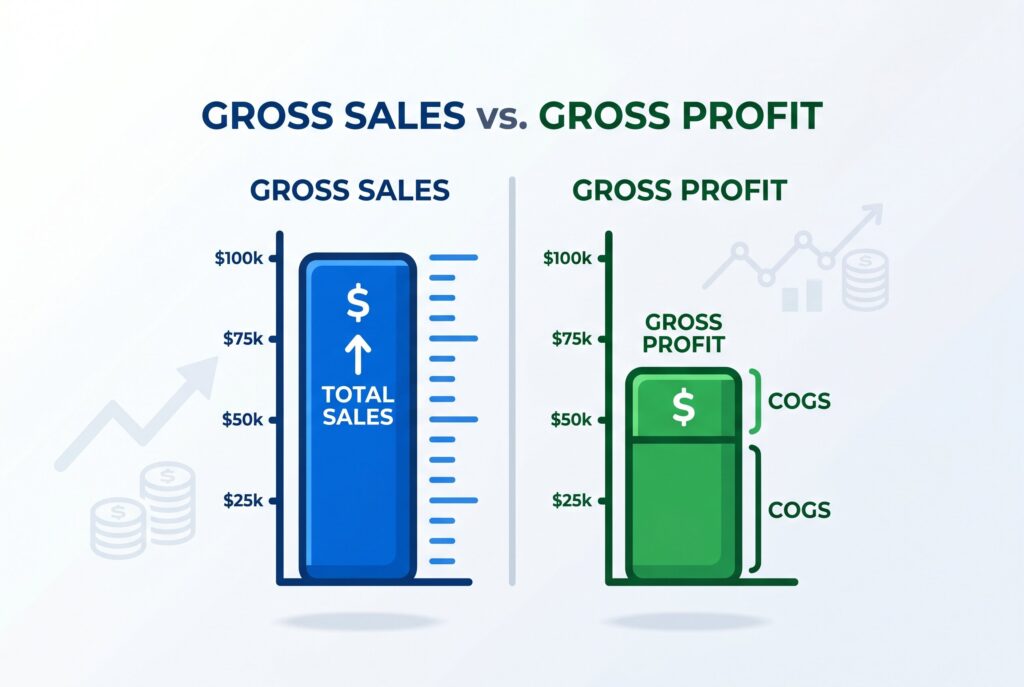
Gross sales and gross profit aren’t the same thing.
Gross sales is money generated before deductions. Gross profit is what remains after subtracting cost of goods sold, or COGS, from net sales.
Here’s the difference:
- Gross Sales = Total sales before deductions
- Net Sales = Gross sales − returns, discounts, and allowances
- Gross Profit = Net sales − COGS
For example, if gross sales are $100,000, deductions are $15,000, and COGS is $50,000, net sales are $85,000 and gross profit is $35,000. This distinction matters because gross sales don’t show profitability. A company can have high gross sales and still lose money if product costs, labor, rent, advertising, or refunds are too high.
Conclusion
Gross sales is a useful starting point. It shows how much customers bought before deductions and helps measure demand, campaign performance, and sales volume. But it shouldn’t be used alone. Celebrate strong gross sales as a marketing and sales win, then compare them with net sales, gross profit, and net profit. If the gap between gross sales and net sales is too wide, fix the reason behind it. These days, smart business owners don’t just ask, “How much did we sell?” They ask, “How much did we keep, and what did it cost us to get there?”