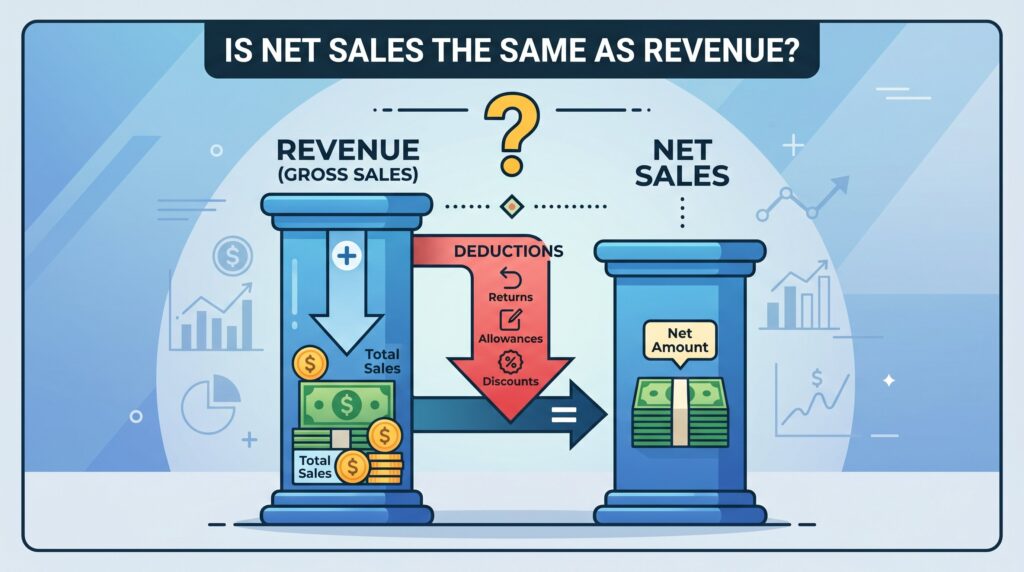
Is net sales the same as revenue? Not always. Net sales vs revenue is a common source of confusion because the two terms are often used casually as if they mean the same thing. But on a financial statement, mixing them up can lead to poor valuation, weak reporting, and bad strategy. Net sales focuses on money from core sales after deductions. Revenue is broader and can include all income streams.
What is Net Sales?

What is net sales? Net sales is the amount a company keeps from core sales after subtracting the “big three” deductions: returns, allowances, and discounts.
The net sales formula is:
Net Sales = Gross Sales − Returns − Allowances − Discounts
Gross sales show the full value of sales before deductions. Net sales show what remains after customers return products, receive partial refunds, or use discounts. For example, if a retailer has $500,000 in gross sales, $30,000 in returns, $10,000 in allowances, and $15,000 in discounts, net sales are $445,000. This number matters because it shows sales quality. If gross sales are high but net sales are much lower, the business may have product issues, aggressive discounting, or unhappy customers.
What is Revenue?

Revenue is the total money a business earns from its activities. For many small businesses, revenue and net sales may look nearly identical because the company only earns money by selling products or services. But for larger or growing businesses, revenue can include more than sales. Total revenue may include operating revenue and non-operating revenue.
Operating revenue comes from the company’s main business, such as product sales, service fees, subscriptions, or billable hours. Non-operating revenue can include interest earned from cash reserves, royalties, licensing fees, rental income, or gains from selling old equipment. That’s why net revenue and total revenue need careful reading. Net revenue may sometimes refer to sales after deductions, but total revenue can include income outside normal sales activity.
Interactive Tool: The Sales vs. Revenue Simulator
A sales vs revenue simulator should let users enter gross sales, returns, discounts, allowances, and non-operating income. Then it should calculate net sales and total revenue separately.
For example:
Gross Sales: $1,000,000
Returns: $50,000
Net Sales: $950,000
Interest Income: $10,000
Licensing Income: $40,000
Total Revenue: $1,000,000
This makes the difference clear. The business generated $950,000 from core sales after deductions, but total revenue reached $1,000,000 because of extra income sources.
2026 Sales vs. Revenue Simulator
Compare core net sales with total revenue after adding non-operating income.
Sales vs. Revenue Breakdown
Net Sales = Gross Sales − Returns − Discounts − Allowances
Total Revenue = Net Sales + Interest Income + Licensing Income
Side-by-Side: Net Sales vs. Revenue
Net sales has a narrow scope. It focuses on core sales only. Revenue has a broader scope. It can include all income streams. Net sales are always reduced by returns, discounts, and allowances. Revenue may include operating income and non-operating income, depending on reporting style.
Net sales measure sales quality and demand. Revenue measures total business inflow. Net sales usually come from product sales, services, subscriptions, or billable work. Revenue may also include interest, rent, royalties, licensing, or other gains.
Real-World Scenario: The Home Tech Retailer

Imagine a smart home organization company sells $1,000,000 in smart storage bins. That is gross sales. Customers return $50,000 of products because of sizing issues and damaged shipments. After returns, net sales are $950,000. During the same year, the company also earned $10,000 in interest from cash reserves and $40,000 from licensing its app software to a partner.
Its total revenue is:
$950,000 net sales + $10,000 interest + $40,000 licensing income = $1,000,000 total revenue
This example shows why the distinction matters. The company’s sales engine produced $950,000, while the full business generated $1,000,000 in total revenue.
Why Tracking Both Matters for Your Valuation

Tracking both numbers helps you understand where money is really coming from. If total revenue is rising but net sales are flat, the business may not be growing its core customer base. It may be relying on one-time asset sales, interest income, licensing deals, or other non-core income.
That can affect valuation. Investors, lenders, and buyers usually care about repeatable operating performance. One-time revenue may help cash flow, but it doesn’t always prove the core business is stronger. Net sales also help managers spot operational problems. A widening gap between gross sales and net sales may mean returns are rising, discounts are too generous, or product expectations aren’t being met. Revenue gives the big picture. Net sales show whether the core business is healthy.
Conclusion
Net sales and revenue are related, but they aren’t always the same. Net sales focuses on core sales after deductions. Revenue can include every income stream. Financial precision matters. Don’t use these terms loosely when reviewing reports, pitching investors, applying for financing, or evaluating growth. To understand your business clearly, separate gross sales, net sales, net revenue, total revenue, and profit. The more precisely you track where money comes from, the better your decisions will be.