
Gross sales can look impressive, but net sales show the real health of your business. If you want to know how to calculate net sales, you need to subtract the money lost to returns, allowances, and discounts. Net sales gives owners, managers, and finance teams a cleaner view of actual top-line revenue, especially when refunds, promotions, and customer adjustments are rising.
Net Sales vs. Gross Sales: What is the Difference?

Gross sales are the sticker price total. They show the full value of everything sold before any deductions. Net sales are what actually remains after customers return products, receive allowances, or use discounts. That’s why net sales vs gross sales matters. Gross sales may show demand, but net sales show revenue quality.
For example, if your store sells $80,000 in products but customers return $10,000 and use $5,000 in discounts, your business didn’t really keep $80,000 in sales. Your net sales are $65,000. Gross sales vs net sales isn’t just accounting language. It helps reveal whether your sales strategy is healthy or hiding problems.
Interactive Net Sales Calculator: The Tool
A net sales calculator should include four inputs: gross sales, returns, allowances, and discounts. Once you enter those numbers, the tool should instantly show net sales and the percentage lost to deductions.
For example:
Gross Sales: $120,000
Returns: $12,000
Allowances: $3,000
Discounts: $5,000
Net Sales = $120,000 – ($12,000 + $3,000 + $5,000)
Net Sales = $100,000
The most important insight is the deduction gap. If you lost $20,000 from $120,000 in gross sales, your deduction rate is 16.7%. That may be normal in some industries, but it could also signal excessive returns, poor product fit, or aggressive discounting.
Interactive Net Sales Calculator
The Net Sales Formula: A Step-by-Step Breakdown
The net sales formula is simple:
Net Sales = Gross Sales − (Sales Returns + Sales Allowances + Sales Discounts)
To calculate it, start with gross sales. This is the total value of sales before deductions. Next, subtract sales returns. These are refunds given to customers who return products. E-commerce businesses should watch this closely because return rates can quickly reduce real sales.
Then subtract sales allowances. These are partial price reductions given when customers keep a product but receive compensation for a defect, delay, or issue. For example, if a customer keeps a slightly damaged item and receives $50 back, that $50 is a sales allowance. Finally, subtract sales discounts. These include promotional discounts, early payment discounts, seasonal coupons, or volume-based price reductions. A common business example is “2/10, n/30,” meaning the customer gets a 2% discount if they pay within 10 days.
Is Net Sales the Same as Revenue?
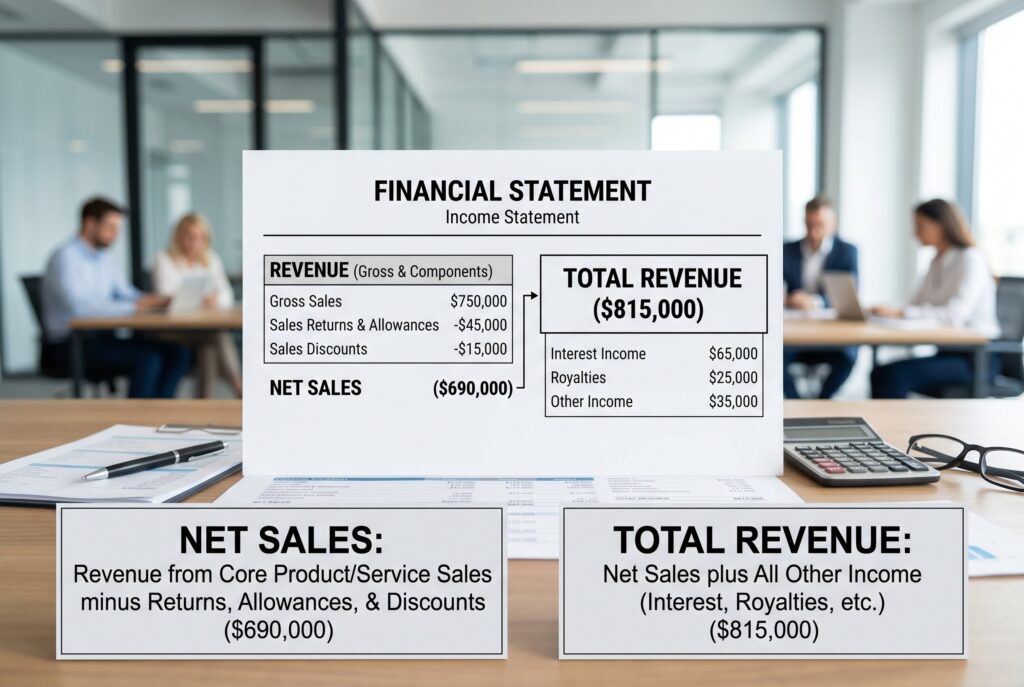
Is net sales the same as revenue? Sometimes people use the terms casually, but they aren’t always identical. Net sales usually refers to revenue from core sales after returns, allowances, and discounts. Revenue can be broader. It may include other income such as interest, royalties, rental income, or asset-sale gains. Net revenue is often used similarly to net sales when a business mainly earns money from selling products or services. Still, the safest approach is to check how the company defines revenue on its income statement.
3 Strategic Reasons Why Your Net Sales Are Dropping

The first reason is product quality issues. If returns are rising, customers may be unhappy with sizing, durability, shipping condition, or product descriptions. High returns aren’t just a finance problem. They’re a customer experience signal.
The second reason is aggressive discounting. Discounts can increase order volume, but too many discounts weaken net sales. If customers only buy when prices are reduced, your pricing strategy may need work. The third reason is pricing misalignment. High allowances may mean customers feel the product value doesn’t match the price. If your team keeps giving partial refunds to save relationships, your offer, quality control, or delivery process may need review.
Net Sales on the Income Statement
Net sales appear near the top of the income statement. They’re a revenue line, not an expense line.
A simplified income statement looks like this:
Gross Sales
Less: Sales Returns
Less: Sales Allowances
Less: Sales Discounts
Net Sales
Less: Cost of Goods Sold
Gross Profit
This structure matters because net sales aren’t the same as gross profit. Net sales subtract customer-related sales deductions only. Gross profit subtracts COGS from net sales. For example, if net sales are $100,000 and COGS is $60,000, gross profit is $40,000.
Conclusion
Net sales show whether your business is growing in a way that actually sticks. Gross sales may look good, but net sales reveal what you keep after refunds, allowances, and discounts. Review net sales every month. If the gap between gross sales and net sales is growing, investigate returns, discounting, product quality, customer expectations, and pricing. Real growth isn’t just selling more. It’s keeping more of what you sell.