


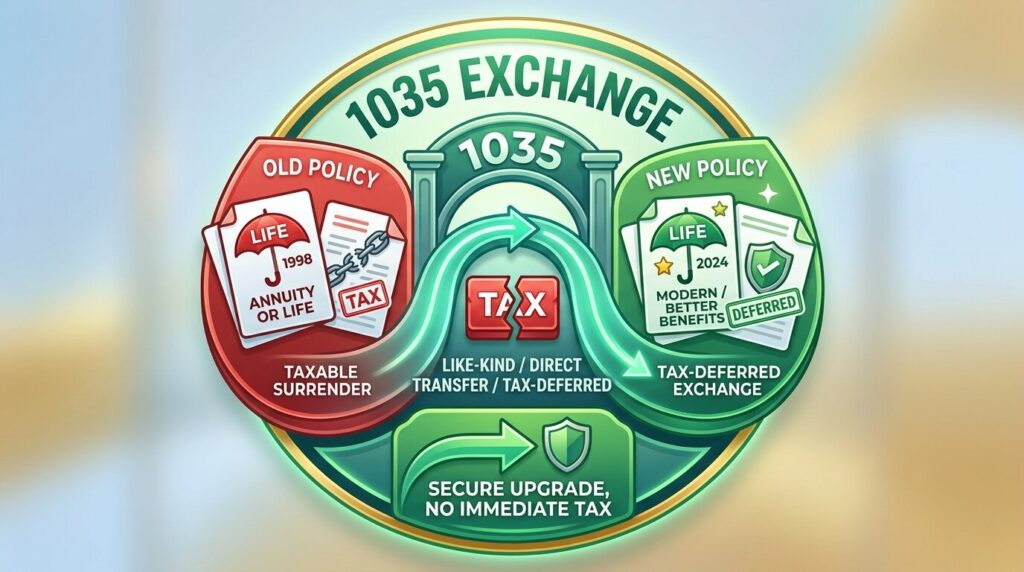
What is a 1035 exchange? A 1035 exchange is a tax-free insurance exchange that lets you move cash value from an old life insurance policy, annuity, or endowment contract into another qualifying contract without immediately paying income tax on unrealized gains. In 2026, it can be a powerful way to update outdated coverage, reduce fees, improve annuity features, or realign your policy with retirement income goals. But a 1035 exchange isn’t automatically the right move. Surrender charges, policy loans, cost basis, and product restrictions can turn a smart strategy into an expensive mistake.
Allowed vs. Not Allowed: The 2026 1035 Matrix
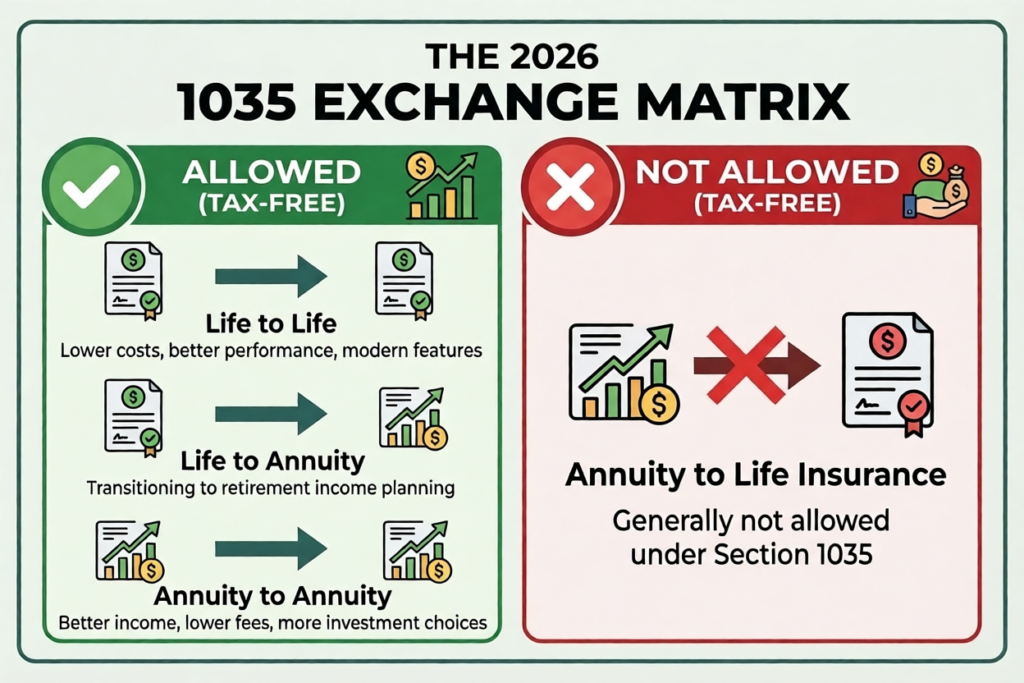
Not every transfer qualifies. The direction of the exchange matters. Allowed exchanges usually include life insurance to life insurance, life insurance to annuity, annuity to annuity, and endowment to another qualifying contract. A life insurance 1035 exchange may make sense when an old policy has high internal costs, weak performance, or outdated features. A tax-free annuity exchange may help when an existing annuity has poor income options, high fees, or limited investment choices. A life insurance to annuity 1035 exchange is allowed because the policyholder is moving from insurance protection toward retirement income planning.
The most common mistake is trying to move from annuity to life insurance. That generally isn’t allowed as a tax-free 1035 exchange. Once money is inside an annuity, it usually can’t move back into life insurance under Section 1035.
Interactive Simulator: 1035 Exchange Cost-Benefit Calculator
A 1035 exchange calculator should compare the old contract with the new one. It should include current cash value, cost basis, surrender charges, outstanding policy loans, new policy fees, new surrender period, expected tax deferral value, and projected income or death benefit improvements.
For example, if your old annuity has $120,000 in cash value and $80,000 cost basis, there is $40,000 of gain. A 1035 exchange may defer tax on that gain. But if the old contract has a $7,000 surrender charge and the new contract starts a fresh 10-year surrender period, the benefit may not be worth the cost. The point isn’t just to avoid taxes. The new policy should be meaningfully better.
1035 Exchange Cost-Benefit Calculator
Use this simulator to compare an old contract with a potential new policy or annuity. Enter current cash value, cost basis, surrender charges, policy loans, new policy fees, expected tax deferral value, and projected income or death benefit improvements.
Old Contract
New Contract
Embedded Gain = Current Cash Value − Cost Basis
Total Exchange Costs = Surrender Charges + Outstanding Policy Loans + New Policy Fees
Total Estimated Benefits = Expected Tax Deferral Value + Projected Income Improvement + Projected Death Benefit Improvement
Net Benefit = Total Estimated Benefits − Total Exchange Costs
Benefit-Cost Ratio = Total Estimated Benefits ÷ Total Exchange Costs
Note: This calculator is for educational comparison only. A 1035 exchange can involve tax rules, surrender schedules, policy loans, product suitability, liquidity risk, and insurance-specific terms. Review the exchange with a qualified financial, tax, or insurance professional before making a decision.
The Hidden Trap: Policy Loans and Boot
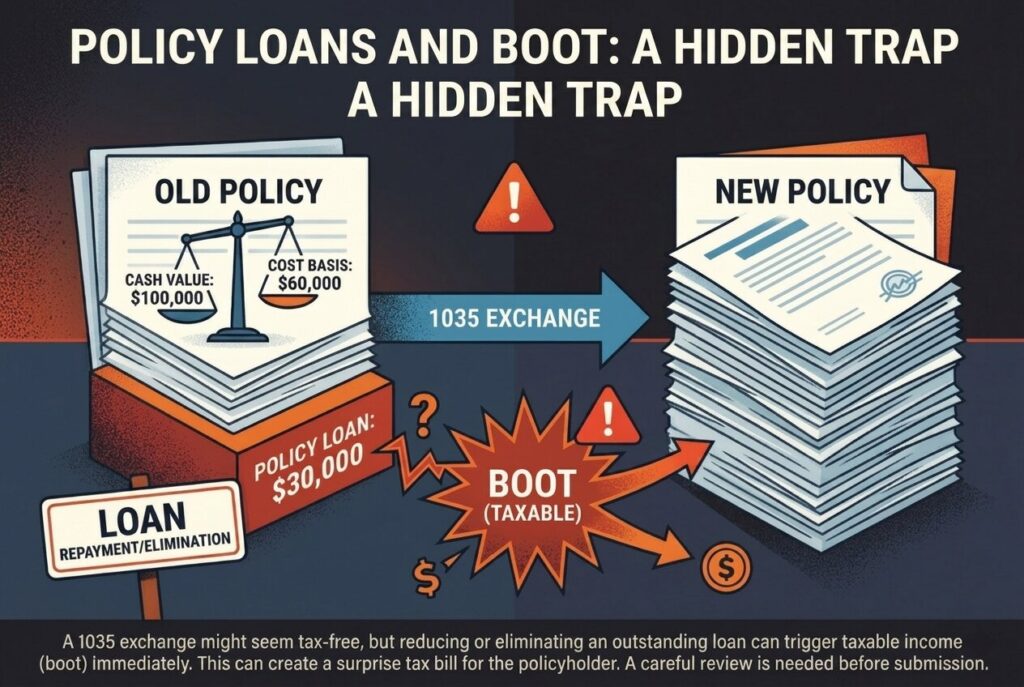
Policy loans can create one of the biggest 1035 exchange traps. If an old life insurance policy has an outstanding loan, and that loan is reduced, paid off, or eliminated during the exchange, the IRS may treat the debt relief as “boot.” Boot means value received outside the qualifying exchange. It can be taxable immediately.
For example, suppose a policy has $100,000 in cash value, $60,000 in cost basis, and a $30,000 policy loan. If the exchange eliminates that loan, part of the transaction may be treated as taxable income. The policyholder may think the entire move is tax-free, but the loan treatment can create a surprise tax bill. This is why a policy loan 1035 exchange needs careful review before paperwork is submitted.
Partial 1035 Exchanges: New Rules for 2026
A partial 1035 exchange lets a policyholder move part of an annuity or policy value into a new contract while keeping the original contract active. This can be useful when you want to diversify annuity providers, create different income start dates, or keep certain legacy benefits. However, partial exchanges are more sensitive than full exchanges. Timing matters. If you take withdrawals too soon after a partial exchange, the IRS may view the transaction as connected and taxable. Practitioners often watch the 180-day period carefully when planning post-exchange withdrawals. The key rule is simple: don’t treat a partial 1035 exchange like a quick cash-out strategy. It should be structured as a genuine policy or annuity exchange.
Step-by-Step: The 2026 1035 Execution Process
- First, request an in-force illustration. This shows how your current life insurance or annuity is performing, including cash value, death benefit, fees, surrender charges, and projected future values.
- Second, compare costs. Look at surrender charges, new policy expenses, riders, commissions, and new surrender periods. A cheaper-looking contract may become expensive if the fine print is weak.
- Third, verify ownership. The same owner rule matters. The owner and insured or annuitant structure generally must remain consistent for the exchange to qualify.
- Fourth, use a direct transfer. The new insurance company should request funds directly from the old company. You shouldn’t take a personal check and then deposit it into the new contract. That can break the exchange and create taxes.
- Fifth, keep records. Save exchange forms, surrender charge disclosures, 1099-R documents, cost basis records, and policy illustrations.
Conclusion
A 1035 exchange can be a valuable tax-deferral strategy, but it isn’t just a tax trick. The real purpose is to improve the contract. Use it when a new life insurance policy, annuity, or long-term planning product gives you better features, lower costs, stronger guarantees, or a clearer retirement income path.
Don’t use it just because someone says “tax-free.” Tax-free doesn’t mean cost-free. Review surrender charges, cost basis, loans, partial exchange rules, ownership requirements, and new contract terms before signing. A well-planned 1035 exchange can preserve wealth. A rushed one can create taxes, fees, and regret.

