



How do you know when your team is too small, fully optimized, or too crowded? That is exactly where the marginal product of labor becomes useful. In MPL economics, this metric helps managers see how much extra output they gain from adding one more worker or one more labor hour. When labor costs, automation, and productivity tools are all changing fast, MPL is one of the clearest ways to find your hiring sweet spot.
How to Calculate MPL: Step-by-Step with Data
To calculate the marginal product of labor, you need two numbers: total output before adding labor and total output after adding labor.
- Step 1: Identify your starting total output and current staff.
If a small factory produces 25 widgets per hour with 2 workers, that is your baseline. - Step 2: Add one more worker and record the new total output. If output rises to 35 widgets per hour with 3 workers, the added worker increased production.
- Step 3: Subtract the old output from the new output.
35 – 25 = 10 extra widgets. - Step 4: Divide by the change in labor units.
Since you added 1 worker, MPL = 10 / 1 = 10.
Example calculation:
| Workers | Total Output | Marginal Product |
| 1 | 10 widgets | 10 |
| 2 | 25 widgets | 15 |
| 3 | 35 widgets | 10 |
| 4 | 40 widgets | 5 |
This marginal product of labor examples shows that total output keeps rising, but each additional worker adds less output after a certain point.
Interactive Tool: The MPL & Diminishing Returns Simulator
A simple MPL simulator asks three questions:
- How many workers do you have now?
- How much output do they produce?
- How much output do you produce after adding one more worker?
Then it calculates:
MPL = New Output − Old Output
If your MPL rises, your team may be gaining from specialization. If your MPL falls, your team may be hitting space, equipment, training, or coordination limits. For example, a restaurant kitchen may work better when it moves from 1 cook to 2 cooks because one person can prep while the other cooks. But adding the 8th cook may not help if there are only four burners and one prep station.
MPL & Diminishing Returns Simulator
The Law of Diminishing Marginal Returns

The law of diminishing marginal returns explains why MPL eventually drops. It says that when you keep adding labor while holding other inputs constant, each new worker eventually contributes less additional output. Imagine a small restaurant kitchen. With 1 cook, everything is slow. With 2 cooks, output jumps because tasks can be divided. With 3 cooks, the kitchen becomes even more efficient. But with 6 cooks, people start bumping into each other. With 10 cooks, some workers may just stand around waiting for equipment.
The key lesson is simple: just because total output is rising doesn’t mean every new hire is equally valuable. A falling MPL isn’t always a sign that workers are bad. It may mean the business needs more capital, such as better software, more machines, a larger kitchen, stronger processes, or improved training.
MPL vs. MRP: Why You Must Know the Difference

MPL measures output units. Marginal revenue product measures money.
MPL answers: “How many extra units did one more worker produce?”
MRP answers: “How much extra revenue did that worker create?”
For example, if one added worker helps produce 5 extra pizzas per hour, the MPL is 5 pizzas. If those pizzas sell for $20 each, the marginal revenue product is $100 per hour.
Formula:
MRP = MPL × Marginal Revenue
This distinction matters for hiring. A business should hire workers only as long as their marginal revenue product is greater than their wage. If a worker adds $100 per hour in revenue and costs $60 per hour, hiring makes sense. If the worker adds only $40 per hour but costs $60, the company may lose money by expanding labor. This is also where marginal product connects to staffing strategy. Labor isn’t just a cost. It is an input that should generate measurable output and revenue.
Marginal Product of Labor vs Marginal Revenue Product
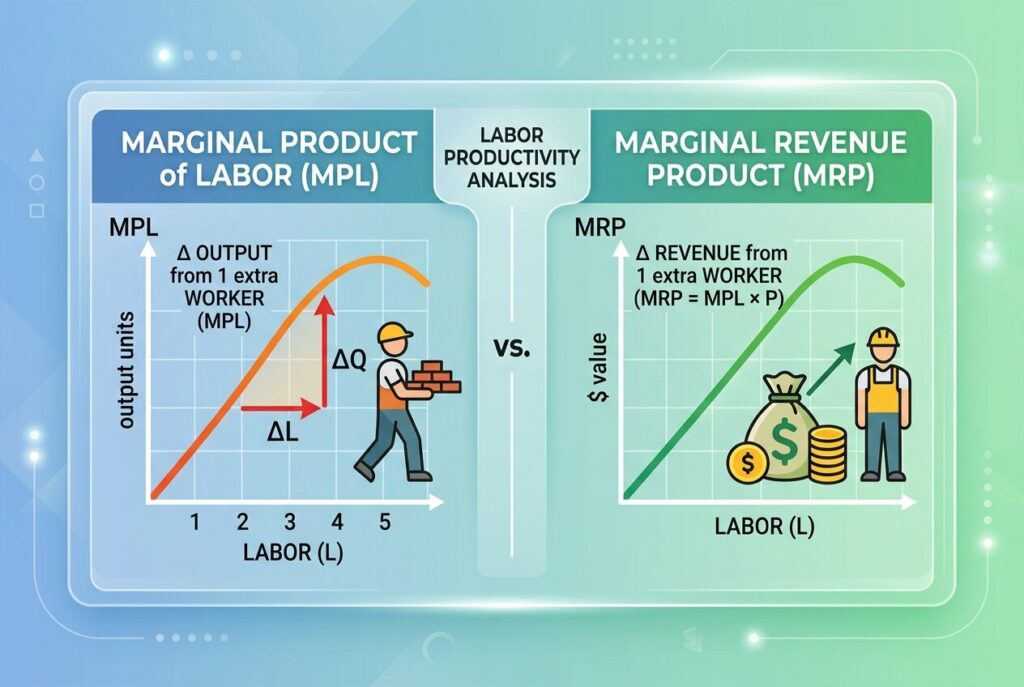
Marginal product of labor vs marginal revenue product is one of the most common points of confusion. Marginal product of labor is a physical productivity measure. It counts units, meals, orders, appointments, tickets, or completed tasks. Marginal revenue product is a financial measure. It translates that added output into dollars.
For example, a support team member may close 12 extra tickets per day. That is the worker’s marginal product. If those solved tickets improve retention and protect $600 in daily revenue, that is the marginal revenue product. This difference matters because managers shouldn’t make hiring decisions based on activity alone. More output is helpful only if the value of that output justifies the labor cost.
Common Pitfalls in Calculating MPL
The First Mistake: Assuming Capital Stays Useful Forever
The first mistake is assuming capital stays useful forever. MPL calculations hold other production factors constant, but in real life, equipment, software, space, and management capacity can become bottlenecks. If you add workers but don’t add more tools, computers, machines, or stations, MPL will eventually drop.
The Second Mistake: Assuming All Workers Are Identical
The second mistake is assuming all workers are identical. Labor units are rarely perfectly equal. One experienced worker may produce more than two untrained workers. That means MPL should be interpreted carefully, especially in skilled roles.
The Third Mistake: Measuring Output Too Broadly
The third mistake is measuring output too broadly. If you add one salesperson, don’t measure total company revenue without considering market demand, seasonality, pricing changes, and marketing spend.
The Fourth Mistake: Ignoring Quality
The fourth mistake is ignoring quality. A worker may increase output but also increase errors, refunds, waste, or customer complaints. True productivity should consider usable output, not just raw volume.
Conclusion
Marginal product of labor is more than an economics formula. It’s a practical hiring and productivity tool. It helps managers see whether adding another worker will improve output, create revenue, or simply crowd the system. If your MPL is rising, more labor may help. If MPL is falling quickly, the smarter move may be investing in better software, equipment, training, or workspace instead of hiring more staff. The most efficient businesses won’t simply add headcount. They will use MPL to understand when people, process, and capital are working together.

