


Retirement planning used to feel simpler. Save money, contribute to your 401(k), retire someday. But modern retirement planning is no longer just about saving. It’s about choosing the right tax structure, the right withdrawal flexibility, and the right long-term strategy.
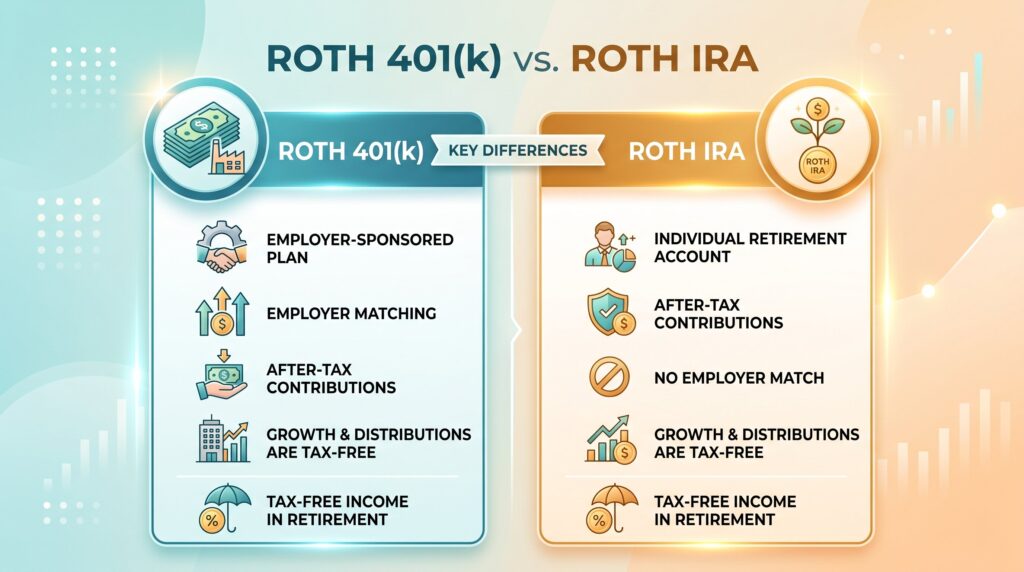
That’s why so many investors compare Roth 401(k) vs Roth IRA. Both accounts use after-tax contributions. Both offer the potential for tax-free withdrawals. Both can help create tax-free retirement income. Yet the differences between them can dramatically shape your flexibility, investment choices, contribution capacity, and long-term retirement strategy.
The truth is, this isn’t really a battle between two accounts. It’s a decision about control, access, and future taxes.
Roth Account Optimizer
Start with four questions. Do you have access to an employer-sponsored retirement plan with matching contributions? Are you above Roth IRA income limits? Do you want maximum contribution capacity? Do you value investment freedom more than convenience?
If employer matching contributions are available, most workers should contribute enough to capture the full match first. That match is essentially additional compensation. After that, many investors choose between maximizing the Roth 401(k), contributing to a Roth IRA, or splitting contributions between both accounts for flexibility.
The Core Difference Between Roth 401(k) and Roth IRA
At first glance, the accounts look similar because both use after-tax contributions and can produce tax-free withdrawals in retirement. But structurally, they’re very different.
| Feature | Roth 401(k) | Roth IRA |
| Sponsored by | Employer | Individual |
| Contribution limits | Higher | Lower |
| Employer match | Possible | None |
| Income limits | None | Yes |
| Investment choices | Limited to plan menu | Broad flexibility |
| Loan availability | Sometimes allowed | No |
| Payroll deductions | Automatic | Self-funded |
| Ownership | Tied to employer plan | Fully individual |
The biggest emotional difference is ownership. A Roth IRA feels personal. A Roth 401(k) feels institutional because it lives inside a workplace retirement system.
Roth 401(k): The Strength of Scale
A Roth 401(k) works well for people who want structure and contribution power.
Higher Contribution Limits
One major advantage is contribution capacity. For 2026, employee 401(k) contribution limits increased to $24,500, with catch-up contributions available for eligible older workers. That’s dramatically higher than Roth IRA contribution limits. For high earners or aggressive savers, this matters because the ability to shelter more money in a Roth structure can compound over decades.
Employer Match Matters
Employer match is another powerful advantage. A Roth IRA doesn’t come with matching dollars. A Roth 401(k) may. Even if the match portion receives separate tax treatment depending on plan structure, matching contributions still increase retirement savings significantly over time. Ignoring the match is often equivalent to declining part of your compensation package.
No Roth 401(k) Income Limits
A common misunderstanding involves Roth 401(k) income limits. Roth IRAs have income phaseouts. Roth 401(k)s generally don’t. This makes the Roth 401(k) especially attractive for high earners who exceed Roth IRA eligibility thresholds but still want Roth style retirement savings.
Roth IRA: The Strength of Freedom

If the Roth 401(k) is about scale, the Roth IRA is about flexibility.
Broader Investment Options
A Roth IRA usually offers far more investment freedom than a workplace plan. Instead of choosing from a limited employer menu, investors can often access individual stocks, ETFs, bonds, mutual funds, and specialized investment strategies. For experienced investors, this flexibility matters.
More Withdrawal Flexibility
Roth IRA withdrawal rules are also generally more flexible in certain situations. Contributions can often be accessed differently from earnings, which creates more liquidity options compared with many workplace retirement plans. That flexibility can matter for early retirees, entrepreneurs, or people pursuing financial independence before traditional retirement age.
Independent Ownership
A Roth IRA belongs entirely to you. It doesn’t depend on your employer, HR department, or plan administrator. If you change jobs, your account stays exactly where it’s. That emotional sense of ownership matters more than many people expect.
How Income Changes the Decision

Young Professionals and Low Earners
For young professionals, Roth accounts often make strong sense because current tax rates may be relatively low compared with future earnings. Paying taxes now while income is modest can create decades of tax-free growth later. This is one reason Roth contributions remain especially popular among early-career workers.
Peak Earning Years
For high-income professionals, the analysis becomes more nuanced. A high earner may prefer traditional pre-tax contributions for part of retirement savings while still using Roth accounts strategically for diversification. Others may prioritize Roth 401(k)s specifically because Roth IRA income limits restrict direct IRA contributions. This is why Roth 401(k) vs traditional planning and Roth 401(k) vs Roth IRA planning often overlap. Retirement tax strategy rarely exists in isolation.
Nuances Many Beginners Miss
Required Minimum Distributions
Required Minimum Distributions, or RMDs, used to create a major difference between Roth accounts. Roth 401(k)s previously faced lifetime RMD rules for original owners, while Roth IRAs didn’t. That changed under SECURE 2.0. Roth 401(k)s are no longer subject to lifetime RMDs for original account owners beginning with tax year 2024. This made Roth 401(k)s significantly more attractive for long-term retirement planning.
The Roth 401(k) Five-year Rule
The Roth 401(k) five-year rule is another important nuance. Qualified withdrawals generally require satisfying the five-year holding period and meeting certain distribution conditions. Many beginners mistakenly assume all Roth money is automatically tax-free anytime. The timing rules matter.
You Can Use Both
One of the biggest mistakes is treating the decision as either-or. Many investors contribute enough to their Roth 401(k) to receive the full employer match, then fund a Roth IRA for additional flexibility. Others maximize both. The accounts can complement each other beautifully when used strategically.
Which Roth Account Usually Wins?
Choose a Roth 401(k) if:
- You want higher contribution limits
- You have access to employer match
- You’re a high earner blocked from direct Roth IRA contributions
- You prefer payroll automation
- You want simple workplace investing
Choose a Roth IRA if:
- You want broader investment choices
- You value withdrawal flexibility
- You want independent ownership
- You prefer controlling your own brokerage account
- You may retire early or want flexible access strategies
Conclusion
The best retirement strategy rarely comes from choosing the “perfect” account. It comes from understanding how different accounts work together. When comparing a Roth IRA vs Roth 401(k), the difference is not about which one is universally better. It is about how each account fits your income, tax strategy, and long term retirement goals.
A Roth 401(k) offers contribution power, employer matching contributions, and workplace simplicity. A Roth IRA offers investment freedom, personal ownership, and flexibility. Both create the possibility of tax free withdrawals and long term tax diversification. The real goal is not winning the Roth IRA vs Roth 401(k) debate. It is building a retirement structure flexible enough to support the future version of your life.

