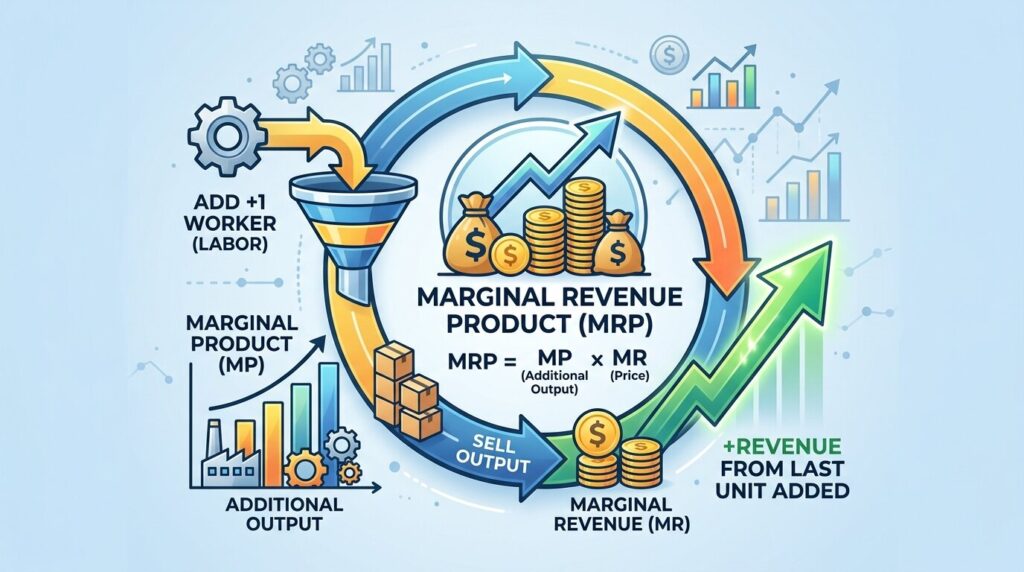
Marginal revenue product is one of the clearest rules for hiring and investment decisions: only add a new employee, machine, tool, or resource if the revenue it creates is greater than its cost. MRP helps businesses measure productivity in dollars, not just units. That makes it useful for workforce planning, wage decisions, automation strategy, and capital allocation.
How to Calculate MRP: A Step-by-Step Guide

To calculate MRP, follow three steps.
- Step 1: Calculate the Marginal Product (MP).
Ask: how many extra units does the new resource produce? For example, if hiring one more software engineer helps your team ship 200 more app subscriptions, the MP is 200 subscriptions. - Step 2: Identify the Marginal Revenue (MR).
Ask: how much revenue does each extra unit generate? If each additional subscription sells for $10, the MR is $10. - Step 3: Multiply MP by MR.
MRP = 200 × $10 = $2,000
That engineer’s marginal revenue product is $2,000 for that measured period. If the engineer costs less than $2,000 during that same period, the hire may create positive value. If the cost is higher, the business needs to rethink the role, pricing, productivity, or timeline.
Interactive Tool: The MRP & Hiring Decision Calculator
You can build a simple hiring decision calculator with four inputs:
- Extra output created by the worker or machine
- Revenue earned per extra unit
- Cost of the worker or machine
- Time period being measured
Example:
- Extra output: 50 units per week
- Marginal revenue: $40 per unit
- MRP: 50 × $40 = $2,000 per week
- Weekly cost of input: $1,500
- Net gain: $500 per week
In this case, adding the input makes sense. But if the weekly cost rises to $2,300, the business loses $300 per week from that decision. This is the heart of MRP analysis: it turns “Should we hire?” into a measurable revenue question.
MRP & Hiring Decision Calculator
Understanding the MRP Curve & Diminishing Returns
The marginal revenue product curve usually slopes downward. The reason is the law of diminishing marginal returns. At first, adding workers or machines can increase output quickly. A second cook in a restaurant kitchen may dramatically increase meal production because tasks can be split. A second sales rep may help cover more leads. A second machine may remove a bottleneck.
But eventually, fixed resources become crowded. Too many workers may compete for the same equipment. Too many sales reps may chase the same leads. Too many machines may sit idle because there isn’t enough demand. As marginal product falls, MRP also falls. If each new worker produces fewer extra units, and revenue per unit stays the same or declines, the dollar value of each added worker drops. This is why the MRP curve is also connected to the factor demand curve. Businesses demand more labor or capital only while the added input creates enough revenue to justify its cost.
MRP vs. VMP: What’s the Difference?
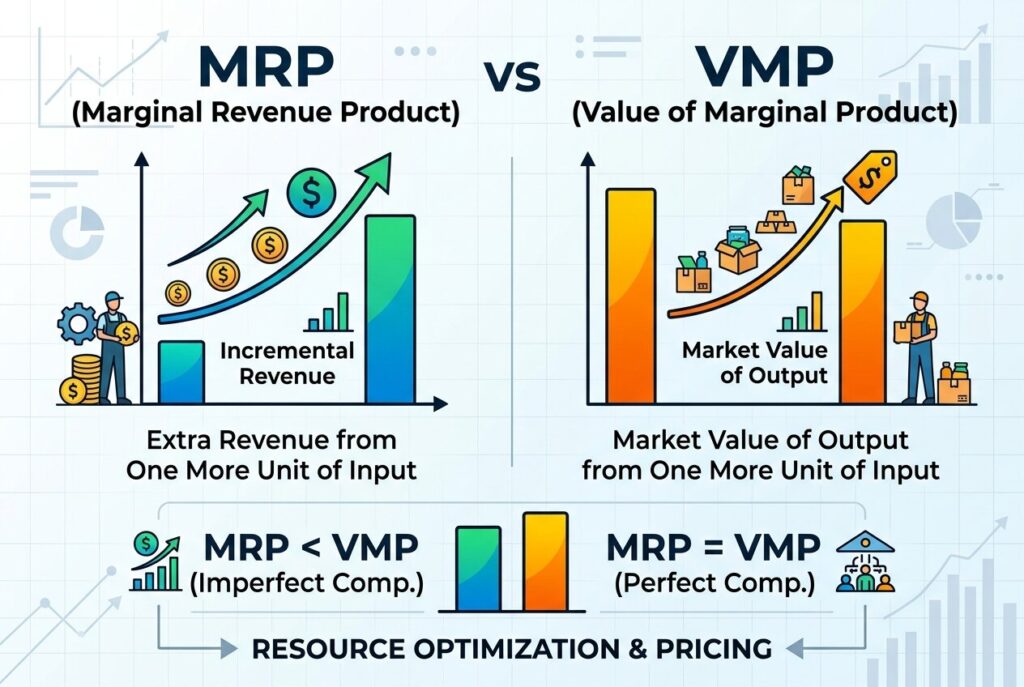
MRP and VMP are related, but they aren’t always the same.
MRP stands for Marginal Revenue Product. It uses marginal revenue:
MRP = MP × MR
VMP stands for Value of Marginal Product. It uses price:
VMP = MP × Price
The difference matters because marginal revenue and price aren’t always equal. In perfect competition, a business can sell more units at the market price, so price and marginal revenue are the same. In that case, MRP and VMP may match. In imperfect competition, such as monopolies, oligopolies, or markets with pricing power, a business may need to lower prices or offer discounts to sell more. That means marginal revenue may be lower than price. In those cases, MRP is the more realistic measure for hiring and production decisions.
Why MRP Drives Your Salary
MRP and wages are closely connected. In a competitive labor market, an employer generally won’t pay a worker more than the revenue that worker adds to the business.
If a worker’s MRP is $30 per hour and they demand $35 per hour, the business loses $5 for every hour they work. If the worker’s MRP is $50 per hour and the wage is $35, the worker creates $15 of additional value per hour. This logic also explains labor demand. A company will keep hiring as long as each additional worker’s MRP is greater than the wage. Hiring usually slows or stops when MRP equals the wage.
That doesn’t mean wages are always perfectly fair or perfectly measured. Real wages can be affected by bargaining power, labor shortages, unions, regulation, benefits, training costs, and market conditions. But MRP remains a powerful framework for understanding why some roles command higher pay than others.
Strategic Analysis: Automation & AI Impact on MRP
These days, automation and AI are changing how businesses think about marginal revenue product. AI tools can increase the marginal product of individual workers by helping them write faster, analyze data, automate repetitive tasks, serve more customers, or produce better decisions. For example, one finance analyst using AI-assisted reporting tools may complete the work that previously required two analysts. A marketer using automation may launch more campaigns without adding headcount. A developer using AI coding support may ship features faster.
When tools increase output per worker, they can raise that worker’s MRP. This is why AI-literate employees may justify higher wages: they don’t only perform tasks, they create more revenue per hour. However, automation also changes the hiring rule. If a machine or software tool creates more MRP than a new employee, the business may invest in technology instead of labor. The best decision depends on cost, scalability, quality, risk, and long-term flexibility.
Conclusion
Marginal revenue product helps businesses move beyond physical output. Producing more units, closing more tickets, or working more hours isn’t enough if the added activity doesn’t create enough revenue. The core lesson is simple: measure productivity by the dollar value of the output. If MRP is greater than input cost, hiring or investing may make sense. If MRP is lower than cost, growth may destroy profit. The smartest businesses won’t simply ask, “Can this person or machine produce more?” They’ll ask, “Will the extra output create enough revenue to pay for itself?”
Related Articles
Marginal Product of Labor (MPL): Calculation & Economic Guide