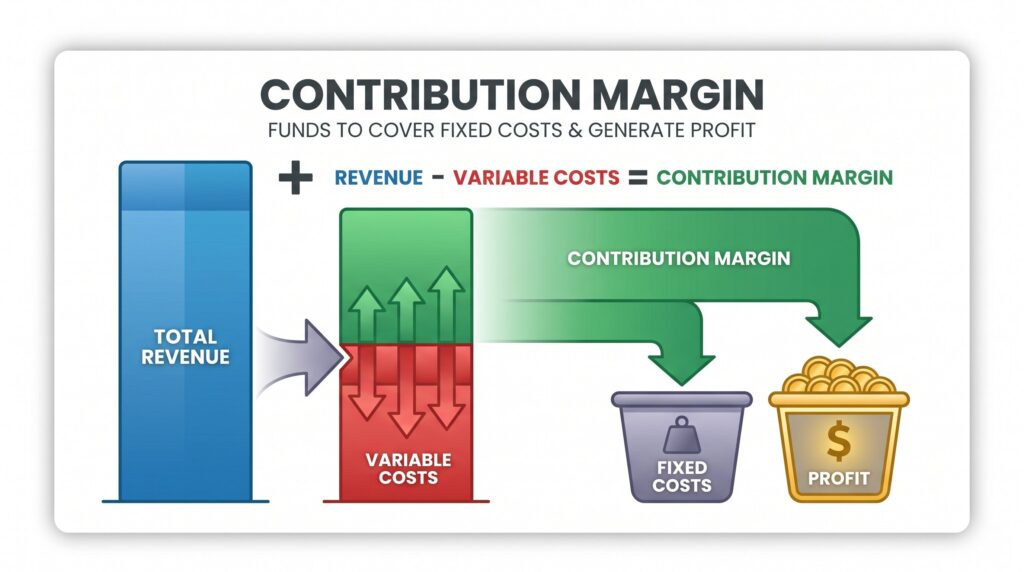
These days, rising costs make revenue alone a weak measure of business health. A product can sell well and still drain profit if its variable costs are too high. That is why contribution margin matters. If you have ever asked what the contribution margin is, the simple answer is this: it shows how much money is left after variable costs are paid, so you can cover fixed costs and generate profit.
What Is Contribution Margin?
Contribution margin is the amount left from sales revenue after subtracting variable costs. Variable costs are expenses that change with sales volume, such as raw materials, packaging, payment processing fees, direct labor, or shipping tied to each order. The remaining amount “contributes” toward fixed costs like rent, salaries, insurance, software, and utilities. After fixed costs are covered, the rest becomes operating profit. This is why contribution margin is so useful for pricing, product decisions, and break-even analysis.
The Contribution Margin Formula: How To Calculate It
The basic contribution margin formula is:
Contribution Margin = Net Sales Revenue − Variable Costs
For example, imagine you sell a T-shirt for $30. The blank shirt, printing, packaging, and payment fees cost $12 per shirt. Your contribution margin is $18.
That $18 doesn’t mean pure profit yet. It must first help pay fixed costs like your website, rent, marketing tools, and admin salaries. Once those fixed costs are covered, the remaining contribution margin becomes profit. If you want to know how to calculate contribution margin, start by separating variable costs from fixed costs. Then subtract only the variable costs from revenue. This is also how to find contribution margin for a product, service, campaign, or sales channel.
Contribution Margin Per Unit Vs. Contribution Margin Ratio
Contribution Margin Per Unit
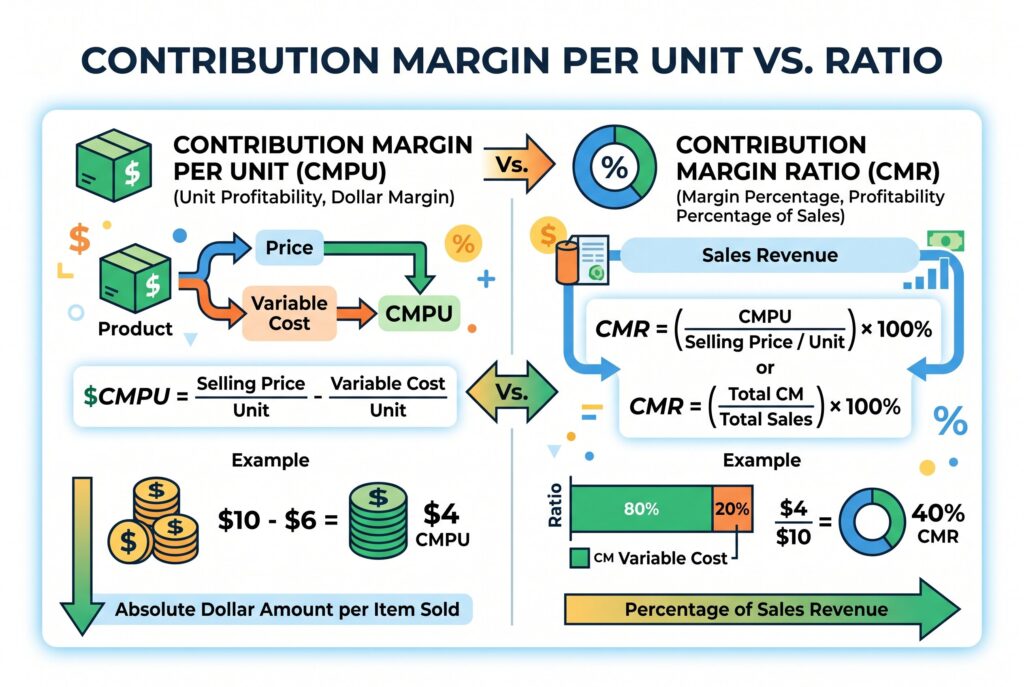
Contribution margin per unit shows how much each individual sale contributes after variable costs. The formula is:
Contribution Margin Per Unit = Selling Price Per Unit − Variable Cost Per Unit
If a product sells for $100 and its variable cost is $60, the contribution margin per unit is $40. This means every unit sold adds $40 toward fixed costs and profit. This metric is useful when comparing products with similar prices or deciding how many units you need to sell. It also helps you spot products that look popular but don’t produce enough margin to justify the work.
The Contribution Margin Ratio Formula
The contribution margin ratio shows contribution margin as a percentage of sales. The contribution margin ratio formula is:
If a product earns $40 in contribution margin on $100 of revenue, the cm ratio is 40%. This means 40 cents of every sales dollar helps cover fixed costs and profit. The contribution margin ratio is especially useful when comparing products with different prices. A $500 product may look better than a $50 product, but the ratio shows which one is actually more efficient.
Profitability And Break-Even Calculator
A profitability and break-even calculator helps turn contribution margin into a decision tool. You enter selling price, variable cost per unit, fixed costs, and expected sales volume. The calculator can then show contribution margin per unit, contribution margin ratio, break-even units, and expected profit.
The break-even formula is:
If your fixed costs are $10,000 per month and your contribution margin per unit is $25, you need to sell 400 units to break even. After that point, each additional unit contributes $25 toward profit.
Contribution Format Income Statement: The Modern Way To View Profits
A contribution margin income statement separates variable costs from fixed costs. This makes it easier to understand how sales volume affects profit. A traditional income statement usually groups costs by accounting category, such as cost of goods sold and operating expenses. That can hide the real break-even structure of the business. A contribution format income statement is more useful for management decisions because it shows sales, variable costs, contribution margin, fixed costs, and operating income.
| Item | Amount |
| Sales Revenue (500 units × $400) | $200,000 |
| Less: Variable Costs (500 units × $180) | $90,000 |
| Contribution Margin | $110,000 |
| Less: Fixed Costs | $70,000 |
| Net Operating Income | $40,000 |
This format is powerful because it reveals whether profit problems come from weak pricing, high variable costs, or excessive fixed costs. It also supports cost-volume-profit analysis and product-level profitability decisions.
3 Ways To Use Contribution Margin To Optimize Profit In 2026
1. Decide Whether To Keep Or Drop A Product
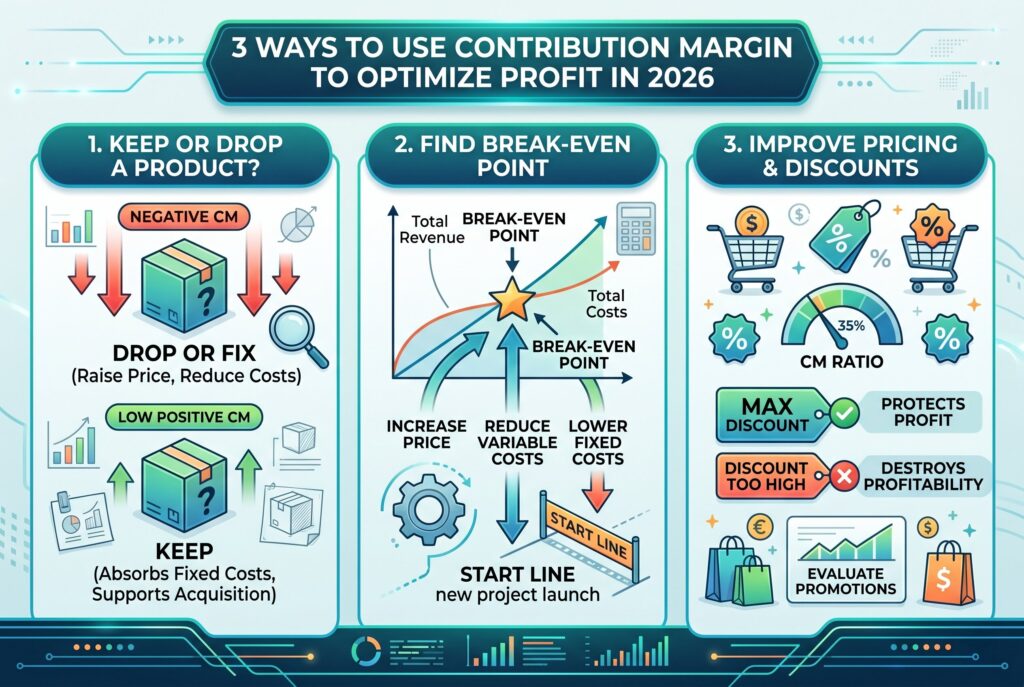
If a product has a negative contribution margin, it is losing money before fixed costs are even considered. That means every sale makes the business worse off. In that case, you may need to raise the price, reduce variable costs, bundle the product differently, or stop selling it. A product with a low but positive contribution margin isn’t always bad. It may still help absorb fixed costs or support customer acquisition. The key is understanding the role it plays.
2. Find Your Break-Even Point
Contribution margin helps you calculate exactly how many units you need to sell before profit begins. This is essential when launching a new product, opening a new location, or testing a new service. If your break-even point is too high, your business may be taking on too much risk. You can improve the model by increasing price, reducing variable costs, or lowering fixed costs.
3. Improve Pricing And Discount Strategy
The CM ratio is one of the best tools for evaluating discounts. If your contribution margin ratio is 35%, a 20% discount may be much more damaging than it appears. You need to know how much room you have before a promotion destroys profitability. This is especially important for ecommerce, retail, and service businesses where discounts are common. Contribution margin helps you set a maximum discount that still protects profit.
Conclusion
Contribution margin is more than an accounting formula. It’s a practical profit lens that shows which products, services, and campaigns actually move the business forward. Use the contribution margin formula whenever you launch a new product, adjust prices, review variable costs, or plan a promotion. Then use the contribution margin ratio and contribution format income statement to compare performance across your business. In 2026, the companies that understand their margins will make better decisions faster.
Related Articles
Contribution Margin Income Statement: Format, Formula And Examples