You just landed a short hauling contract, bought a truck in another state, or need temporary coverage for a specialized rig. Many drivers having the need for custom truck insurance or single truck insurance want flexible short term protection without committing to a full annual policy. That is where one week truck insurance can help.
Short term commercial truck insurance is designed for temporary trucking needs, often lasting from 24 hours to 30 days. It can cover short contracts, seasonal surges, driveaway moves, or coverage gaps, but it must match your exact use. Drivers looking for custom truck insurance should make sure the policy fits their specific truck setup, cargo type, and operating needs. The wrong policy can leave you without broker approval, cargo protection, or FMCSA compliance.
How Much Does One Week Truck Insurance Cost in 2026?
Short-term truck insurance usually costs more per day than an annual policy because the insurer has less time to spread risk. You are paying for speed, flexibility, underwriting, and immediate proof of coverage. Primary liability may cost around $150 to $300 per week for common commercial limits, depending on truck type, state, driver history, and operation. Physical damage may add about $50 to $100 per week, depending on the truck’s value. Motor truck cargo may add roughly $40 to $80 per week, but high-risk cargo can cost more or be declined. Don’t shop by price only. A cheap policy that can’t issue a broker-ready COI or doesn’t cover your exact cargo isn’t really cheap. It’s a compliance gap waiting to happen.
The Covered vs. Not Covered Matrix
Primary Liability vs. Bobtail and Non-Trucking
Primary liability is the core coverage you need when hauling freight for hire. It helps cover injuries or property damage you cause while operating commercially. Brokers often require proof of primary liability before assigning a load. Bobtail and non-trucking liability are different. Bobtail may apply when driving a tractor without a trailer. Non-trucking liability may apply when using the truck for non-business purposes. If you are actively hauling a paid load, bobtail insurance isn’t a substitute for primary liability.
Cargo Coverage Isn’t Automatic
Motor truck cargo insurance protects the freight you are hauling, but it isn’t always included in temporary truck insurance. You must ask for it directly and make sure the cargo type is listed correctly. Some short-term policies exclude hazmat, livestock, refrigerated goods, oversized loads, electronics, jewelry, pharmaceuticals, or other high-value cargo. If the broker requires $100,000 in cargo coverage, your COI must show that limit clearly.
Physical Damage Protects the Truck
Physical damage coverage helps protect your own truck from collision, theft, fire, vandalism, or certain weather events. This matters if you own the truck, finance it, lease it, or are moving a newly purchased vehicle. However, physical damage doesn’t replace liability coverage. It protects the equipment, not the public.
4 Scenarios Where 7-Day Truck Insurance Makes Sense
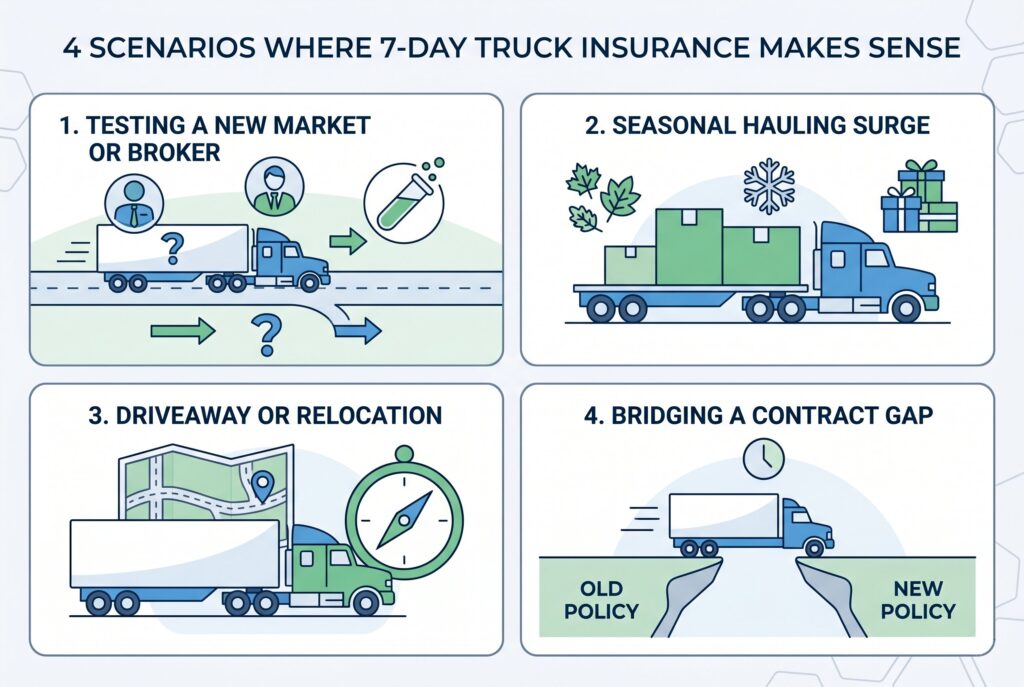
1. Testing a New Market or Broker
If you are trying a new lane, broker, or short contract, temporary truck insurance gives you flexibility before committing to annual coverage. This is useful for new authorities, owner-operators, and small fleets testing whether a route is profitable. Before buying, ask the broker exactly what limits they require. Some won’t accept low liability limits, vague cargo wording, or delayed COI updates.
2. Seasonal Hauling Surge
Agricultural harvests, holiday retail, construction demand, and regional freight spikes can create short windows of opportunity. One week truck insurance can cover a truck temporarily without locking you into a long policy. This works best when the cargo is predictable and the schedule is clear. If the work may extend, ask whether the policy can be renewed before it expires.
3. Driveaway or Relocation
If you bought a semi truck, box truck, dump truck, or tractor in another state, you may only need coverage to drive it home. In that case, temporary truck insurance or driveaway insurance may be more practical than a full commercial policy. Be careful with the distinction. If you aren’t hauling cargo and only relocating the truck, you may need a different policy than someone moving freight for revenue.
4. Bridging a Contract Gap
Sometimes annual coverage ends before a new policy starts. A short-term policy can bridge a few days so you don’t operate uninsured. The key is timing. Coverage must start before the old policy ends. Even a one-day gap can create problems with brokers, FMCSA records, lenders, and future underwriting.
FMCSA Compliance: The COI Speed Trap
Many brokers require proof of truck and trailer insurance before dispatching loads, especially for interstate freight operations. The Certificate of Insurance, or COI, is often the difference between getting the load and losing it. Brokers may refuse dispatch until your COI shows the correct insured name, VIN, DOT number, liability limit, cargo limit, effective date, and certificate holder. The danger is timing. Some low-cost providers may bind coverage but take hours or days to issue a correct COI or update filings. If you need to haul today, choose a provider that can issue an instant digital COI and confirm FMCSA or broker reporting when required.
How to Buy Short-Term Commercial Coverage
- First, gather your VIN, DOT number, MC number if applicable, driver details, truck type, garaging address, route, cargo type, and requested effective date.
- Second, confirm the broker’s required limits, usually $750,000 or $1 million in primary liability for many interstate operations.
- Third, ask whether you need cargo, physical damage, trailer interchange, bobtail, or non-trucking liability.
- Fourth, pay in full, because many short-term policies don’t offer installment plans.
- Fifth, download and verify the COI before moving the truck.
Final Thoughts
One week truck insurance can be a smart tool when you need fast, flexible protection. It works for short contracts, seasonal work, relocation, and coverage gaps. Whether you need custom truck insurance, single truck insurance, truck and trailer insurance, or semi truck and trailer insurance, choosing the right policy matters. Before paying, confirm the coverage type, cargo eligibility, liability limit, effective time, COI speed, and FMCSA requirements. The right short term commercial truck insurance keeps you legal, broker ready, and moving. The wrong one only gives you a false sense of protection.