



When deciding what percentage of income should go to your mortgage, a good rule is to keep total housing costs below 25% to 30% of your income. Many experts recommend staying under 28% of gross monthly income or about 25% of take-home pay for a more comfortable budget. Your housing payment should include PITI: principal, interest, taxes, and insurance, plus PMI and HOA fees if they apply.
Remember that lender approval isn’t the same as affordability. Banks qualify you based on debt-to-income ratios, but only you know your other financial priorities. The best mortgage payment is one that fits your budget while leaving room for savings, emergencies, and the lifestyle you want.
The Golden Benchmark: Decoding the 28/36 Rule
The 28/36 rule is one of the most common ways to understand mortgage affordability. It separates your finances into two layers: housing cost and total debt.
The first layer is front end DTI. This says your monthly housing payment should stay around 28% of gross monthly income. If your household earns $8,000 per month before taxes, the 28% rule suggests a housing payment near $2,240 or less. The second layer is the back end DTI. This says all monthly debt payments should stay around 36% of gross monthly income. That includes your mortgage, car loans, student loans, credit cards, personal loans, and other recurring debt. With $8,000 in gross monthly income, the 36% total debt ceiling would be about $2,880.
This is where buyers get surprised. You may technically fit the 28% mortgage rule, but fail the 36% total debt rule because of car payments or student loans. That’s why the debt-to-income ratio matters so much. A buyer with no debt can often handle a larger home payment than a buyer with the same income but $900 in monthly obligations.
What Counts in the Mortgage Payment?
When people ask how much income should go to mortgage, they often think only about the loan payment. That is too narrow. A real mortgage payment includes more than principal and interest.
Property taxes can change the entire calculation. A house with a lower sale price in a high tax area may cost more per month than a more expensive house in a low tax area. Homeowners insurance also matters, especially in areas with storms, wildfires, hurricanes, or rising rebuild costs. If you put less than 20% down on a conventional loan, PMI may add another monthly charge. If the property is in a condo or planned community, HOA fees can push the payment higher again.
This is why two homes with the same price can feel completely different in your budget. One may have low taxes, no HOA, and modest insurance. Another may have high taxes, HOA dues, PMI, and expensive insurance. The second home may technically be the same price, but it isn’t the same monthly reality.
Gross vs. Net: The 25% Take Home Pay Reality Check
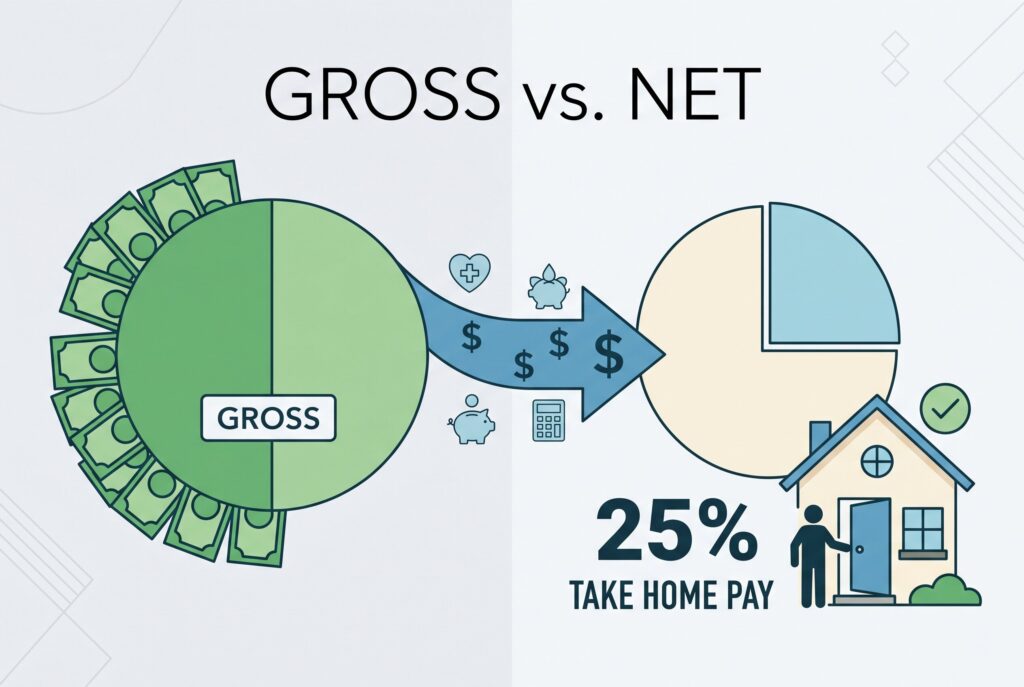
Lenders often use gross income because it is easier to verify and standardize. But you don’t pay your bills with gross income. You pay them with the money that actually lands in your bank account after taxes, health insurance, retirement contributions, and payroll deductions.
That is why the 25% net income rule is so useful. In fact, a good rule is to spend no more than 25–30% of your income on housing, especially when measured against your take-home pay rather than your gross salary. If your household brings home $6,000 per month after deductions, a conservative mortgage target would be about $1,500. This may feel stricter than what a lender approves, but it protects your monthly life.
The 25% rule is especially helpful if you have children, variable income, medical expenses, older cars, aging parents, or aggressive retirement goals. It leaves room for reality. A home should make your life feel rooted, not trapped.
When 28% Is Too Much
No percentage rule works for every household. A dual income couple with no debt, strong savings, and stable jobs may feel comfortable near 28% or even slightly higher. A single buyer with student loans and an older car may feel stressed at the same ratio. Families with childcare costs need special caution. Daycare can cost hundreds or thousands of USD ($) per month. If that expense isn’t counted in your lender’s DTI the same way a debt payment is, you still feel it every month. In that case, spending closer to 20% to 25% of income on housing may be smarter.
High tax states also change the math. If property taxes are high, more of your payment goes to taxes and less goes toward the home itself. That means you may need to shop for a lower purchase price to keep your PITI inside the safe range. Buyers with irregular income should also stay conservative. Freelancers, commission earners, business owners, and seasonal workers need more cash reserves because income can swing. A payment that feels fine in a strong month can feel dangerous in a slow one.
Lender Approval vs. Personal Affordability
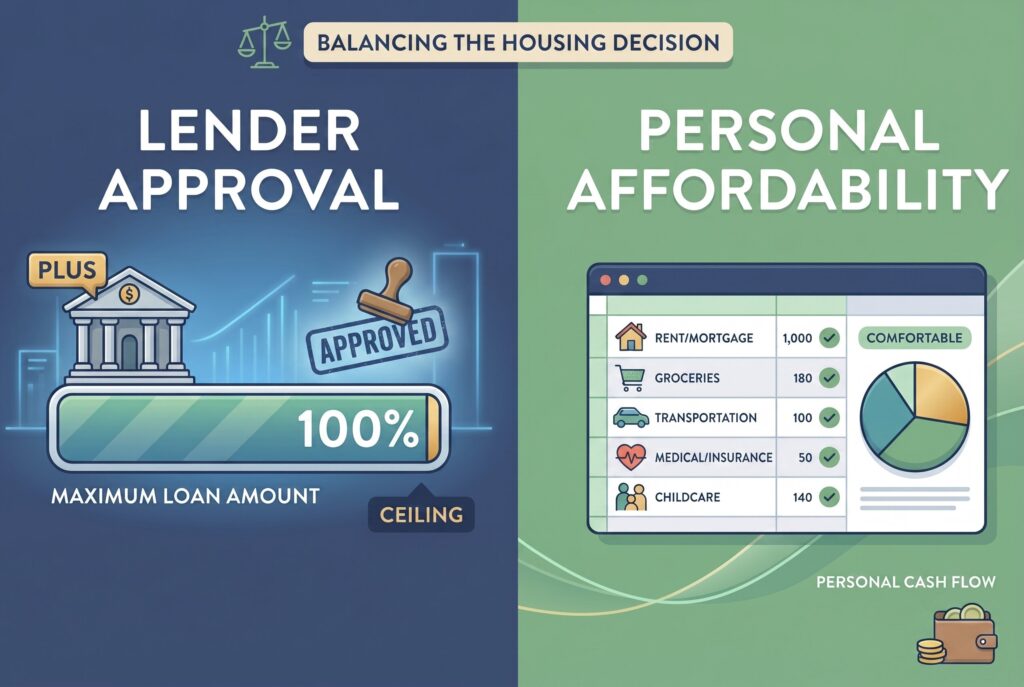
The most dangerous sentence in homebuying is, “You’re approved for more.” Approval is not a command. It’s only a ceiling.
Some loan programs may allow higher debt-to-income ratio limits, especially if the borrower has strong credit, savings, or compensating factors. But just because a lender can approve a payment doesn’t mean the payment fits your life. A lender’s job is to decide whether the loan is likely to be repaid. Your job is to decide whether the home will still let you live well.
Before accepting the maximum mortgage, build a real monthly budget. Include groceries, utilities, transportation, insurance, childcare, subscriptions, repairs, savings, travel, gifts, medical costs, and retirement contributions. Then test the new mortgage payment inside that budget. If every normal expense becomes tight, the house is too expensive.
How to Lower Your Mortgage to Income Ratio
If your target home pushes your mortgage percentage of income too high, you have several options. You can buy a less expensive home, increase your down payment, pay down existing debt, improve your credit score, shop for a better rate, or choose a home with lower taxes and insurance. You can also wait while saving more. Waiting isn’t failure if it helps you buy with confidence. A smaller mortgage, cleaner debt profile, and stronger emergency fund can make homeownership feel peaceful instead of fragile.
Conclusion
So, what percentage of income should go to mortgage? Financial planners often point to 28% of gross income as a traditional guideline, while many homeowners find that 25% of take-home pay feels more comfortable in practice. Use 28% of gross income as the classic upper guardrail, 25% of take-home pay as the safer personal comfort rule, and 36% of gross income as the total debt warning line.
The best mortgage isn’t the biggest one. It’s the one that lets you own a home, pay your bills, save for the future, and still enjoy your life. A beautiful house becomes a burden if it eats every dollar of flexibility. Keep your payment inside the 25 to 30% range, include the full PITI, respect your debt-to-income ratio, and choose a home that supports your life instead of swallowing it.
Related Articles
What Do You Need to Buy a House? The 90-Day Roadmap
How Much Money Do You Need to Buy a House? Do The Math
Smart Ways to Budget for Housing and Reduce Financial Pressure

