
Many homebuyers assume they need a 20% down payment. In reality, you may need far less upfront, but you’ll still need more cash than just the down payment. A practical 2026 target is often around 10% to 15% of the home’s price when you account for closing costs, moving expenses, initial repairs, and emergency savings.
Some buyers can qualify with as little as 3% down on certain conventional loans, 3.5% down through FHA, or even 0% down through VA or USDA programs if eligible. However, the down payment is only one part of the equation. The smartest buyers focus not just on getting the keys, but on how much money they’ll have left after the purchase is complete.
Home Prices Matter More Than Most Buyers Realize
The amount of money you need depends largely on where you plan to buy. A buyer looking at homes in New York faces a very different reality than someone shopping in Ohio. A home priced around $500,000 may be relatively normal in parts of New York, while a similar buyer in Ohio might find homes closer to $250,000.
That difference changes everything. It affects the down payment, closing costs, property taxes, insurance, and the size of the emergency fund you’ll likely need after moving in. Before calculating anything else, start with a realistic home price in the market where you actually plan to live.
The 20% Down Payment Myth
Many buyers delay homeownership for years because they think 20% down is required. It isn’t. A 20% down payment can help you avoid private mortgage insurance, lower your monthly payment, and create instant equity, but it’s not the entry ticket for every loan. For a $400,000 home, 20% down means $80,000. That sounds impossible for many first time buyers. But 5% down is $20,000, 3.5% down is $14,000, and 3% down is $12,000. Those numbers are still serious, but they change the conversation from “I can’t buy” to “I need a plan.”
The tradeoff is the monthly cost. A smaller down payment usually means a larger mortgage, possible PMI, and less equity at the start. That’s why the best down payment isn’t always the biggest one. It’s the amount that gets you into a manageable payment while leaving you with enough savings to survive repairs, job changes, medical bills, and moving surprises.
What % of Income Should Go to Mortgage?
Before asking what you need to buy a house, make sure your budget can support it. A common guideline is the 28/36 rule: keep housing costs near 28% of gross monthly income and total debt below 36%. Housing costs include your mortgage, property taxes, homeowners insurance, and HOA fees if applicable. Even if you qualify for more, aim to spend only 25% to 30% of your income on housing. Staying within that range helps you avoid becoming house poor and leaves room for other financial goals.
The 6 Hidden Costs of Buying a Home
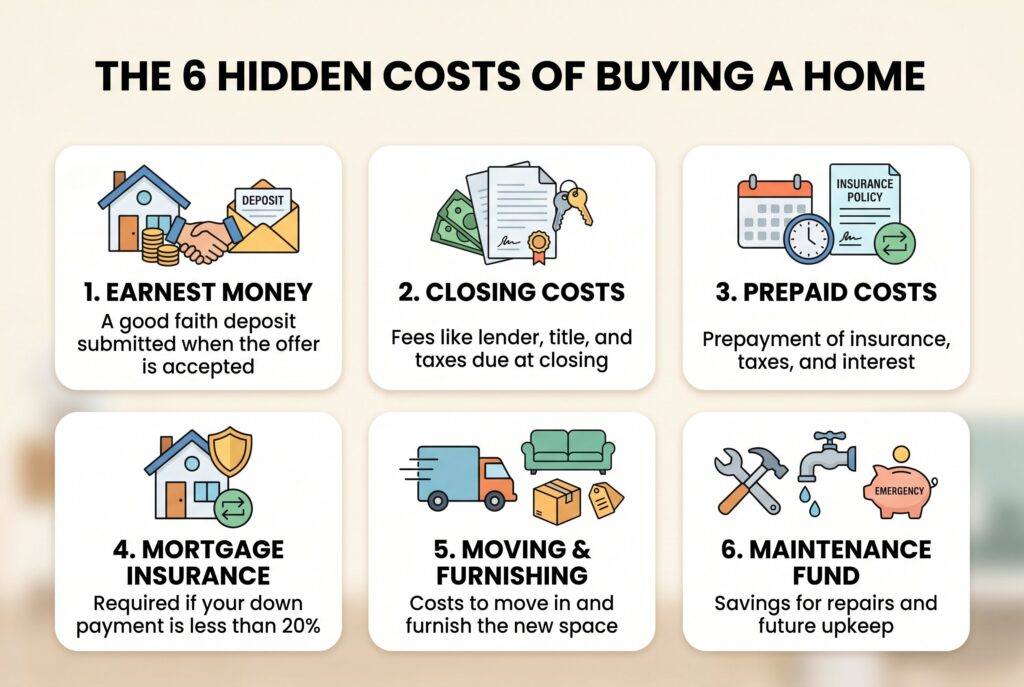
1. Earnest Money Deposit
Earnest money is a good faith deposit you submit after your offer is accepted. It often ranges from 1% to 3% of the purchase price, depending on the market. On a $400,000 home, that could be $4,000 to $12,000. This money may later count toward your cash to close, but you need it available early.
2. Closing Costs
Closing costs often run 2% to 5% of the loan amount or home price. They can include lender fees, title fees, appraisal fees, credit report charges, attorney fees, escrow fees, recording fees, and taxes. On a $400,000 home, that could mean $8,000 to $20,000.
3. Prepaid Costs
Prepaid costs are easy to miss because they don’t feel like normal fees. You may need to prepay homeowners insurance, property taxes, mortgage interest, and escrow reserves. These are real cash requirements at closing, even though they’re tied to future bills.
4. Mortgage Insurance
If you put less than 20% down on a conventional loan, you may pay PMI. FHA loans also have mortgage insurance costs. This doesn’t always make a low down payment a bad choice, but you should include it in your monthly budget before making an offer.
5. Moving and Furnishing
Moving can cost a few hundred USD if you do it yourself or several thousand USD if you hire movers. Furniture, blinds, appliances, tools, cleaning supplies, and basic setup can add even more. A new house often exposes gaps you didn’t have in an apartment.
6. Maintenance and Emergency Fund
A smart homeowner budgets at least 1% of the home’s value per year for maintenance. For a $400,000 home, that means about $4,000 annually. You may not spend it every year, but when the roof leaks or the water heater fails, you’ll be glad it’s there.
Doing the Math: State-by-State Examples
To truly answer how much you need, you have to look at local real estate values. The cash required varies wildly depending on where you are buying. Let’s do the math on two different markets using a realistic 5% down payment strategy, assuming 3% for closing costs and reasonable estimates for moving and emergency reserves.
| Expense Category | Scenario A: New York (NY) | Scenario B: Texas (TX) |
|---|---|---|
| Estimated Median Home Price | $500,000 | $350,000 |
| Down Payment (5%) | $25,000 | $17,500 |
| Closing & Prepaid Costs (~3%) | $15,000 | $10,500 |
| Moving & Essential Setup | $5,000 | $4,000 |
| Post-Move Emergency Fund | $10,000 | $8,000 |
| Total Target Cash Needed | $55,000 | $40,000 |
Note: These are estimates. Your actual costs will vary based on your specific lender, property taxes in your county, and lifestyle choices.
As the math shows, buying a $500,000 house in New York with 5% down doesn’t mean you just need $25,000. To close comfortably and avoid immediate financial stress, your target savings goal should be closer to $55,000.
Action Plan: How to Save and Increase Your Income
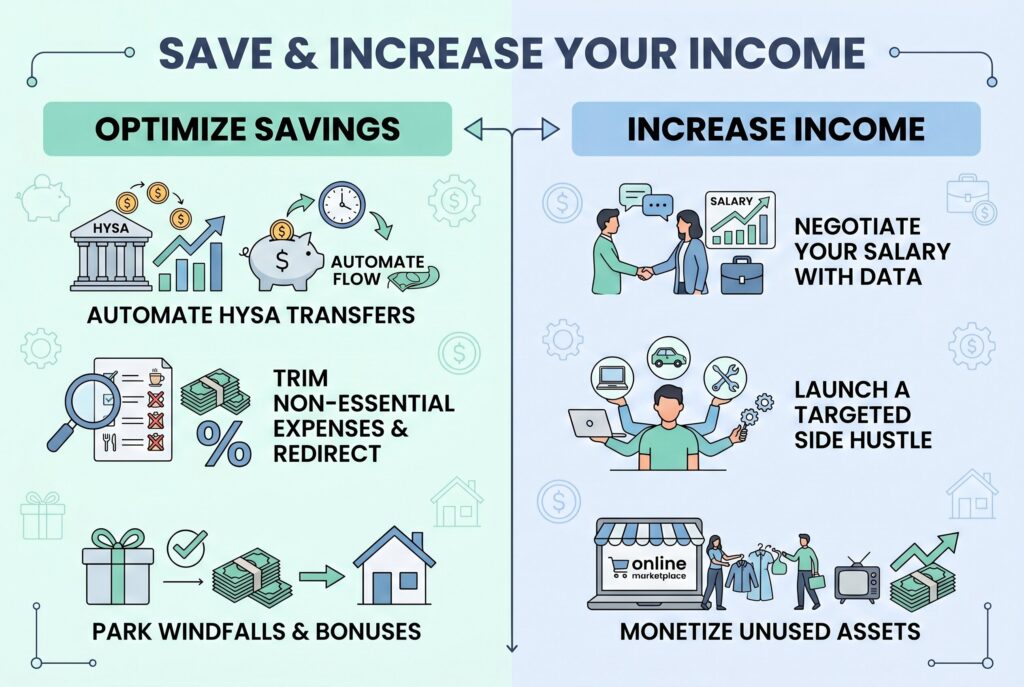
If the total cash needed feels intimidating, the solution is to attack the goal from two sides: aggressively optimizing your savings and actively increasing your income.
1. Optimize Your Savings Strategy
- Automate High-Yield Savings: Don’t leave your house fund in a standard checking account. Open a High-Yield Savings Account (HYSA) and set up automatic transfers every payday. If the money is out of sight, it’s out of mind.
- Audit and Trim Expenses: Print your last three months of bank statements. Highlight every non-essential expense (subscriptions, dining out, impulse buys). Redirect 50% of those cut expenses directly into your house fund.
- Park Windfalls: Any tax refunds, work bonuses, or cash gifts should bypass your checking account entirely and go straight into your down payment fund.
2. Increase Your Income Streams
- Negotiate Your Current Salary: The fastest way to increase your income without sacrificing more time is to get paid more for the job you already do. Research local salary benchmarks and present a data-driven case for a raise at your next review.
- Launch a Targeted Side Hustle: Dedicate 10 to 15 hours a week to freelance work, consulting, or the gig economy. Earmark 100% of this secondary income strictly for your closing costs and emergency fund.
- Monetize Existing Assets: Sell depreciating assets you no longer need. Clearing out high-value electronics, unworn designer clothing, or even a secondary vehicle can instantly inject thousands of dollars into your cash reserves.
Conclusion
The biggest first time buyer mistake is draining every dollar to make the down payment look stronger. That can backfire fast. A house isn’t finished costing money after closing. It starts.
So, how much money do you need to buy a house? Enough for the down payment, closing costs, prepaid costs, moving, mortgage insurance, repairs, and emergency reserves. If you can buy with 3% down and still keep savings, that may be safer than putting 10% down and having nothing left. Do the math before the open house. Let the numbers decide your price range, then shop with confidence instead of pressure.
Related Articles
Smart Ways to Budget for Housing and Reduce Financial Pressure