
Buying a house takes more than saving for a down payment. In the months leading up to your purchase, you’ll need to strengthen your credit, organize financial documents, estimate your budget, and prepare for mortgage approval. Starting early can help you avoid costly delays and put you in a stronger position when it’s time to make an offer.
This 90-day roadmap breaks the process into manageable steps, so you’ll know exactly what to do before buying a home and what lenders expect along the way.
Phase 1: Day 1 to 30, The Brutal Financial Math
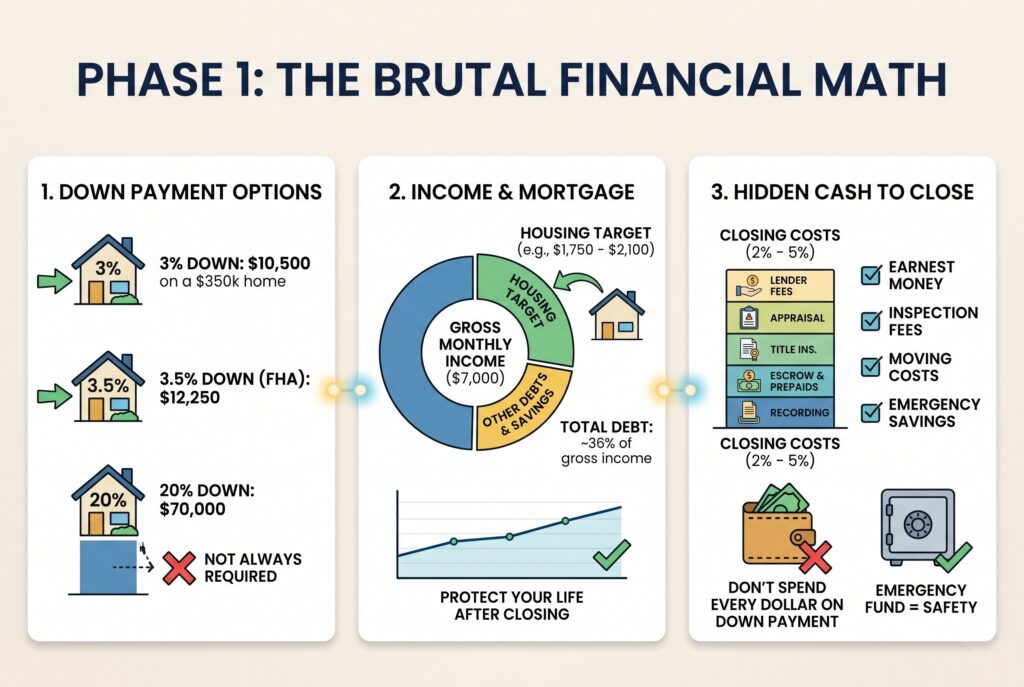
The Myth of the 20% Down Payment
The 20% down payment rule is useful if you want to avoid private mortgage insurance and lower your monthly payment, but it isn’t required for many buyers. Conventional loans may allow 3% down, FHA loans often require 3.5% down, and VA or USDA loans can offer 0% down for eligible borrowers.
So, how much money do I need to buy a house? Start with the home price. On a $350,000 home, a 3% down payment is $10,500. An FHA style 3.5% down payment is $12,250. That’s still serious money, but it’s very different from the $70,000 people imagine when they hear 20%.
What Percentage of Income Should Go to Mortgage?
Smart buyers don’t let emotions drive their decisions. They first look at what their income can comfortably support. Many lenders look at debt to income ratio, or DTI, which compares your monthly debt payments to your gross monthly income.
A common guideline is the 28 and 36 rule. Housing costs should stay around 28% of gross income, while total debt should stay around 36%. If you earn $7,000 per month before taxes, a cautious housing target may be around $1,750 to $2,100 per month. That includes principal, interest, taxes, insurance, and any HOA dues. This rule protects your life after closing. A beautiful house isn’t worth it if every repair, grocery bill, or car issue turns into panic.
The Hidden Cash to Close
One thing many buyers forget when calculating the cost of a home is closing costs. These can run about 2% to 5% of the loan amount. Closing costs may include lender fees, appraisal fees, title insurance, escrow costs, prepaid taxes, prepaid homeowners insurance, and recording charges. You may also need earnest money, inspection fees, moving costs, new locks, utility deposits, and emergency savings. Don’t spend every dollar on the down payment. A buyer with a smaller down payment and a healthy emergency fund may be safer than a buyer who puts more down but has nothing left.
Phase 2: Day 31 to 60, Paperwork and Preapproval
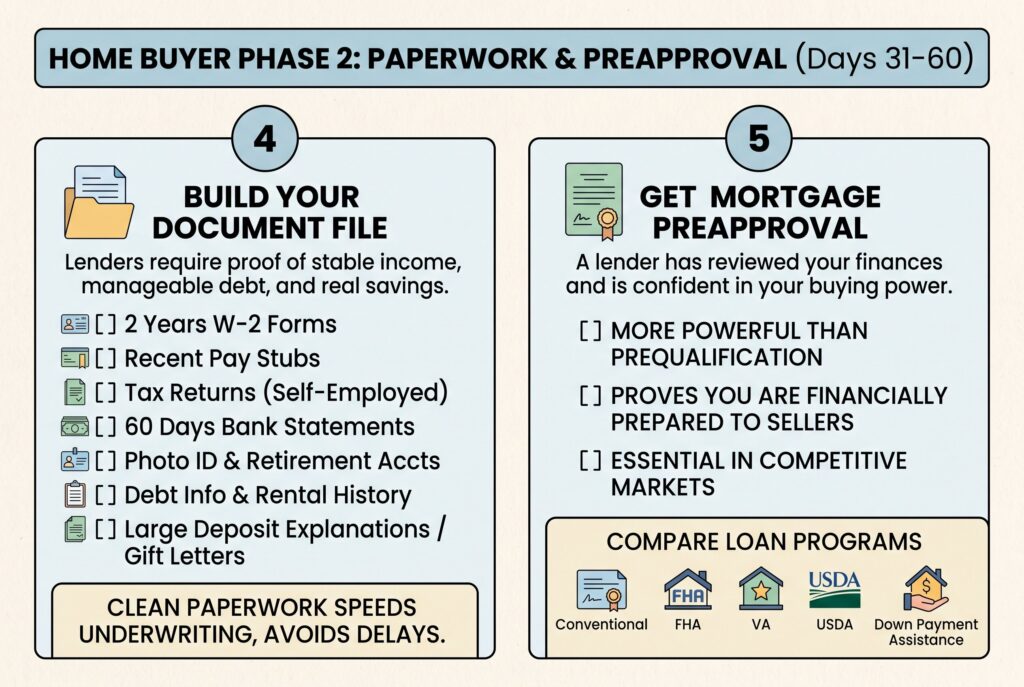
Build Your Document File
First-time home buyer requirements are mostly about proof. Lenders want to see that your income is stable, your debts are manageable, and your savings are real.
Prepare W-2 forms from the last two years, recent pay stubs, tax returns if self-employed, bank statements from the last 60 days, photo ID, retirement account statements, debt information, rental history, and explanations for large deposits. If money is coming from family, ask the lender early about gift letter rules. Clean paperwork can speed up underwriting. Messy paperwork can delay closing or weaken your offer.
Get Mortgage Preapproval Before Touring Homes
Mortgage preapproval is more powerful than prequalification. Prequalification is usually a quick estimate. Preapproval means a lender has reviewed your financial details and is more confident about your buying power. Don’t spend weekends touring homes without it. In a competitive market, sellers want proof that you can close. To sellers, a preapproval letter is a sign that you’re a serious buyer with the financial backing to move forward.
This is also when you compare loan programs. Conventional, FHA, VA, USDA, and down payment assistance programs all have different rules. The right loan balances your monthly payment, upfront costs, mortgage insurance, and long-term financial flexibility.
Phase 3: Day 61 to 90, Search, Offer, and Closing
Choose the Right Real Estate Agent
A strong real estate agent does more than unlock doors. They explain neighborhoods, price trends, offer strategy, seller expectations, inspection norms, and contract deadlines. For first time buyers, that guidance can prevent expensive mistakes. Choose someone who communicates clearly, understands your budget, and doesn’t pressure you beyond your comfort zone. You need an advocate, not a salesperson chasing the biggest possible deal.
Make an Offer Without Losing Your Head
Once you find the right home, your offer should reflect both market reality and your financial limits. A winning offer isn’t always the highest offer. It may be cleaner, better documented, faster, or more flexible. Still, don’t waive every protection just to win. Inspection and appraisal contingencies exist for a reason. If the appraisal comes in low, the lender may not finance the full offer price. If the inspection reveals foundation damage, electrical hazards, roof failure, or major plumbing problems, you need room to renegotiate or walk away.
Inspection, Appraisal, Insurance, and Closing
The home inspection protects you. The appraisal protects the lender. Homeowners insurance protects both you and the mortgage company from major loss after closing. During this phase, read every document carefully. Review your loan estimate, closing disclosure, insurance quote, inspection report, title documents, and final cash to close. Ask questions before signing day, not after. Closing is exciting, but it’s still a legal and financial transaction. Slow down enough to understand what you’re accepting.
Beyond Day 90: What to Buy After Closing
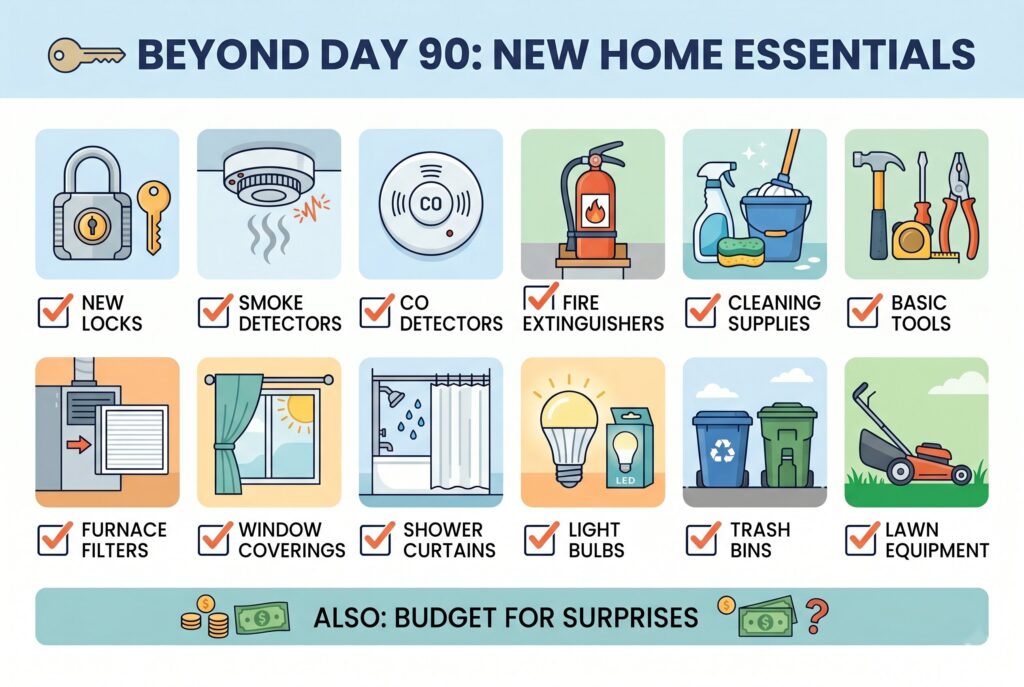
The journey doesn’t end when you receive the keys. Budget for new locks, smoke detectors, carbon monoxide detectors, fire extinguishers, cleaning supplies, basic tools, furnace filters, window coverings, shower curtains, light bulbs, trash bins, and lawn equipment if needed. Budgeting for a new home goes beyond the purchase itself. Essential items, routine maintenance, and unexpected repairs are all common expenses during the first year of ownership.
Conclusion
Knowing what you need to buy a house is about more than meeting a lender’s requirements. It’s about preparing your finances, understanding the true cost of homeownership, and giving yourself enough time to make informed decisions. Following a 90-day plan can help you avoid common mistakes, strengthen your mortgage application, and enter the buying process with greater confidence.
Related Articles
What Percentage of Income Should Go to Mortgage? Safe Limits