


Recent annuity news has pulled more conservative investors back into the conversation, especially as stock-market volatility keeps reminding people how fragile retirement confidence can feel. That’s why the fixed rate annuity has become a hot topic again. Savers want to know whether today’s rates are still attractive, whether waiting could help, and whether now is the right time to lock in guarantees. The answer isn’t just about headlines. It’s about understanding how fixed annuities work, what today’s rate environment really means, and why the best decision often depends more on your retirement timeline than on trying to outguess the market.
2026 Annuity News: Record Sales and Rate Forecasts

The annuity market has real momentum behind it. U.S. annuity sales reached a record $461.3 billion in 2025, marking the fourth straight record year, according to LIMRA. Fixed indexed annuity sales alone also set a new annual record at $128.2 billion in 2025.
That surge matters because it tells you something about saver behavior. People aren’t just casually browsing annuities. They’re actively looking for ways to balance safety, predictable income, and better yields than older low-rate environments offered. Indexed products have taken a growing share of the market as well, with LIMRA noting that registered index-linked annuities and fixed indexed annuities together represented 45% of total annuity sales in 2025.
As for rate direction, current forecasts suggest interest rates may edge lower through 2026 rather than rise sharply. Fixed-income market expectations and policy commentary both point to a softer path for short-term rates, even if the outlook remains uncertain. That matters because fixed annuity pricing and fixed index annuity rates are heavily influenced by the broader interest-rate backdrop. If market rates gradually soften, some annuity payouts and crediting terms may become less generous over time.
So yes, rates remain historically competitive by recent standards, but the broad expectation isn’t for a major upward reset from here. That’s one reason “Should I wait?” question feels more urgent right now.
Back to Basics: What is a Fixed Annuity?
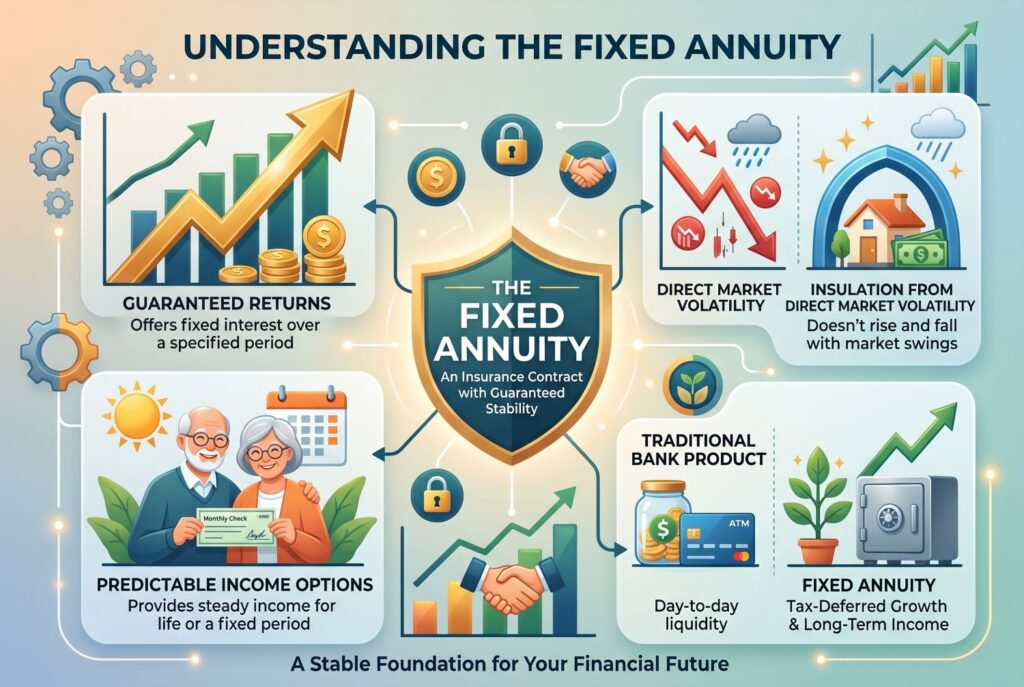
What is a fixed annuity? At its core, it’s an insurance contract that offers guaranteed returns, predictable income options, and insulation from direct market volatility. Unlike stocks, your principal doesn’t rise and fall with market swings. Unlike many ordinary bank products, the appeal is usually centered on a stronger long-term income structure and tax-deferred growth rather than day-to-day liquidity.
A fixed annuity can be used in different ways. Some buyers use it as a deferred contract, where money grows for a period before income starts. Others later turn the contract into a payout stream. In either case, the core promise is stability. The insurer credits a contract rate or guaranteed structure, and the buyer exchanges some flexibility for more certainty.
That’s why fixed annuities appeal most to people who care about protecting part of their retirement assets from market shocks. They aren’t designed to outperform stocks over long periods. They’re designed to transfer some risk away from the retiree.
Are Annuities a Good Investment Right Now? (Pros and Cons)
Are annuities a good investment right now? For the right person, they can be. But the question only makes sense if you evaluate the tradeoffs honestly.
The Pros of Fixed Annuities
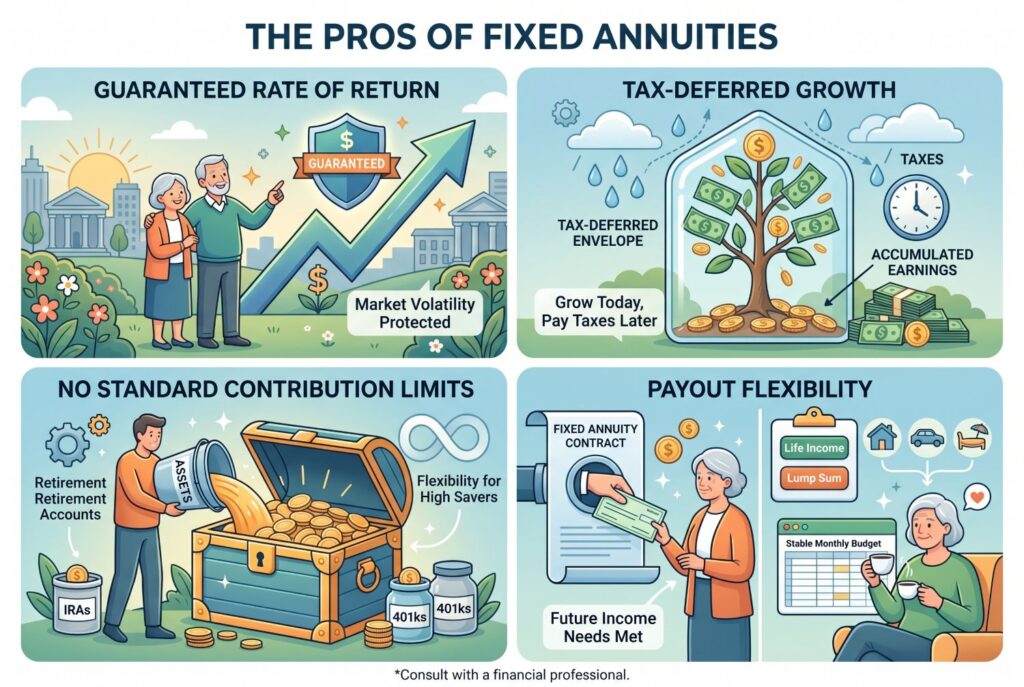
- Guaranteed rates of return: In uncertain markets, fixed annuities provide contractual certainty, something many other investments lack. This stability is particularly valuable for retirees or those nearing retirement who may not have time to recover from significant losses.
- Tax-deferred growth: Earnings within the annuity typically grow without being taxed annually until withdrawal, making it a useful tool for long-term retirement planning.
- No standard contribution limits: Unlike many retirement accounts, fixed annuities generally don’t impose strict annual contribution caps. This offers flexibility for individuals looking to allocate additional funds into more stable assets.
- Flexible payout options: Annuities can often be tailored to match future income needs, not just accumulation goals. This makes them appealing for building a reliable and predictable retirement income stream.
The Cons of Fixed Annuities
- Surrender charges: Early withdrawals can be costly, particularly during the initial years of the contract, making fixed annuities less suitable for funds you might need on short notice.
- Early withdrawal penalties: In many cases, taking money out before age 59½ may trigger IRS penalties, so timing and funding sources require careful consideration, especially for younger investors.
- Inflation risk: While fixed payouts provide stability, their real purchasing power can decline over time if inflation remains elevated, meaning steady income doesn’t always translate to maintained value.
Market Timing vs. Life Timing: The Golden Rule of Annuities

This is the point many buyers miss. Annuities aren’t stocks. They aren’t meant to be perfectly timed around market peaks and troughs. They’re contracts designed to transfer risk.
That’s why the strongest rule in annuity decision-making is this: life timing matters more than market timing. If you’re buying a lifetime income product, age, health, retirement goals, and need for guaranteed cash flow often matter more than whether rates tick slightly higher or lower next quarter. The “best time” to buy isn’t when the financial news feels dramatic. It’s when the contractual guarantees solve a real retirement problem in your life.
This is also why waiting for the perfect moment can backfire. If someone delays a needed income solution for too long while chasing a slightly better rate, they may lose valuable time, miss years of guaranteed payments, or simply carry more uncertainty than their plan can comfortably absorb.
Actionable Strategy: Building a Fixed Annuity Ladder
For savers who are nervous about committing everything at once, a fixed annuity ladder is one of the smartest strategies available.
Instead of placing all retirement money into one contract on one date, you divide the funds across multiple annuities purchased at different times or with different maturity periods. This reduces the pressure of trying to guess rate movements perfectly. Some contracts may capture today’s rate environment, while others may be added later if rates shift.
The benefit is practical. Laddering can create staggered liquidity windows, reduce timing regret, and spread rate exposure across multiple points in time. It isn’t a magic solution, but it’s often better than the all-or-nothing mindset that causes many retirees to freeze and do nothing.
Conclusion
Today’s annuity news makes one thing clear: retirees and pre-retirees are looking for stability, and fixed annuities remain part of that search. Rates are still competitive, but the broader outlook suggests some gradual softening may be more likely than a major jump higher. That means waiting indefinitely for a better headline may not be the smartest move.
The better approach is to focus on fit. If a fixed annuity helps secure the cash flow you need, reduce the market risk you can’t afford, and match your actual retirement timeline, then the decision may already be timely enough.

