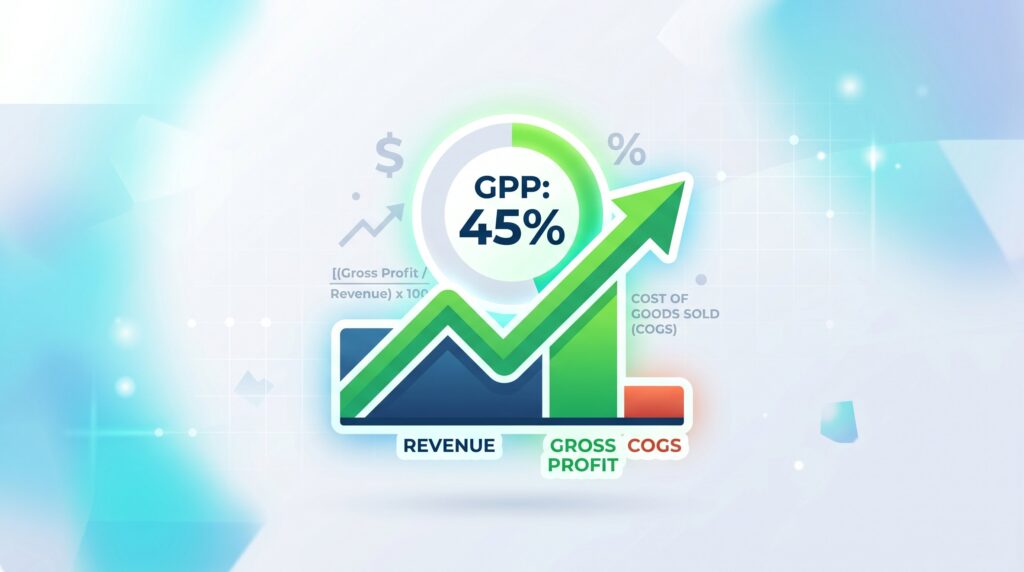
If you’re trying to understand the gross profit percentage formula, you’re really trying to answer a bigger business question: how much of each sales dollar do you actually keep after covering direct costs? That’s why the gross profit percentage matters so much. It turns raw gross profit into a cleaner efficiency signal, which makes it easier to compare products, months, and even competitors. It also helps you move beyond simple revenue vanity and focus on whether your pricing and cost structure are actually working.
A lot of people know gross profit in dollars but still miss the deeper insight. Two businesses can each generate the same gross profit, yet one may be far more efficient because it earns that result on less revenue. That’s where the gross profit ratio becomes useful. It shows how much gross profit is left from each dollar of revenue after direct costs are removed.
What Is the Gross Profit Percentage?
Gross profit percentage is the percentage of revenue a business keeps after subtracting the cost of goods sold. In simple terms, it measures how efficiently a business turns sales into gross profit before overhead and other operating expenses are deducted. That’s why it’s also often called the gross profit ratio or closely related to gross profit margin.
This number matters because the raw dollar amount of gross profit doesn’t always tell the whole story. A business with higher revenue may look stronger at first glance, but if its direct costs are too high, its gross profit percentage may be weak. A healthier ratio usually means better pricing, better cost control, or both.
So if you’ve been asking what this metric really tells you, the answer is simple: it shows how much of every revenue dollar is left over after direct production or delivery costs.
The Gross Profit Percentage Formula
The gross profit percentage formula is:
That’s why the gross profit percentage formula and gross profit margin formula are so closely connected. The first step is finding gross profit in dollars. The second step is converting that result into a percentage of total revenue.
Let’s say your business brings in $100,000 in revenue and your cost of goods sold is $65,000. Your gross profit is $35,000. Then you divide $35,000 by $100,000 and multiply by 100. Your gross profit percentage is 35%. That number is far more useful than gross profit alone when you want to evaluate efficiency.
How to Calculate Gross Profit Percentage in 4 Simple Steps
1. Determine Total Net Revenue
Start with your total sales revenue for the period you’re analyzing. In a more refined version, this should be net revenue, which means revenue after returns, discounts, or allowances that materially reduce what you actually earned.
2. Calculate Cost of Goods Sold
Next, calculate your direct costs. This is the part that trips people up most. Cost of goods sold usually includes direct materials, direct labor, and other direct production or fulfillment costs. It doesn’t usually include general overhead, admin payroll, or broad marketing expenses.
3. Calculate Gross Profit
Subtract cost of goods sold from revenue:
Gross Profit = Revenue − COGS
This gives you the dollar value of gross profit before operating expenses.
4. Apply the Percentage Formula
Take the gross profit result, divide it by revenue, and multiply by 100. That final result is your gross profit percentage. This is the cleanest answer to how to calculate gross profit percentage. The arithmetic is simple. The real skill is making sure revenue and COGS are classified correctly.
2026 Industry Benchmarks: What Is a Good Percentage?
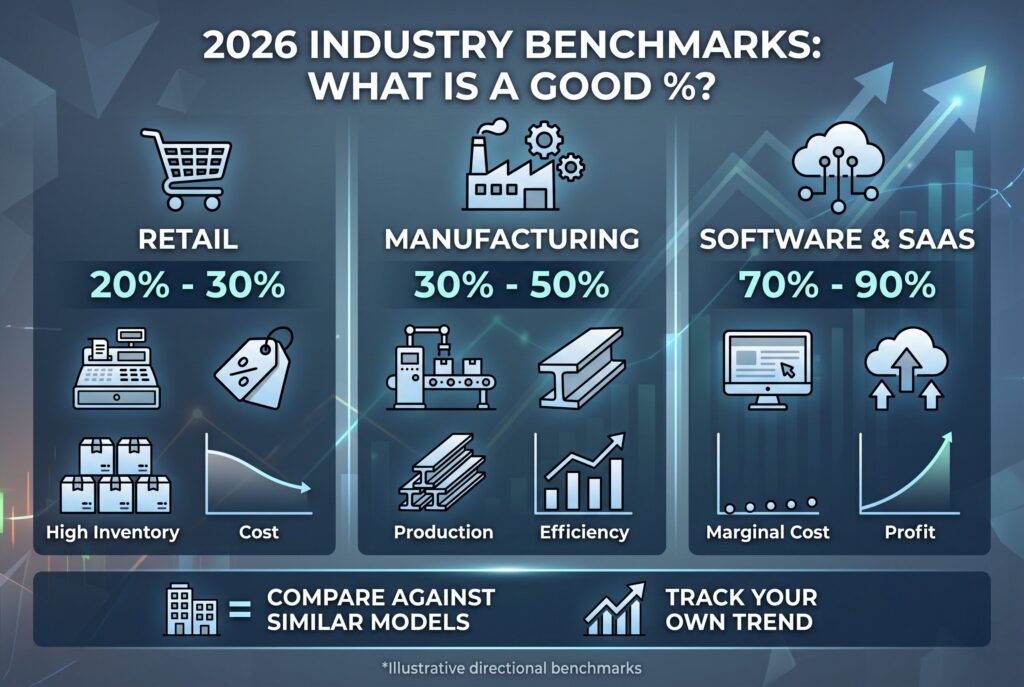
One of the most common follow-up questions is whether your result is good. The answer depends heavily on industry. Retail businesses often operate in the rough range of 20% to 30%, because inventory costs are high and price competition can be intense. Manufacturing businesses often fall somewhere around 30% to 50%, depending on complexity, materials, and production efficiency. Software and SaaS businesses can reach 70% to 90% because the marginal cost of delivering software is often much lower than in physical-goods businesses.
These aren’t universal truths, but they’re useful directional benchmarks. The key point is that a “good” gross profit percentage in one industry may look terrible or amazing in another. That’s why benchmarking without context can mislead you. The smarter way to use the metric is to compare your business against similar models first, then track your own trend over time.
Real World Examples: Retail vs. Service Business

Imagine a clothing store that earns $200,000 in revenue and spends $140,000 on inventory and direct fulfillment costs. Gross profit is $60,000, so the gross profit percentage is 30%.
Now imagine a consulting firm that earns the same $200,000 in revenue, but its direct client-delivery labor and project-specific costs total $80,000. Gross profit is $120,000, so the gross profit percentage is 60%.
Both businesses made sales. Both generated gross profit. But the service business kept far more of each revenue dollar after direct costs. That doesn’t mean it is automatically more successful overall, because overhead structures may differ. But it does show how the gross profit ratio can reveal major differences in economic efficiency. This is why gross profit percentage example comparisons are so helpful. They make the formula feel practical instead of abstract.
Common Mistakes: Why Your Ratio Might Be Wrong
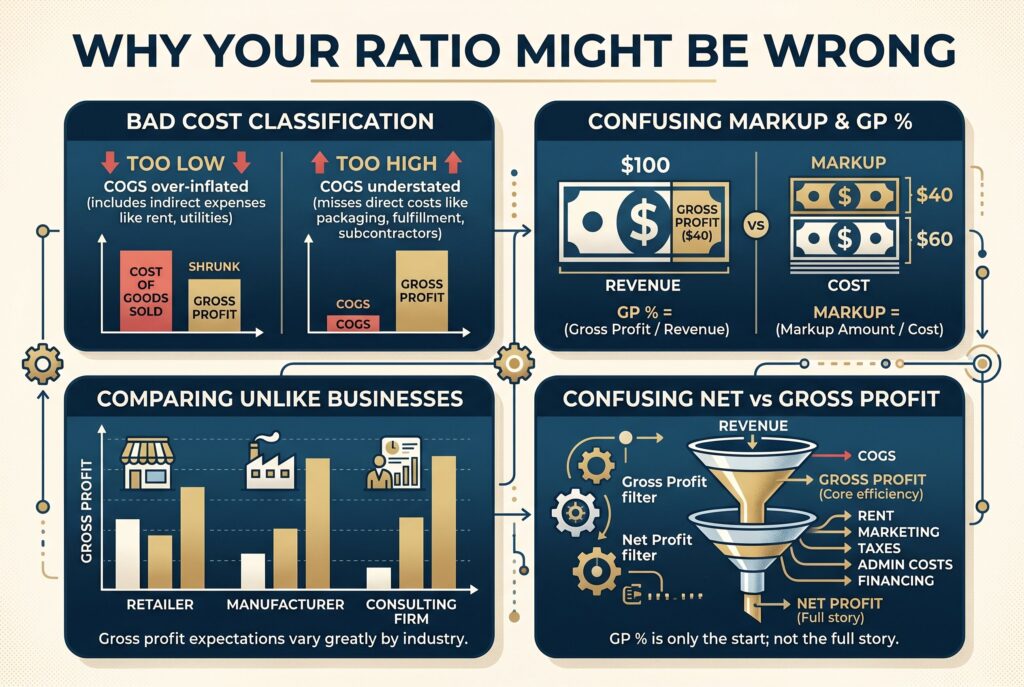
The biggest source of error is bad cost classification. A lot of businesses accidentally include indirect operating expenses inside COGS. That pushes gross profit down and makes the ratio look worse than it really is. On the other hand, some businesses leave out direct packaging, fulfillment, or subcontractor costs that should be included, which makes the percentage look better than reality.
Another mistake is confusing gross profit percentage with markup. They aren’t the same. Markup is based on cost. Gross profit percentage is based on revenue. A third mistake is comparing gross profit percentage too casually across businesses. A retailer, manufacturer, and consulting firm shouldn’t expect the same ratio. Finally, some people confuse net profit vs gross profit and assume this percentage tells them the full story of profitability. It doesn’t. It tells you how efficient the core revenue engine is before rent, marketing, taxes, admin costs, and financing expenses are deducted.
Conclusion
The gross profit percentage formula gives you more than a math answer. It gives you a practical management lens. Once you know your gross profit ratio, you can spot pricing problems earlier, see whether supplier costs are squeezing you, and compare business lines more intelligently.
That’s why this metric deserves regular attention in 2026. Revenue can rise while efficiency quietly falls. Gross profit percentage helps you catch that early. Track it monthly, compare it to your own historical trend, and use it as a signal for pricing changes, supplier negotiations, and product mix decisions. That’s where the formula stops being accounting jargon and starts becoming a growth tool.